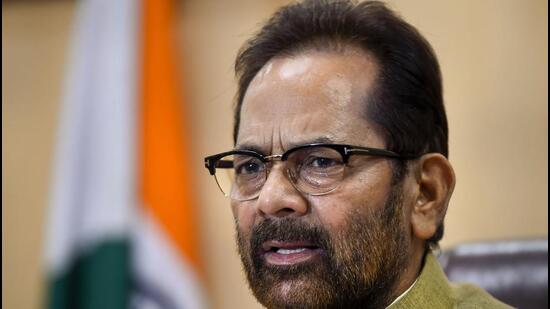
A three-time lawmaker who was till recently the only Muslim face in the PM Modi-led Union Cabinet, Mukhtar Abbas Naqvi says tokenism is no guarantee of development and empowerment of minorities. Naqvi, who resigned as the minister for minority affairs on July 6, a day before his term in the Rajya Sabha came to an end, tells Smriti Kak Ramachandran that the BJP will have to make more efforts to change the perception that it is anti-minorities even though the government’s policies have been based on the principle of “development without discrimination and empowerment without appeasement”. Edited excerpts:
What do you consider as achievements during your tenure as the minority affairs minister?
The highlight of my tenure was never hurt, never hate and never be hostile to any personality or ideology. I worked with everyone for the betterment of society and today I can see its impact on the ground, which is also why even our opponents cannot say the Narendra Modi government discriminated in development or empowerment.
I am also happy and satisfied that when I was given the charge of managing the party’s election in Ladakh, the BJP won that parliamentary seat for the first time in independent India and most recently the bypoll to Rampur seat where over 55% of the electorate is Muslim.
The government says it works with the motto of Sabka Sath, Sabka Vikas, yet there is a perception within the country and internationally that a majoritarian sentiment is taking root in India. How do you see this?
{{/usCountry}}The government says it works with the motto of Sabka Sath, Sabka Vikas, yet there is a perception within the country and internationally that a majoritarian sentiment is taking root in India. How do you see this?
{{/usCountry}}Those who talk about majoritarianism in India are either not aware of our culture and commitment towards tolerance and inclusivity or they are wilfully ignoring this. As far as the minority affairs ministry is concerned, after it was formed the government was facing several challenges. There was a concerted effort by a big Modi-bashing brigade to create a campaign against him nationally and internationally…There were issues such as intolerance and award wapsi (retuning state awards), and sometimes incidents of lynching were raised … In such circumstances to create confidence among people was a big challenge.
PM Modi gave us a free hand to ensure that the last man in the queue received the benefits of pro-people policies and other developmental works. As a result of the many transformations that took place, today we can see the outcome of our policy of development without discrimination and empowerment without appeasement in various fields, be it education, infrastructure or employment.
There is a section of people in the country who thinks India should not have a minority affairs ministry and that the term minority should not be used particularly for Muslims who form a sizeable population in India.
Our government follows the Constitution. People may have varied opinion, there can be a national debate on the issue, such cases have also been taken up in courts, but we go by what is laid down in the Constitution as far as the definition of minorities is concerned. Sometimes people tend to think that minorities get some special status— that is not the truth. They are equal partners and whatever schemes such as opening hospitals or schools for minorities are undertaken by the government, these facilities are not limited only to the minorities but a larger section of people can benefit from this. What we do, however, is that where there is a gap in minority-dominated areas, we work on addressing those.
Despite the BJP’s efforts to focus on welfarism, it is still largely seen as an anti-Muslim party. What do you think is the reason and what will change this perception?
Yes, I agree there is such a perception but it is not our fault. It is a well-planned conspiracy by our political opponents who are traditional BJP bashers. They have always painted the BJP as anti-minority and anti-Muslims. Despite the development and welfare schemes, this perception exists in some sections among the minorities because of that. As the PM says it is our duty to reach out to these people and tell them that when there is no discrimination in development, why they should discriminate in voting. Our opponents only talk about this secular-communal formula which is exposed now.
Minorities have had a stake in all the developmental policies. For instance, of the 24.5 million houses that were built under the PM Awas Yojana, 31% were in minority-dominated areas; of the 120 million farmers who got money disbursed under the PM Kisan Nidhi, 33% were from the minority communities; similarly of the 360 million people benefitting from the Mudra loan scheme, 34% are from the minority communities.
The government has also been criticised for not empowering the minorities. At present there is no Muslim face in the Union council of ministers or among BJP lawmakers in Parliament. Does this not go against the principle of inclusivity?
Inclusivity is not based on tokenism. Tokenism is not a guarantee of development and empowerment. The Prime Minister or a cabinet minister does not work on the basis of caste or creed or faith. Their constitutional duties require them to work for the benefit of the poor, the downtrodden and the backward sections. It is wrong to assume that people who come from different sections will not be as invested and committed towards the development and empowerment of other communities. It is wrong to think that the council right now is not committed towards other communities… They are equally or more committed than someone who comes from the same community.
You have also been a minister of parliamentary affairs. Of late we have seen a lot of acrimony between the government and the Opposition in Parliament. What do you think has changed and why are we witnessing so much strife in Parliament?
Coordination and communication are the core of parliamentary working. In Parliament, people of different ideologies are colleagues and political opponents but not enemies. When I was the parliamentary affairs minister, I used to work on this formula and our party people still do the same. The outcome of this is that even for crucial bills we could get support.
The prime minister is always in favour of sending bills for further scrutiny to standing or select committees. He has a democratic and transparent approach towards parliamentary work. Many important bills were referred to standing or select committees.
… But the opposition now blames the government for not sending crucial bills to these committees.
This is not correct. Earlier, only 30-31% of the bills used to be referred to such committees and in the last eight years, it has risen to 63%. I have said this on the floor of the House also that it is not true that bills are not being sent for scrutiny. Many crucial bills, including GST, were referred for further scrutiny.
You have been a minister and three-time MP: what is next for Mukhtar Abbas Naqvi?
I believe next is always the best if you are not impatient. As far as I am concerned, I always feel responsibility on my shoulders. There are times when some people have a lot of responsibilities but we do not feel the burden of it. For me, it doesn’t matter what is the official mandate but I feel a responsibility towards society and the nation.