
 E-Paper



‘Peacekeeping must be anchored in strong ecosystem of technology, innovation’: EAM at UNSC debate
The United Nations Security Council on Wednesday unanimously adopted a resolution on ensuring accountability for crimes against UN peacekeepers for the first time during a meeting held under the Indian presidency


The United Nations Security Council on Wednesday unanimously adopted a resolution on ensuring accountability for crimes against UN peacekeepers for the first time during a meeting held under the Indian presidency.
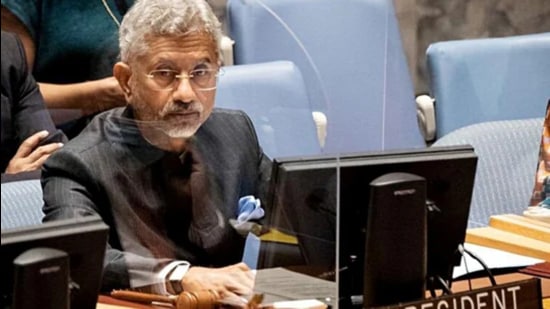
The resolution, adopted at an open debate chaired by external affairs minister S Jaishankar, calls for prevention, investigation and prosecution to bring to justice perpetrators of crimes against UN peacekeepers. It was initiated by India in the Security Council earlier this year and co-sponsored by all 15 permanent and non-permanent members of the body.
The Security Council also adopted the first technology-related presidential statement on peacekeeping — “Technology for Peacekeeping” — which called for recognising that “technology has the potential to act as a force multiplier”.
India, which holds the rotating presidency of the Security Council for August, is one of the largest troop contributors for UN peacekeeping missions. It has provided more than 250,000 personnel for 49 missions over the decades, and 174 of its troops have died during these deployments. Currently, more than 5,000 Indian personnel are deployed in nine missions.
The open debate with the theme “Protecting the protectors” was one of three signature events being hosted by India as part of its presidency of the Security Council. Prime Minister Narendra Modi chaired a virtual open debate on global cooperation for maritime security on August 9, while Jaishankar will chair a briefing on counter-terrorism on August 19 that is expected to discuss the situation in Afghanistan following the takeover of the country by the Taliban.
Jaishankar told the meeting that UN peacekeeping operations “must be anchored in a strong ecosystem of technology and innovation” to adapt to changing conflict dynamics. He proposed a four-point framework that lays out an architecture for securing UN peacekeepers from contemporary threats.
This framework, Jaishankar said, should focus on technologies that are “operationally proven, cost-effective, widely available, reliable and field-serviceable”. It should establish a sound information and intelligence foundation for ensuring early warning and mobilising a coherent and early response.
The framework should ensure regular technological improvements that are readily available in gear, weapons and tools for peacekeepers, and there should be attention and investment to consistent training and capacity building of peacekeepers in the field of technology, he added.
In this regard, Jaishankar said, India is backing the UN in rolling out the “UNITE Aware” platform in selected peacekeeping missions. “This initiative is based on the expectation that an entire peacekeeping operation can be visualised, coordinated and monitored on a real-time basis. We should ensure that any attack on a peacekeeper or a civilian is predictable, preventable or responded to immediately,” he said.
India contributed $1.64 million for the UNITE Aware platform that is being used by four peacekeeping missions in Somalia, South Sudan, Mali and Cyprus. The platform is a situational awareness software programme that uses modern surveillance technology and provides real-time threat assessment to improve the overall security of UN peacekeepers.
The platform records data on critical incidents and events and tracks daily operational activities. It also provides access to live video and satellite imagery and early warnings in a volatile environment.
The first presidential statement in the Security Council focused on using technology to help peacekeepers. It also encourages the use of modern technology to improve the performance, safety and security of peacekeepers operating in increasingly complex and risky environments.
As part of India’s initiatives for the training and capacity building of peacekeepers in the realm of technology, a memorandum of understanding (MoU) was signed between India and UN to support the “Partnership for Technology in Peacekeeping” initiative and the UN Command, Control, Communications, Computers, Intelligence, Surveillance, and Reconnaissance (C4ISR) Academy for Peace Operations based in Entebbe, Uganda.
Jaishankar said 21st-century peacekeeping “must be anchored in a strong ecosystem of technology and innovation” that can facilitate missions to implement their mandates in complex environments. “After all, it helps them to adapt to changing conflict dynamics and take advantage of increased efficiencies. This is also in line with the Strategy for Digital Transformation of UN peacekeeping which seeks to advance the use of technology across the Action for Peacekeeping themes, including performance, safety and security, politics, protection and peace-building,” he said.
UN Secretary-General António Guterres said digital tools, such as long-range cameras, unmanned aerial vehicles and ground surveillance radars, help peacekeepers protect civilians and themselves. However, new technologies also pose profound threats, reflected by the online proliferation of violent extremist ideologies, cyber-attacks and deadly vaccine misinformation.
“Anonymous actors are able to target critical infrastructure such as power stations, hospitals, government facilities and the IT systems crucial to running our societies,” he said. “We are also seeing the increased use of autonomous weapon systems. On this rapidly emerging issue, governments must work together to ensure that sufficient human control and judgement is retained in the use of force.”
Before the debate, Jaishankar participated in a ceremony held at the UN Peacekeepers Memorial that was also attended by Guterres and all council members. The event was held to pay tribute to UN peacekeepers who sacrificed their lives in the line of duty.


