
 E-Paper



People of Bangladesh should never forget India’s role in 1971 Liberation War: PM Sheikh Hasina
Sheikh Hasina made the remarks after giving away the first Bangabandhu Sheikh Mujibur Rahman Student Scholarships to descendants of 10 Indian military personnel who were either killed or seriously injured in the war that led to the creation of Bangladesh


New Delhi: The people of Bangladesh should never forget the role played by India’s people and armed forces in the Liberation War of 1971 as the sacrifices of Indian military personnel were no less than those of Bangladeshi freedom fighters, visiting Prime Minister Sheikh Hasina said on Wednesday.
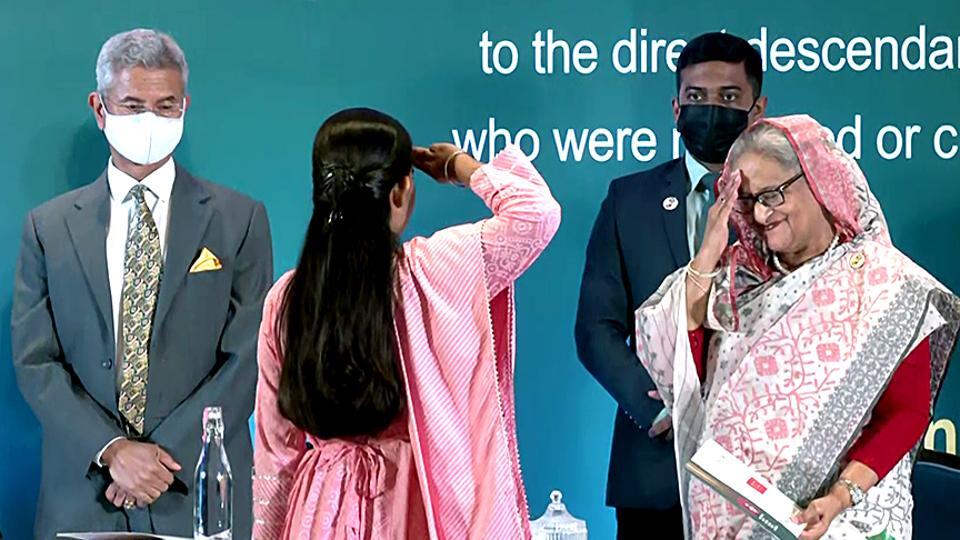
She made the remarks after giving away the first Bangabandhu Sheikh Mujibur Rahman Student Scholarships to descendants of 10 Indian military personnel who were either killed or seriously injured in the war that led to the creation of Bangladesh. A total of 200 scholarships — 100 each for students of class 10 and class 12 — will be awarded by the Bangladesh government.
Among the recipients was Anuj Ekka, grandson of legendary war hero Albert Ekka, who posthumously was awarded the Param Vir Chakra, India’s highest military honour for valour, for his role in the Battle of Gangasagar.
Both Hasina, who is on a four-day visit to India, and external affairs minister S Jaishankar highlighted how the collaboration between Bangladeshi freedom fighters and the Indian armed forces in 1971 had forged special bonds between the people of the two countries.
“For the people of my country, I will only say that...our people struggled with whatever resources were available for the liberation war to make the country independent. And close to us, the people and armed forces of India fought in the war and gave their blood along with our people,” said Hasina, speaking in Bengali.
“We should never forget that their people, government and armed forces stood by us,” added Hasina, who is the daughter of Sheikh Mujibur Rahman, regarded as the father of the Bangladeshi nation.
The scholarships are being given so that the Bangladeshi people “never forget the huge sacrifices made by the fathers and families of the awardees for our independence”, Hasina said.
“The way our people sacrificed their blood for the country’s independence, the people of a friendly neighbouring country also stood by us, sheltered one crore refugees, gave food and medical care, and assisted them,” she said. “We want our friendship to always remain intact.”
Jaishankar said the India-Bangladesh relations “are in many ways a continuation of the bonds that were forged in blood 50 years ago”. He described Rahman as an “iconic symbol of the historic 1971 Liberation War” and a statesman “who liberated from oppression the spirit of a brave people and brought forth a nation”.
He added: “For us in India, Bangabandhu Sheikh Mujibur Rahman is iconic — a man of action, courage and conviction. He is as revered and remembered in India, as he is in Bangladesh.”
Following talks between Hasina and her Indian counterpart Narendra Modi on Tuesday, the two sides signed seven agreements for cooperation in areas ranging from sharing of river waters to space and technology, and unveiled new connectivity and energy initiatives. The leaders of the two sides also held up the bilateral partnership as a role model for the neighbourhood.
Hasina said the new scholarships were “very close to my heart” as this was opportunity to pay homage to those who died from India and Bangladesh in 1971. She recalled that Bangladesh had honoured other Indian leaders and citizens in the past, such as the Bangladesh Freedom Award being conferred on late prime minister Indira Gandhi in 2018, and other awards given to late premier Atal Bihari Vajpayee and late president Pranab Mukherjee.
The scholarships will help reconnect a younger generation to their historic past and the awardees should act as ambassadors of Bangladesh-India friendship and be a bridge between the two countries, she said.


