The Indian economy is strong on its robust banking system which transformed from a means of financial transaction to a tool for “good governance”, eradicating corruption through direct delivery of services, Prime Minister Narendra Modi said on Sunday, adding that the era of digital banking has replaced the regime of “phone banking” that existed eight years ago.
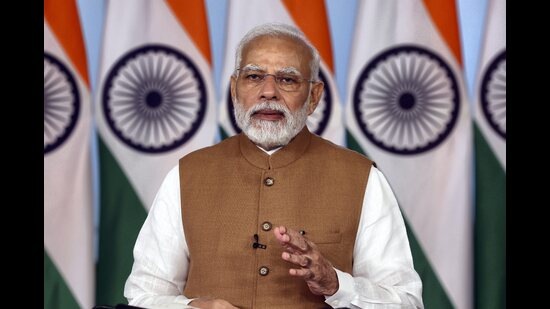
“The economy of a country is as progressive as is the strength of its banking system. Today, India’s economy is moving forward with a continuum. This is becoming possible because in these eight years, the country has shifted from the pre-2014 ‘phone banking’ system to digital banking.”
The Prime Minister was referring to malaise in the banking system in the form of hidden liabilities of financial institutions that were brushed under the carpet until the government in 2015 decided to launch a transparent Asset Quality Review (AQR) that saw a surge in non-performing assets (NPAs) of public sector banks (PSBs) from ₹2,16,739 crore on March 31, 2014 to ₹8,95,601 crore on March 31, 2018 mainly due to indiscriminate lending, which the PM referred to as “phone banking”.
Dedicating 75 Digital Banking Units (DBUs) across 75 districts to the nation via video conferencing, the Prime Minister said: “You will remember and understand very well the phone banking that existed before 2014. Banks used to get calls from the top, and it was decided how the banks should work, whom to give money [loans] to. This phone banking politics made the banks vulnerable, dumped them in the pit [of NPAs], made the country’s economy insecure… [It sowed] seeds of scams worth thousands of crores…, news constantly covered these scams...”
Speaking on the occasion, PM Modi said that since 2015, the government has revamped the banking system, made it stronger and people-centric. “After bringing transparency in the identification of NPAs, lakhs of crores of rupees were brought back into the banking system. We recapitalised banks, took action against wilful defaulters, and reformed the Prevention of Corruption Act,” he said.
{{/usCountry}}Speaking on the occasion, PM Modi said that since 2015, the government has revamped the banking system, made it stronger and people-centric. “After bringing transparency in the identification of NPAs, lakhs of crores of rupees were brought back into the banking system. We recapitalised banks, took action against wilful defaulters, and reformed the Prevention of Corruption Act,” he said.
{{/usCountry}}He said the resolution of NPAs was expedited with the help of the Insolvency and Bankruptcy Code (IBC) that provided for removal of promoters from management of their defaulting firms and provided strong action for recovering bad loans. In order to make the system objective and remove individual discretion, use of technology and analytics was introduced, he added.
“Decisions such as the merger of banks were victims of policy paralysis, but the country took these bold decisions. The results of these decisions are before us today,” PM Modi said, adding that a new self-driven mechanism is being created for the banking system through new initiatives such as DBUs and innovative use of fintech. He said these initiatives have brought much autonomy for the consumers and also convenience and transparency for banks.
DBUs were announced in the Union Budget by finance minister Nirmala Sitharaman to ensure the benefits of digital banking reach every nook and corner of the country involving 11 PSBs, 12 private banks and one small finance bank. “In recent years, digital banking, digital payments and fintech innovations have grown at a rapid pace in the country. The government is continuously encouraging these sectors to ensure that the benefits of digital banking reach every nook and corner of the country in a consumer-friendly manner. Taking forward this agenda, and to mark 75 years of our Independence, it is proposed to set up 75 Digital Banking Units (DBUs) in 75 districts of the country by Scheduled Commercial Banks,” Sitharaman announced on February 1 in her Budget speech.
The Prime Minister said the aim of the government is to empower the citizens and make them powerful, and as a result, policies were made keeping in mind the last person and the entire government moving in the direction of their welfare.
Stressing on the need to make the banking system transparent and promote financial inclusion, he asked banks to shun their traditional ways when people had to go to the bank for services. The PM said the approach of his government is to bring banks to the people. “We have given top priority to ensure that banking services reach the last mile,” he said.
Talking about the changed approach, he said: “We not only removed the physical distance but, most importantly, we removed the psychological distance.” Highest priority was given to cover far-flung areas with banking, he added.
He said that over 99% villages in India have a bank branch, a banking outlet or a “banking mitra” within 5km radius. “Extensive Post Office network too was harnessed via India Post Banks for providing the banking needs to the common citizens,” he said. “Today, the number of branches per one lakh adult citizens in India is more than countries such as Germany, China and South Africa,” he added.