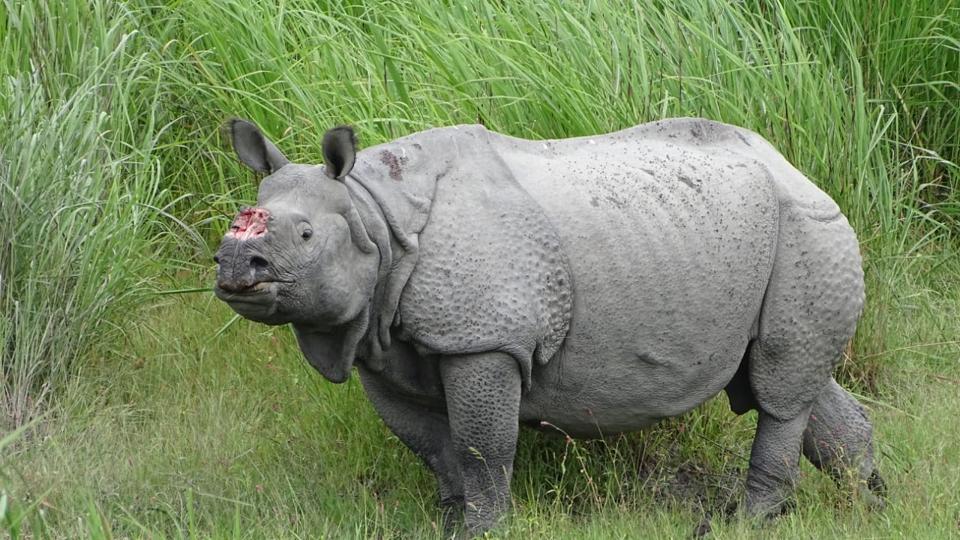
Poachers tranquillise rhino to remove horn in Assam
The incident came to light on Monday when personnel deployed in the park found the dehorned sub-adult male rhino aged around 8-10 years, during routine patrolling in Muwamari area.
In a first instance of its kind, poachers in Assam removed the horn from a rhino after tranquilising it (instead of resorting to the usual practice of first killing it) in the state’s Orang National Park, officials said on Thursday.
This is the first instance of poaching of a rhino horn using tranquiliser guns in Assam’s Orang.
{{^htLoading}} {{/htLoading}}
The incident came to light on Monday when personnel deployed in the park found the dehorned sub-adult male rhino aged around 8-10 years, during routine patrolling in Muwamari area.
“Only in rare cases do rhinos lose their horns during fights with other rhinos. But in order to be sure, we summoned a team of experts, including veterinary doctors from the state zoo in Guwahati who visited the park on May 10,” Pradipta Baruah, divisional forest officer, Mangaldai wildlife division, said.
After tranquilising the rhino, the team found that the horn was cut with a sharp weapon by an expert hand, officials familiar with the matter said. No bullet injuries were found on the rhino. The team concluded that the animal was tranquilised by poachers and then its horn was removed.
{{^htLoading}} {{/htLoading}}
{{^usCountry}}
“This is the first instance of poaching of a rhino horn using tranquiliser guns in Orang. Earlier, one-two such instances were recorded in Kaziranga National Park in the state. But this is the first time we have found that the horn has been removed in such a manner that the animal continues to be alive and healthy,” Baruah, who is also the field director of Orang Tiger Reserve, said.
{{/usCountry}}
{{#usCountry}}
“This is the first instance of poaching of a rhino horn using tranquiliser guns in Orang. Earlier, one-two such instances were recorded in Kaziranga National Park in the state. But this is the first time we have found that the horn has been removed in such a manner that the animal continues to be alive and healthy,” Baruah, who is also the field director of Orang Tiger Reserve, said.
{{/usCountry}}
Orang is one of the few national parks and wildlife sanctuaries in Assam which have a population of one-horned rhino, an endangered species targeted by poachers for its horn, which is used in Chinese traditional medicine and fetches a very high price in international markets.
A seasoned senior journalist, I have nearly three decades of experience across print, digital, and online platforms, covering political transitions, insurgencies, environmental issues, and development stories in India and Nepal. I am skilled in breaking news, leading editorial teams and launch of newspaper editions. I am adept at leveraging digital trends and social media to expand global reach, with a strong ethical foundation and a reputation for impactful journalism. An alumnus of Asian College of Journalism, I joined Hindustan Times in New Delhi as a trainee reporter in May 1997. Over the years, I have been posted in Dehradun, Kathmandu (Nepal) and Guwahati. Currently, as Senior Assistant Editor at Hindustan Times, I lead a team reporting on India’s northeastern states. My work involves in-depth analysis, and engaging multimedia storytelling across formats, including text, photo, video, and interactive content. I am skilled in producing timely, shareable content, leveraging digital platforms and social media to engage global audiences. Throughout my career with the Hindustan Times, I have led diverse editorial teams, designed capacity-building activities, and supported reporters in developing strong story ideas, ethical reporting practices, digital skills, and fact-checking techniques. As Senior Assistant Editor for Northeast India, I have been responsible for guiding correspondents through complex political, humanitarian, and community-level stories using multimedia formats. Earlier, as Foreign Correspondent in Nepal, I produced extensive reporting during Nepal’s democratic transition and the 2015 earthquake and its aftermath.
Get the latest India News, breaking headlines, and real-time updates from across the nation. Stay informed on politics, government policies, crime, weather, and major national developments.
Get the latest India News, breaking headlines, and real-time updates from across the nation. Stay informed on politics, government policies, crime, weather, and major national developments.
Home/India News/Poachers tranquillise rhino to remove horn in Assam
{{^htLoading}}
Advertisement
{{/htLoading}}
SHARE THIS ARTICLE ON
{{#usCountry}}{{/usCountry}}
Notifications
Get breaking alerts directly from the newsroom
Notifications are on!You'll be notified when news breaks