
 E-Paper



PoK will return to India voluntarily, says Rajnath
The use of indigenous weapons and systems during the operation showed that India has the capability to punch through the enemy’s armour, Rajnath Singh said.


Defence minister Rajnath Singh on Thursday indicated that India could have hit Pakistan harder during the May 7-11 military confrontation that sparked fears of a full-blown war, hailed the performance and reach of locally made weapons and systems deployed during Operation Sindoor and said that Pakistan-occupied Kashmir (PoK) would voluntarily reunite with India.
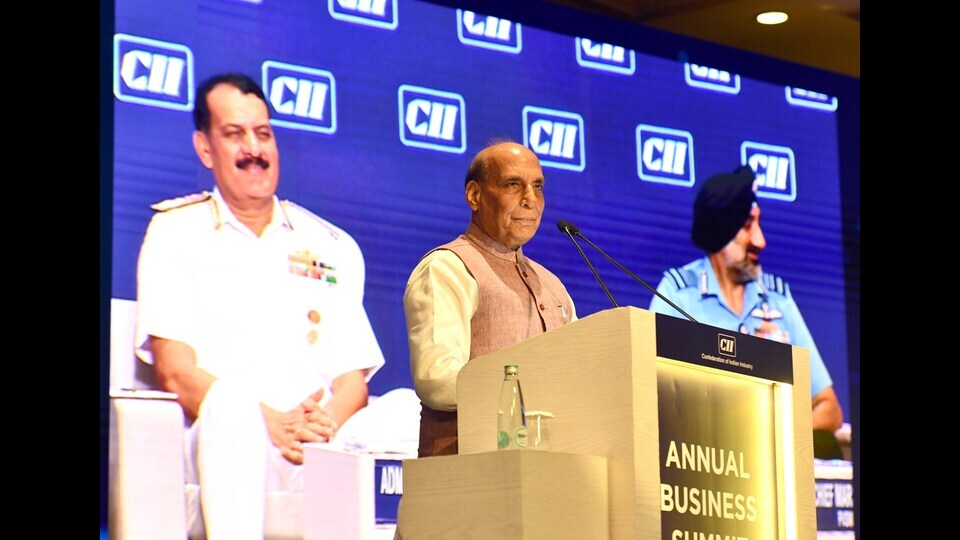
“We destroyed the terrorist hideouts and then the military bases. We could have done a lot more, but we presented a great example to the world of how we balanced power and restraint,” he said at the CII Annual Business Summit 2025.
Operation Sindoor was New Delhi’s military response to the April 22 Pahalgam terror strike. It triggered four days of strikes and counterstrikes with fighter jets, missiles, drones, long-range weapons and heavy artillery before the two sides reached an understanding on stopping all military action on May 10.
The use of indigenous weapons and systems during the operation showed that India has the capability to punch through the enemy’s armour, Singh said.
A locally developed air defence control and reporting system, called Akashteer, emerged as the centrepiece of India’s air defence grid during the four-day clash; it punctured multiple waves of Pakistani aerial attacks on Indian military installations, airbases and civilian areas by guaranteeing prompt detection and targeting of the incoming threats.
The locally produced military hardware that packed a formidable punch during the confrontation with Pakistan included Akash surface-to-air missiles, the Samar (surface-to-air missile for assured retaliation) system, loitering munitions and several counter-drone weapons.
“’Make in India’ is an essential component of our national security and it played a key role in the effective action against terrorism during Operation Sindoor,” Singh said.
Between the launch of the operation in the early hours of May 7 and the ceasefire on the evening on May 10, Indian forces bombed nine terror camps in Pakistan and PoK, killing at least 100 terrorists, and the Indian Air Force (IAF) struck targets at 13 Pakistani airbases and military installations.
Indian forces would not have been able to take effective action against terrorism in Pakistan and PoK if the country had not strengthened its indigenous defence capabilities, he said.
“India has redesigned and redefined its strategy against terrorism. Pakistan has realised that running the terror business is not cost-effective, rather it may have to pay a heavy price. India has recalibrated its engagement and scope of dialogue with Pakistan and now talks will only be on terrorism and PoK,” he said.
Prime Minister Narendra Modi had made it clear that strikes against terror mark a new normal for India.
The Pahalgam terror attack in which 26 people were shot dead was the worst attack on civilians since the 26/11 Mumbai strikes. The Indian precision strikes on nine terror targets in Pakistan and PoK began at 1.04 am on May 7 and were over in 23 minutes.
On May 16, Singh said India’s zero-tolerance approach to terrorism is now a core part of its national defence doctrine. “Our actions were just a trailer; we will show them the full picture if needed. Attacking and eliminating terrorism is the new normal,” he said at the Bhuj airbase.
On Thursday, he reiterated that PoK was a part of India and the people who were geographically and politically separated will --- sooner or later --- voluntarily reunite with India. “The government is committed to its resolve of Ek Bharat Shreshtha Bharat. Most people in PoK have a deep connection with India. There are only a few who have been misled.”
The chief of air staff Air Chief Marshal AP Singh, who was among the speakers at the CII event, said Operation Sindoor reflected the changing character of warfare. “Every day we see new technologies coming in... Operation Sindoor has again given us a clear idea of where we are headed and what we need in the future. A lot of work needs to be done in realigning our own thought processes, which is already on.”
He also put the spotlight on the armed forces’ agonising wait for new weapons and systems, saying he could not recall a single instance of a project being executed on time --- a wake-up call for the country’s defence production sector.


