Prime Minister Narendra Modi on Saturday said India had moved from policy paralysis to policy dynamism in 13 years, returning to Delhi University’s Shri Ram College of Commerce (SRCC) to claim vindication for the case he had made in 2013 from the same stage before he came to power.
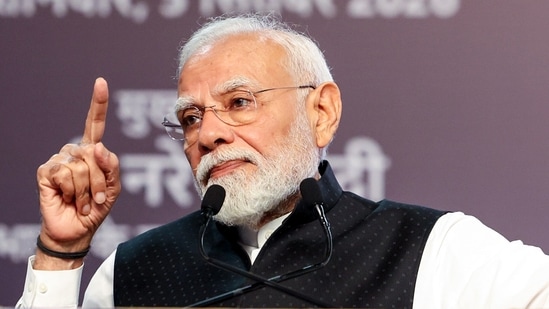
Modi last addressed SRCC in February 2013 during a business conclave, when his party was in opposition and he was a year away from national office. Speaking at the college’s centenary celebrations, Modi said his 2013 address had set off a “wave”, and attacked those who had pushed India into the “Fragile Five” and were now “unable to digest its 7.8% growth”.
“India in 2013 was dealing with a series of challenges, including terror attacks, inflation and corruption. Growth was at its lowest and inflation was at the peak,” he said.
Deep Dive
What achievements did PM Modi highlight about India's economy during his speech at SRCC?
How did PM Modi describe the situation of India in 2013 compared to now?
What was the significance of PM Modi's return to SRCC for its centenary celebrations?
“Scams were at an all-time high, terrorists were fearless, Pakistan was aggressive at the borders and there was complete policy paralysis. The world was considering us in the fragile five nations. But now, if Pakistan even tries to attack, we respond with an attack. Naxalism has been rooted out and people are talking of policy dynamism.”
The Prime Minister was addressing a gathering packed with students and spoke for close to 50 minutes.
{{/usCountry}}The Prime Minister was addressing a gathering packed with students and spoke for close to 50 minutes.
{{/usCountry}}He returned to the analogy he had used at the college in 2013.
“I gave the example of a glass filled with water. Some people see the glass as half full. Some say it is half empty. I said there are people who can see the glass as fully filled — half with water and half with air. It was a time when the country was lacking hope,” he said. Critics who saw the glass half-empty then, he added, held the same view today.
Modi cited a 7.8% GDP growth rate in the most recent quarter and a ratings upgrade by a Japanese credit agency.
“Achieving a 7.8% quarterly growth amidst the West Asia war and global trade hurdles demonstrates India’s intrinsic capability,” he said. Between April and June, he said, electricity production rose 9%, vehicle sales 20%, and steel and cement consumption 8% — evidence, he argued, of expanding construction, housing and jobs.
He said his 2013 formulation of P2G2 — pro-people, good governance — had since been delivered.
Referring to his Independence Day address, Modi said: “From the Red Fort, I gave a homeopathic pill of ‘Dimagi Naxal’. As soon as I said this, all the ‘Dimagi Naxals’ began emerging one after another. Now their treatment will begin.”
Modi, who took the Metro to the venue, traced SRCC from a sapling in Daryaganj to a major academic pillar, and peppered his speech with Gen Z terms. “The alumni of SRCC are, in your language, the OG. They may not be ‘Dhurandhars’, but they have made an impact (Dhoom),” he said. The Gen Z register came amid a Bharatiya Janata Party (BJP) push to reach younger audiences after the Jantar Mantar protests earlier this summer that culminated in the resignation of then education minister Dharmendra Pradhan.
Critics, he said, questioned every project like a “naraz phupha” (angry uncle)— from the world’s largest statue and high-speed rail to UPI, chip manufacturing, the new Parliament building and the national war memorial.
“Jan Dhan Yojana was started 12 years ago when over 50% of the population did not have a bank account… since 2012, over 60 crore new bank accounts have opened,” he said, adding that the scheme had “completely finished this mai-baap culture”.
India imported most smartphones in 2014 and now produced and exported them worth ₹2.5 lakh crore, he said.
“In the defence sector, we imported even the smallest parts. I spoke to all three forces and created a negative list of parts we will not import anymore. We now have a defence production of ₹2 lakh crore and export of ₹40,000 crore,” he said.
“Today our youth can dream of launching a startup, building unicorns, entering sectors such as space and drones, building cutting-edge AI solutions and innovating in agriculture. Your seniors could not dream of these 13 years ago,” he said, closing with a poem drawn from the college crest of a rising sun and a moving ship.
Education minister Pralhad Joshi said 45 million students had entered higher education this year, 10 million more than a decade ago, and that startups had grown from under 400 in 2016 to 230,000.