The Cockroach Janta Party (CJP) leadership will on Wednesday begin a two-day strategy meeting in Maharashtra to discuss the future of the youth-led movement after it spearheaded nationwide protests over alleged examination irregularities.
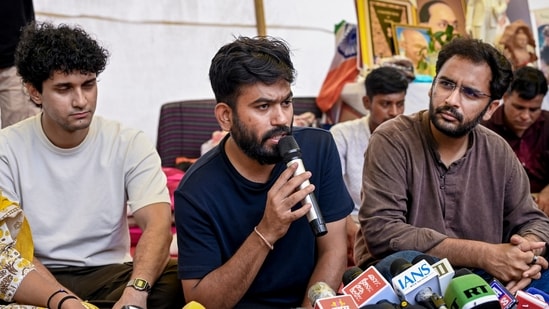
The meeting, being held on Wednesday and Thursday, is being attended by CJP founder Abhijeet Dipke, chief spokesperson Saurav Das, spokesperson Vaishnavi Gaur and other senior members of the organisation.
Addressing the media ahead of the meeting, the CJP leadership said discussions would focus on reviewing the recent protest movement, expanding the organisation at the grassroots level and finalising its future roadmap.
Also read: ‘Until govt orders CBI probe’: Students' ultimatum as Ranchi protest deepens
The CJP, a youth-led satirical political movement, led last month's nationwide protests over the alleged NEET paper leak, which culminated in the resignation of Union education minister Dharmendra Pradhan.
With the protests over, attention has now shifted to how the organisation plans to sustain the momentum and broaden its outreach.
No immediate plans to enter electoral politics
{{/usCountry}}With the protests over, attention has now shifted to how the organisation plans to sustain the momentum and broaden its outreach.
No immediate plans to enter electoral politics
{{/usCountry}}The CJP leadership ruled out any immediate plans to enter electoral politics, saying its priority is to build a grassroots movement rather than become a conventional political party.
"The purpose will be to form the agenda for the Cockroach Janta Party and discuss how we can take this social movement forward," Dipke told Reuters.
He said the organisation would also consult Gen Z on the issues they want the movement to take up.
"Our core team members, including our spokespersons and everyone who helped us manage the protest, will be attending. All our core members will be here. As of now, we have no plans to form a political party," Dipke said.
Focus on grassroots expansion
Saurav Das said the two-day meeting would help define the next phase of the movement.
"We were asked questions about where this movement will go after the success of the protest, and we have all come to strategise around the same. We will hold discussions over it and think about how to take it to the grassroots level. When we come up with something concrete on August 6, we will inform everyone about our future strategy," he said.
Das reiterated that the CJP views itself as a movement rather than a political alternative.
Also read: Complaint against Noida teen who ‘abused’ PM Modi at NEET protest dropped
"While there are numerous political parties, the answer to people's pain is not another political party, but an awakening at the grassroots level, and this is what CJP is doing," he said.
Speaking to Bloomberg, Das said the organisation aims to build a grassroots network with workers in every district.
"The movement is about accountability. The issues that we want to raise are all going to be youth-centric. We want to take this movement to the grassroots because people at the grassroots face a lot of issues and nobody hears them out," he said.
Leaders criticise government's response to protests
CJP spokesperson Vaishnavi Gaur criticised the government's handling of the recent protests, saying authorities should engage in dialogue instead of imposing decisions.
"The way BJP and RSS have held other rallies recently, it is not much of a dialogue; it is dictation. So we just hope that they engage in dialogue instead of dictation. Children should not be bullied. That is our hope. Otherwise, we will continue working on our youth movement," she told ANI.
Also read: A tale of two Kashmirs: As J&K rises with integration, PoK sinks deeper into crisis
CJP leader Ratna Singh said the impact of the protests had extended beyond major cities and resonated with people across the country.
"No, the RSS comes forward only to help them whenever they do, so there is no doubt about that. But whether this movement has had an impact on voters... it definitely has, because just as much as you saw at Jantar Mantar, it has also had an impact in every village where people couldn't even come," she said.
CJP's rise during NEET protests
The CJP emerged as the face of last month's student protests over the alleged NEET paper leak, drawing large crowds through demonstrations and social media campaigns. The movement gained national attention during its march to Delhi's Jantar Mantar, where thousands of students demanded accountability over examination irregularities.
The protests eventually led to the resignation of Union education minister Dharmendra Pradhan, marking the biggest political outcome of the agitation. The organisation has since said it wants to channel the support it received during the protests into a broader grassroots movement focused on youth and public issues beyond examination reforms.