During his visit to NASA’s Wallops Flight Facility in Virginia in 1963, a painting caught the attention of APJ Abdul Kalam, a young exchange programme scientist at the time.
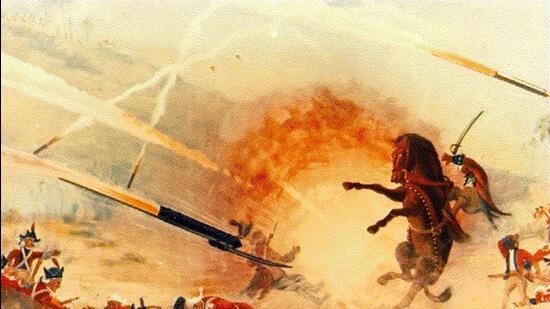
The painting depicted the first use of rockets on a battlefield. It particularly caught his eye because the soldiers on the side launching the rockets were not white, but racial features of people found in South Asia. Eventually, to his surprise, he learnt that it was 18th-century ruler Tipu Sultan who invented battlefield rockets.
Kalam, who went on to become the President of India, was soon fascinated by the history of rockets and Tipu Sultan. “The development of Indian rockets in the twentieth century can be seen as a revival of the eighteenth-century dream of Tipu Sultan.” Kalam wrote in his book ‘The Wings of Fire’, admiring the ruler.
Cut to March 25, 2022, a decision to alter the chapter on Muslim ruler Tipu Sultan in Karnataka’s textbooks has raked up a controversy. Karnataka primary and secondary education minister BC Nagesh on Friday said a report by the committee recommended alterations to the textbooks in the state, especially regarding references to Tipu Sultan.
An official aware of the matter said the report has recommended that parts that “glorify” Tipu Sultan must be removed. “The committee has recommended changes to certain imbalances in the syllabus and kept the chapters neutral,” the official added.
The decision comes amid the government already facing criticism over the hijab row and ban on Muslim traders in Hindu temples. Earlier, in July 2020, the government had dropped a chapter on Tipu Sultan in the Class 7 syllabus.
{{/usCountry}}The decision comes amid the government already facing criticism over the hijab row and ban on Muslim traders in Hindu temples. Earlier, in July 2020, the government had dropped a chapter on Tipu Sultan in the Class 7 syllabus.
{{/usCountry}}The controversy over Tipu Sultan and a political movement to remove him from the textbooks have surfaced in Karnataka over the last decade. The root of the controversy goes back to the campaign of the Tipu Sultan against the Kodava community and allegations of murder and forced conversions. The Kodavas are an ethnic-lingual tribe that consider themselves to be the original inhabitants of Kodagu. Considered martial race, the memory of their persecution under Tipu Sultan serves as a reminder of their loss of dignity.
Kodavas’ oral history says that Tipu killed several of them in Devati Parambu and then took close to 100,000 of them as prisoners to his fort at Srirangapatnam, where he forcibly converted them. The community has been opposing the hailing of Tipu as a freedom fighter.
UM Poovaiah, editor of Brahmagiri, a Madikeri-based weekly said that hailing Tipu as a freedom fighter is an insult to patriotic Kodavas. “The district has produced one field marshal, a general, eight lieutenant generals, 30 major generals, 50 brigadiers, more than 100 colonels and six air marshals. But no Kodava opinion or sentiment has ever been honoured by the government,” he said.
Narendar Pani, a political analyst and professor at the School of Social Sciences at Bengaluru’s National Institute of Advanced Studies (NIAS), pointed out that politicians are trying to project the events of the 18th century with the delusions of the modern era.
He pointed out that Tipu’s campaigns were more part of the territorial expansion than a communal attack as claimed by certain political parties.
“If you look at the battle of Bangalore, his allies were Hindus. Similarly, when the temples of Sringeri mutt in Karnataka was attacked by the Maratha empire, it was Tipu who helped them defend themselves. The fact that he attacked the Nizam of Hyderabad more than the Marathas shows that his intentions were territorial rather than communal. This being the 18th century, his method of achieving it was violence,” Pani said.
Pani also pointed out his campaigns were related to land and controlling territories. “In the 18th century, there were two ways of the controlling land, one through middlemen and other directly controlling the lands. In the coastal Karnataka and Western ghats region, Tipu opted to control the territories directly. The battles were the result of the conflict between the middlemen controlling the land and the Tipu’s forces,” he said.
According to Pani, the communalisation of these campaigns is part of today’s politics, without considering the realities of the 18th century. He added that though the British Empire had slaughtered several thousands of Indians during the battle for Bangalore Fort and in other places, that part of history has been conveniently ignored in this new political narrative, even though many of those slaughtered by the British were Hindus.
While the political campaign, taking new twists and turns, the scientific community considers the politicisation of the Tipu Sultan would erase a golden age of India’s scientific achievements.
BJP MLA Basanagouda Patil Yatnal said school textbooks should not have lessons on “bigot” kings from history. “Those who have been excessively glorified – Tipu, Babur, Akbar, Aurangzeb and other bigot kings should be removed,” Yatnal, the Bijapur City MLA. “We learned about Akbar the Great, but not about the conversion and oppression Hindus faced. Likewise, Tipu killed one lakh Hindus in Kodagu, but he was glorified as a freedom fighter. By distorting history, it was wrong to have glorified some kings just for the sake of appeasement,” he added.
According to historians, rockets find their origin on the road alongside Jumma Masjid and Taramandalpet in Bengaluru – the hub of the rocket project of Tipu Sultan. Military inventions such as Tipu Sultan’s rockets and Bangalore Torpedoes by the Madras Sappers, an engineering group of the Corps of Engineers of the Indian Army, are considered examples of Bengaluru’s rich history in military inventions.
The army of Tipu Sultan was the first in the world to weaponise rockets. The ruler had created a designated force of nearly 5,000-strong men to operate rockets. Even though the Chinese and Europeans tried to make rockets soon after the invention of gunpowder, according to historians, since they used bamboo to make rockets, the prototypes were not effective, and they were soon replaced by canons.
Even though the use of rockets in combat was perfected in Tipu’s labs in Bengaluru, this history was long forgotten. In his book ‘The Wings of Fire’, Kalam wrote: “The painting depicted a fact forgotten in Tipu’s own country, but commemorated here on the other side of the planet.”
A faculty member at the National Institute of Advanced Studies who had researched extensively on the Tipu’s rockets said that students of the state, even the country, not learning the origins of India’s role in rocket technology would be a loss. “School textbooks are important because they give children history and especially in this land where Tipu is a local king. Removing a person and sanitising history is dangerous,” said the member, who didn’t want to be named.
Meanwhile, the Opposition in Karnataka has come out against the controversy. Education minister BC Nagesh has said that an announcement of the revised portions on Tipu Sultan will be announced soon.
“He is been placed now in the London Museum also. When tourists go to Srirangapatana, Devanahalli and other places...these are things that the government cannot remove? By removing him from textbooks, the students will be deprived of learning about his fight against the British and other history associated with him,” said Congress legislator UT Khader.