Punjab cannot handle its paddy, but it can’t change without help
The toxic air in Delhi and adjoining areas is a by-product of multiple factors. Smoke from stubble burning in Punjab and Haryana is an important contributor.
Updated on: Nov 16, 2021, 21:17:22 IST
By Abhishek Jha and Roshan Kishore, Hindustan Times, New Delhi
The toxic air in Delhi and adjoining areas is a by-product of multiple factors. But the smoke from stubble burning, which travels to Delhi from the neighbouring states of Punjab and Haryana is an important contributor to pollution levels. In the period from October 20 this year, the contribution of stubble burning to Delhi’s PM2.5 concentration has ranged between 2% on October 24 to as much as 48% on November 7, according to the System of Air Quality and Weather
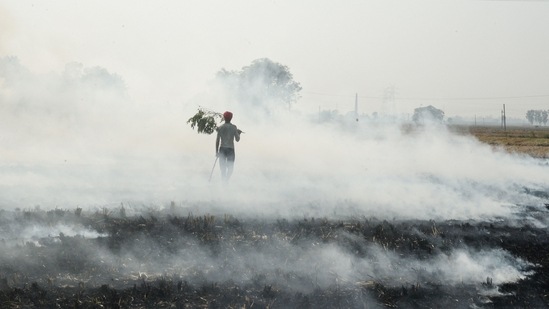
Punjab is responsible for the largest number of farm fires in the northern region, over six times the number of fires in the states of Haryana and Uttar Pradesh. (PTI)
There is no doubt that stubble burning in Punjab and Haryana produces smoke. How much does that smoke contribute to pollution in Delhi? The contribution can vary depending on the amount of stubble burnt and the proportion of that smoke that enters Delhi and stays close to the ground. The latter two are dependent on temperature and the speed and direction of wind. Because the weather conditions helpful for accumulation of pollutants close to the ground in Delhi – low-speed wind blowing from north-west to east and low temperatures – coincide with the stubble burning period, PM2.5 concentration in Delhi has a high correlation with fires in Punjab and Haryana in October and November.
{{^usCountry}}{{/usCountry}}
Why stubble burning?
It is a race against time for farmers. There is a very small window between the harvesting of the kharif (monsoon) season’s paddy crop and sowing of the rabi (winter) crop in this region. This is partly a result of government regulations that mandate delayed sowing of the kharif crop (because there is a shortage of water, itself brought about by the fascination with paddy in this part of the country). Then there is the question of money. Setting fire to fields to prepare them for farming is among the oldest methods in agriculture. This is how early humans learnt agriculture, except what they would set fire to what were forest lands. The reason this technique has resurfaced in regions such as Punjab is, ironical as it may sound, not a lack of technique – our ancestors did not have the farm equipment we have today – but the economics of farming. Paddy, when harvested by human labour does not leave behind much in terms of stubble. This is not the case when it comes to harvesting with machines such as combine harvesters.
There are two factors that encourage the use of mechanised harvesting in Punjab compared to other states: larger farm sizes, which facilitates theuse of such machines and higher cost of labour compared to other states. Data from the latest Land and Livestock Holdings of Households and Situation Assessment of Agricultural Households (SAS) by the National Sample Survey Office (NSSO) puts this in perspective.
The average size of land under paddy cultivation is 1.97 hectares in Punjab and 1.88 hectares in Haryana, among the highest under paddy cultivation in major states. This is in complete contrast with the situation outside Punjab. The average size of land under paddy cultivation in the third-ranked state (Madhya Pradesh) is almost half of that in Punjab (1.01 hectares). In most big states, the average size of land under paddy cultivation is under one hectare.
This, when read with the fact that average agricultural wages in Punjab are higher than the national average, and even more so than the agricultural labour exporting states such as Bihar, Jharkhand and parts of Uttar Pradesh, explains why it makes sense for farmers in Punjab to first use mechanised harvesting and then resort to stubble-burning.
The dominance of big farmers in paddy cultivation in Punjab (and its neighbouring Haryana) is a reflection of the fact that paddy is more a commercial than subsistence crop in these states. This is borne out by the fact that paddy’s share of themarketed surplus is significantly higher in Punjab than in eastern states such as Bihar and West Bengal.
Agricultural policy has played a role too. 71% of the total rice procurement in the 2021-22 Kharif Marketing Season (figures up to November 11, 2021) in India was in the state of Punjab. Any sudden withdrawal of this support will inflict a huge economic shock to the farmers in the state, as receipts from paddy accounted for more than half of cultivation receipts in Punjab in the latest SAS. As is obvious this will also have a huge political backlash. To hope that the state’s farmers will stop cultivating paddy (and burning its stubble) without a holistic overhaul of agricultural policy is an exercise in collective delusion.
Get Latest News, breaking headlines, and top India News, and today real-time updates from across the nation. Stay informed on politics, government policies, crime, Today Weather, and major developments on Hindustan Times
Get Latest News, breaking headlines, and top India News, and today real-time updates from across the nation. Stay informed on politics, government policies, crime, Today Weather, and major developments on Hindustan Times
Home/India News/Punjab cannot handle its paddy, but it can’t change without help
{{^htLoading}}
Advertisement
{{/htLoading}}
SHARE THIS ARTICLE ON
{{#usCountry}}{{/usCountry}}
Notifications
Get breaking alerts directly from the newsroom
Notifications are on!You'll be notified when news breaks