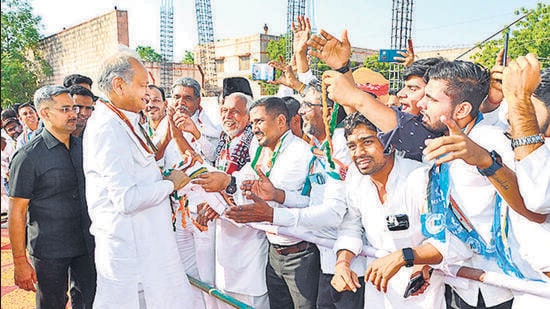
“You have never visited us after winning. You don’t even take our calls,” said an angry elderly woman at Achalpur village of Dausa district to Rajasthan women and child development minister Mamta Bhupesh, who was canvassing for votes as she walked through a newly-cemented village road.
Bhupesh is the Congress MLA from the reserved Sikrai assembly seat and has been facing protests. She claims they are “orchestrated” by the BJP, but the woman criticising her is earnest: “Hum hamesha se
“You have never visited us after winning. You don’t even take our calls,” said an angry elderly woman at Achalpur village of Dausa district to Rajasthan women and child development minister Mamta Bhupesh, who was canvassing for votes as she walked through a newly-cemented village road.
Bhupesh is the Congress MLA from the reserved Sikrai assembly seat and has been facing protests. She claims they are “orchestrated” by the BJP, but the woman criticising her is earnest: “Hum hamesha se Congress voter hain, par aapne toh jitne ka baad puchna bhi nahin (We have been Congress voters, you did not care for us after winning).” Bhupesh retreated from the woman’s small brick house which ironically sports a Congress flag. The woman later explained that her anger is only against the lawmaker and not chief minister Ashok Gehlot, whom she credited with introducing welfare schemes for the poor.
READ | Ashok Gehlot releases Rajasthan Congress manifesto, promises caste census days before assembly poll
Bhupesh is not the only Congress MLA, who is facing the ire of voters. Subhash Garg, Rajasthan’s technical education minister, contesting on a ticket from the Rashtriya Lok Dal (RLD), a Congress ally, had to encounter angry villagers in Sunhari village of Bharatpur district last week, for “lack of development” there. “This is part of elections. We have to bear it,” Garg said, as he sat in his car heading to the next village in the whirlwind tour of the constituency. More than 200km away, in western Rajasthan’s Antroli village in Laxmangarh assembly seat in Sikar district, state Congress president and former school education minister Govind Singh Dotasara stood with folded hands in front of village elders who were chastising him for not visiting them after winning. “I apologise for not being able to come.”
Meena, Mali and Muslims (3Ms)
A senior Congress functionary in Jaipur said that the party’s internal surveys highlighted anger against some of the sitting MLAs and that the response was the denial of tickets to 23 of them. “(But) Denying tickets to a large number of MLAs can prove to be counter-productive. It sends the wrong message that the ruling party has failed to deliver and therefore, has denied tickets to so many MLAs. Each MLA has some votes in their constituency and they contest as rebels, marring the chances of the party candidate to win,” the functionary added by way of explanation as to why more MLAs were not dropped.
READ | Raj polls: Gurjars of Alwar divided on supporting Congress in aftermath of Pilot-Gehlot feud
This election, the leader said, the party is heavily banking on 3Ms – Meenas, Malis (the gardner community to which Gehlot belongs) and Muslims – to counter the anti-incumbency against the MLAs. Meena and Malis each constitute about 7% of the state’s population and Muslims, 9.07%, as per 2011 national census. “They are about 23% and we hope to get most of their votes,” the leader said.
At a memorial for 22 Gujjars, who were killed in police firing while seeking OBC reservation in 2007, at Sikandra in Dausa district, Ram Avatar Saini, a Mali, vociferously counters Vidyanand Giri, a Gujjar, on the Rajasthan government’s work. “Nobody has worked like Ashok ji for Rajasthan. His schemes are being talked all over the country,” he said, as Giri tried to highlight corruption and crime as issues of concern. Gehlot himself has invoked his caste by releasing a video saying he is “proud” to be a Mali. “Like a mali (gardner) takes care of every flower in the garden, I have taken care of all 36 communities in Rajasthan,” Gehlot said in a video released on November 17 by the Congress.
READ | Rajasthan elections: Congress is trying to run each other out, says PM Modi
In Bari assembly seat in Dholpur district, a retired government employee, Hemram Meena, explained the reason why his community was backing the Congress. “The Congress gave us Scheduled Tribe (ST) reservation and the community benefited from it. We cannot forget that. This time, Gujjars are with the BJP and Meenas are backing the Congress,” he said.
In Rajasthan, Gujjars and Meenas are seen as rivals – the Gujjars have been seeking ST status like the Meenas, who do not want this to happen. Raja Ram Gujjar, a farmer at Achalpur village, said his community was unhappy with the Congress for not making Sachin Pilot the state chief minister after winning the 2018 assembly polls. “That is the biggest grouse of our community against the Congress, even though Ashok Gehlot has included us in sub-category (of OBC quote) of 5% for Most Backward Classes (MBC) carved out in 2019,” he said. The other castes in MBCs sub-quota are Banjaras, Gadia Lohars, Raikas and Gadaria. Pilot, formerly a deputy chief minister of the state before a revolt-that-wasn’t saw him lose the post, is a Gujjar.
In Laxmangarh assembly seat, an elderly Muslim man Riyaz Khan, who claimed to have voted for BJP leader Vasundhara Raje in the past, expressed his anguish with the party. “Now, they (the BJP) are spreading hatred towards us. I found Vasundhara ji sympathetic towards us but she has been sidelined in the party,” he said, with a group of Muslim men silently listening to him. “Gehlot ji has done very good work,” he added, with others nodding in conformity.
Social welfare push
Claiming that he was aware of the Congress’s caste consolidation strategy, a senior Rajasthan BJP functionary in Jaipur said the party has reached out to leaders of all communities in preparation for the polls and provided funds for renovation of their religious places. “Our workers have visited every home at least twice explaining to voters the issues of rising crime and appeasement politics,” he said. The leader said they have tried to explain to people how the “pre-poll” freebies given by Gehlot will drain the state revenues and impact infrastructure development. But the freebies have their own appeal.
A group of women workers at MGNREGA site in Kunwalsar village in Dantaramgarh assembly seat in Sikar district, said they have benefitted from the social welfare schemes of the Gehlot administration. “We got cooking gas cylinder for ₹500 and free rations,” said one of them, refusing to give her name. Another woman said her father-in-law got a by-pass surgery done under Gehlot’s free health treatment scheme called Chiranjeevi, in which medical treatment costing up to ₹25 lakh is free. In its manifesto, the Congress has promised to double the ceiling under the scheme to ₹50 lakh.
Even some BJP workers speak well of these schemes, but insist the Congress will lose because that’s the trend. “There is a change in party government every five years in Rajasthan. The trend will continue this time also,” said a BJP worker, Ram Prasad, in Laxmangarh.
One Subscription.
Get 360° coverage—from daily headlines
to 100 year archives.
Archives
HT App & Website