
 E-Paper



Rajnath Singh refers to 'removal of AFSPA' from J&K. Here's what he said
The Armed Forces Special Powers Act was imposed in July 1990 in the Kashmir Valley and in August 2000 in the Jammu region to curb insurgency.

 Prefer HTon Google


Defence minister Rajnath Singh on Saturday said all three defence services wanted the removal of Armed Forces Special Powers Act from Jammu and Kashmir soon, news agency ANI reported.
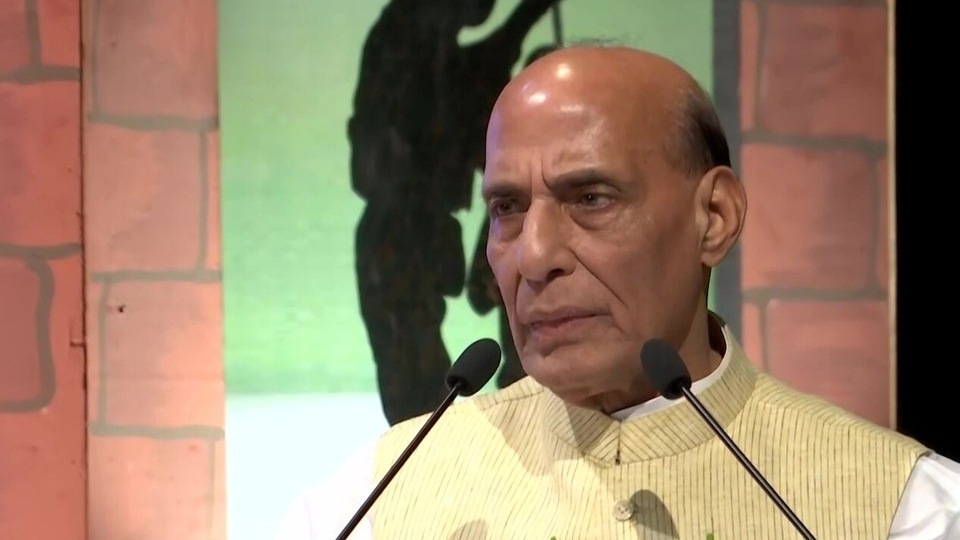
The defence minister was speaking during the felicitation of 1971 war veterans at Guwahati in Assam. This is not the first time when Rajnath Singh has spoken on the removal of the AFSPA in the Kashmir valley. During his visit to J&K as the home minister way back in 2015, Singh had said that the armed forces act can be removed with the situation is conducive.
The AFSPA was imposed in July 1990 in the Kashmir Valley and in August 2000 in the Jammu region to curb insurgency.
“AFSPA was removed from 15 police stations in Manipur and Nagaland. That in itself means a lot. This is the result of durable peace and stability in this area,” the minister added.
“It's no small thing that for the last 3-4 years, the work of removing AFSPA is being done in the northeastern states. Recently AFSPA was completely removed from 23 districts of Assam,” the minister recalled the recent developments on the AFSPA in the north eastern states.
On March 31, union home minister Amit Shah announced that the Centre had decided to reduce the disturbed areas under the ambit of AFSPA in Nagaland, Manipur and Assam after decades.
After the move, the mainstream political parties in the Kashmir Valley had raised a fresh pitch for revoking the AFSPA from J&K.
“Not a day passes when someone from the Centre or UT does not talk about the improved security situation in J&K. If that is really the case, then why aren’t areas under AFSPA also being reduced," National Conference spokesperson Tanvir Sadiq had said.
Enacted in 1958 amid the Naga insurgency, the Armed Forces Special Powers Act empowers the army, state and the central police forces to control and maintain public order in areas which are designated as ‘disturbed’.
As per Section 3 of the act, an entire state or part of the state can be designated as ‘disturbed’ by either the governor of the state, the administrator of a union territory (UT) or the Centre.
The section 4 of the act accords special powers to armed forces and authorises security personnel to open fire, arrest people without warrants, enter and search without warrant while having immunity from prosecution.


