Prime Minister Narendra Modi on Thursday called Singapore “a strong pillar of Act East Policy” as he lauded the strengthening cooperation between the two countries on artificial intelligence and semiconductors.
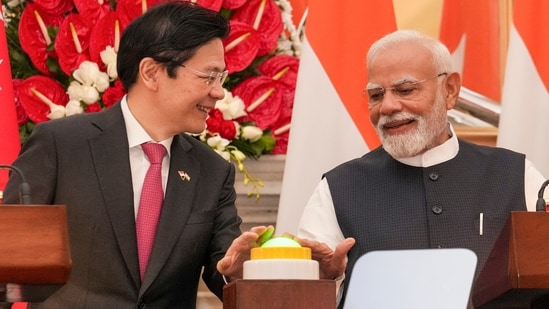
PM Modi said that the bilateral relations between the two Asian nations “go far beyond diplomacy” and thanked his Singaporean counterpart Lawrence Wong for their sympathy towards the victims of the April 22 Pahalgam terror attack.
“Singapore is a strong pillar of our Act East Policy,” PM Modi said during the joint statement. He said, “We share common concerns regarding terrorism. We believe that fighting against terrorism with unity is the duty of all humanitarian countries.”
Modi further said that tech and innovation are pillars of strong relationship between the two nations.
The Prime Minister's remark comes as India and Singapore on Thursday pledged to strengthen cooperation in artificial intelligence and semiconductors. The two nations inked new industry agreements as New Delhi accelerates trade partnerships to counter the impact of punitive US tariffs that have doubled levies on Indian imports to 50%.
The partnership holds significance at a time when Washington has imposed some of the highest tariffs on India in retaliation for its continued purchases of Russian crude oil, adding urgency for New Delhi to secure trade agreements with other partners.
{{/usCountry}}The partnership holds significance at a time when Washington has imposed some of the highest tariffs on India in retaliation for its continued purchases of Russian crude oil, adding urgency for New Delhi to secure trade agreements with other partners.
{{/usCountry}}According to a Bloomberg report, Singapore already accounts for about 10% of global chip production and 20% of semiconductor equipment output. This makes it an ideal partner for India's ambitions of rolling out its first made-in-India semiconductors by year-end.
Agreements across multiple sectors
The two nations signed pacts spanning shipping, civil aviation, and emerging technologies. Wong said cooperation would extend to state-level skill centers in areas such as aviation and semiconductors. “These efforts will generate new growth opportunities for both our countries,” he added.
Meanwhile, Modi highlighted Singapore’s role in establishing a National Centre of Excellence for Skilling in Chennai, which he said would help develop manpower for advanced manufacturing.
He added, “The Semiconductor Ecosystem Partnership agreement signed last year has also given a new direction to research and development. The enthusiastic participation of Singaporean companies in the ‘Semicon India’ conference is in itself a significant development.”
"We have decided that the Bilateral Comprehensive Economic Cooperation Agreement and our Free Trade Agreement with ASEAN will be reviewed in a time-bound manner to accelerate mutual trade," Modi said.
The Prime Minister further noted that states such as Odisha, visited earlier this year by Singapore President Tharman Shanmugaratnam, will also play a role in deepening ties. Modi added that Gujarat’s GIFT City was now helping connect stock markets in both countries, boosting financial integration.
Act East policy
Modi emphasized the broader regional vision. "Singapore is an important pillar of our Act East Policy. We will continue to work together with ASEAN to advance cooperation and joint vision of peace and stability in the Indo-Pacific region," he said.
Singapore’s ethnic Indian community has also traditionally supported bilateral ties, providing cultural and business linkages. Bilateral trade between India and Singapore stood at $34.26 billion in 2024-25, according to a government data, cited by Bloomberg.
Wong’s India visit follows that of German foreign minister Johann Wadephul, who recently expressed optimism that an EU-India free trade agreement could be finalized by autumn.