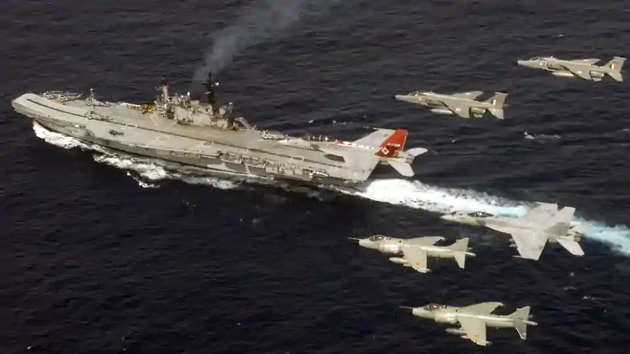
Warships of four major Indo-Pacific democracies - the United States, Japan, Australia and India - will manoeuvre together in the Malabar naval exercise off the Goa coast on Tuesday, the second round of the war games by the QUAD countries over the last month that marks the evolution of the informal ‘QUAD’ partnership into a potential strategic alliance.
India had invited Australia to this year’s war games for the first time in more than a decade, a move that has angered President Xi Jinping’s Communist Party of China government to an extent that its mouthpiece, China Daily chided the Australian government for “aggressively sending warships to China’s doorsteps” as part of Exercise Malabar. India and Australia, however, stayed firm, a sharp contrast from 2007 when several countries that had participated in the naval exercise eventually backed down in face of China’s protests.
But President Xi’s aggressive approach has united the member countries of the four-nation alliance. For years, he had been pushing Japan over his claim to the Senkaku islands, threatening Australia with a trade war and talking nuke missiles to the US navy that made its presence felt in the South China Sea. China crossed the line with New Delhi this year when PLA soldiers attempted to seize control of Indian territory in Ladakh, setting up a face-off at the border that has stretched for more than six months in Ladakh and is expected to continue into next year.
Also Watch l Malabar Exercise 2020: Navies of India, US, Japan & Australia in action
{{/usCountry}}Also Watch l Malabar Exercise 2020: Navies of India, US, Japan & Australia in action
{{/usCountry}}Beijing’s approach in Ladakh has convinced India that it needs to be prepared for similar Chinese aggression in the high seas. People familiar with the matter said the government has already asked the Indian Navy to start prepping to counter the PLA Navy and change its orientation from diplomacy to deployment. The focus should be on the navy developing the capacity to be deployed from the Gulf of Eden to the Malacca Strait, and beyond.
This year’s Malabar exercise - that mirrors the deepening strategic ties within QUAD - is one step. That is why, a national security planner said, the presence of the USS Nimitz strike group and India’s INS Vikramaditya at the exercise reflects the determination of the four countries to draw red lines for China’s People’s Liberation Army Navy.
“It is a tectonic shift in the regional power balance,” he said.
It was in this context that Australia’s Defence Minister Linda Reynolds recently described the naval manoeuvres not only as a demonstration of the strategic trust the four democracies held in each other but also “strengthened our collective ability to contribute to regional security”.
Australia’s participation in the Malabar war games is considered significant given its geopolitical role in the Indo-Pacific region. Besides, Canberra is an advanced NATO alliance nation and has a military collaboration with the US and strategic security relations with Japan.
Officials said the four-nation alliance could be expected to expand to other countries in one form or the other. For one, France is showing keen interest in QUAD’s move to secure sea lanes and freedom of navigation from the Gulf of Aden to western coast of the US.
The barrage of commentaries in the Chinese communist party’s many mouthpieces that have attacked New Delhi’s invitation to Australia reflect the unease at the joint military drills.
“Despite the drill jointly participated by India, the US, Australia and Japan, experts noted that such an ill-intentioned attempt to corner China is a hollow bluff, and China will not be disrupted by India’s irrationality or US interference,” the Global Times, a tabloid run by the communist party’s lead mouthpiece China Daily, asserted. It has also reported on the possibility of Germany’s interest in getting involved in the Indo-Pacific region.