The Rashtriya Swayamsevak Sangh (RSS) has decided to increase the percentage of women office bearers in its affiliate organisations, aiming to increase its outreach among women and changing the perception that it is entirely driven by men, people familiar with the matter said on Friday.
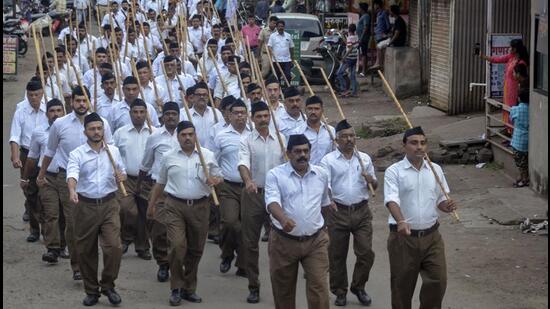
The RSS has a separate wing for women, the Rashtriya Sevika Samiti, but its affiliates that work in the sectors of labour, agriculture and economy, among others, have women in their national executive committees and as office bearers.
According to functionaries aware of the details, a decision to have more women as office bearers was taken at the Akhil Bharatiya Samanvaya Baithak (All India Coordination meeting) of the Sangh held in Raipur last month.
“The Sangh wants to encourage women to take up leadership positions and have a greater say in decision-making. As on date there are several women in the national executive of various sangathans (offshoots), but we want to increase their number,” said a functionary speaking on condition of anonymity.
The Sangh is looking at gradually increasing the percentage of women office bearers to 33-50% the functionary said.
{{/usCountry}}The Sangh is looking at gradually increasing the percentage of women office bearers to 33-50% the functionary said.
{{/usCountry}}A second functionary said, in line with the decision to have gender parity, women office bearers of some of the offshoots were given the mandate of presenting the annual reports at the Ranchi meeting.
The RSS has been criticised by its opponents for being a male-dominated outfit and for segregating activities for men and women. The attempt to redraw the organisational hierarchy with the inclusion of more women is also an attempt to alter the image of the Sangh that will mark its centenary celebrations in 2025.
Since the Sangh has drawn up an ambitious plan to have its footprint across all districts in the country by then, it wants greater participation by women for its activities.
The political arm of the Sangh, the BJP has already earmarked 33% of posts for women in the organisational hierarchy. The party’s constitution also specifies the minimum number of women that have to be included in the national office bearers’ team and at all levels in the district and state committees.
At present in affiliates such as the Bharatiya Kisan Sangh, which works in the agricultural sector, 7 of the 51 national executive committee members are women.
In the Bharatiya Mazdoor Sangh, that claims to have a membership of almost 1 million and 5000 affiliate unions; the position of president and general secretary at the state level are held by women in six states. One fourth of the 25-member national executive are women and so are 40 general secretaries in confederations that work in sectors including banking and insurance.
“Women are a significant part of the workforce and there are some unions such as those of Asha workers, Anganwadi workers and Midday meal providers that are run entirely by women. The BMS has been running special training programmes for women to encourage them to be part of the decision-making process because they tend to focus more on families and are reluctant to take on office bearer responsibilities,” said a senior BMS functionary.
In Swadeshi Jagran Manch too, there is a provision to have at least one woman as coordinator for every campaign that the offshoot on economic issues takes up.
The issue of women’s empowerment also figured prominently in RSS chief Mohan Bhagwat annual Vijaydasahmi address in Nagpur on Wednesday.
“Until women’s equal participation is ensured, the efforts aimed at the progress of the country will not be successful,” Bhagwat said adding that men and women complement each other and for society to be organised, women cannot be limited to their sphere of activity.
He said in the Indian tradition men and women were seen as complementary, but the tradition was forgotten and numerous limitations were placed on women.
“At the very outset of our national regeneration, our great leaders rejected all manner of false practices that had become the lot of women. Both extremes – placing women’s power on a divine altar and freezing it there at the one end and the other extremity of treating women as second-class citizens and restricting them to kitchen – were avoided. Rather the focus was on the means and methods required for progress, empowerment of women in all domains of society, along with their participation and equity in the decision-making process,” he said.