Satya Niketan building collapse: What we know about the property
The collapsed PG was a load-bearing structure without a reinforced cement concrete frame, with thin brick walls measuring about 4.5 inches in thickness.
On Sunday afternoon, a building that housed a PG facility collapsed in Delhi’s Satya Niketan, killing at least seven people and triggering a rescue operation involving the Municipal Corporation of Delhi (MCD), Delhi Fire Service, Delhi Police and other departments.
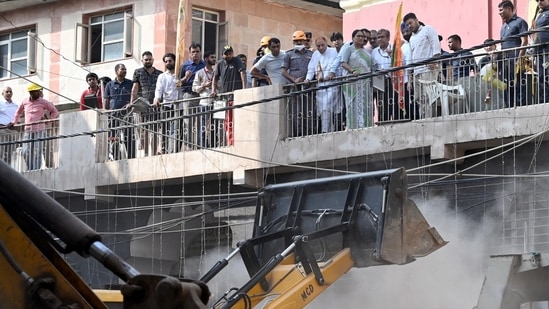
Delhi Chief Minister Rekha Gupta oversees the rescue operations ongoing at the building collapse site in Satya Niketan, in New Delhi on Monday. (ANI)
{{^htLoading}} {{/htLoading}}
The area is a densely populated resettlement colony in South Delhi, where plots are typically small, measuring around 55 square yards. A large number of properties in the area are used as paying guest accommodation, mainly catering to students. Building-related activities in the area fall under the jurisdiction of MCD. Follow live updates on Delhi building collapse here.
According to property-tax records, the collapsed structure was a basement plus four-storey building. Construction of the ground floor, first floor, second floor, and part of the third floor dates back to 1970-1980. A basement in part of the property and the remaining portion of the third floor were constructed later, in 1997-98.
What were the main factors contributing to the collapse of the Satya Niketan building?
The building collapse was potentially influenced by its age, lack of a reinforced concrete frame, and recent heavy rainfall, which may have weakened the structure. There were also unauthorized renovations being conducted at the time.
How has the Municipal Corporation of Delhi responded to the building collapse in Satya Niketan?
The Municipal Corporation of Delhi has initiated a crackdown on illegal constructions, announcing that properties with more than four floors will be sealed immediately. They have also started a magisterial inquiry and registered an FIR against the building owner.
Why is the issue of unauthorized construction a concern in Satya Niketan?
Unauthorized construction is a concern due to the area being densely populated, with properties often misused for paying guest accommodations. This can lead to safety hazards, as seen in the recent building collapse.
Powered ByAsk HT
{{^usCountry}}
The building was a load-bearing structure without a reinforced cement concrete frame, with thin brick walls measuring about 4.5 inches in thickness.
{{/usCountry}}
{{#usCountry}}
The building was a load-bearing structure without a reinforced cement concrete frame, with thin brick walls measuring about 4.5 inches in thickness.
{{/usCountry}}
The road outside the property is a commercially notified road. The ground floor was being used for shops, while the upper floors were used as paying guest (PG) accommodation. The property had been paying the applicable conversion charges annually for this use since 2007.
Property-tax records also show that the owners availed themselves of the SUNIYO scheme from 2020-21 to 2025-26.
MCD officials who reached the site found, as a preliminary assessment, that no new construction was underway at the time of the collapse. However, the owner had recently undertaken some repair and renovation work.
{{^htLoading}} {{/htLoading}}
The exact cause of the collapse has not yet been established. Officials have, however, indicated that heavy rainfall over the preceding several days may have weakened the old structure.
Rescue operations began immediately after the collapse. As of 8:30 am on Monday, debris removal and site clearance were continuing and were expected to be completed by the end of the day.
Rescue personnel conduct a rescue operation on the second day after a 50-year-old five-storey building collapsed.
Wider crackdown on unauthorised construction
{{^htLoading}} {{/htLoading}}
The collapse comes amid intensified action by MCD against unauthorised construction and misuse of premises, following recent incidents in Saket and Malviya Nagar.
Between June 1 and September 3, 2026, the civic body carried out demolition at 983 properties, sealed 464 properties, issued 1,516 show-cause notices for unauthorised construction and 708 sealing show-cause notices, and issued 726 demolition orders.
MCD has also conducted a three-month survey of residential areas to identify commercial misuse of residential properties. Around 300,000 properties across 404 colonies and 168 wards have been surveyed.
The survey has identified more than 8,000 cases of commercial activity in residential areas, with the civic body initiating action against activities considered impermissible under the Master Plan for Delhi. Around 30-40 properties have already been sealed, while action against several others is at various stages.
Shishir Gupta is Executive Editor at Hindustan Times and one of India's top journalists covering national security, strategic affairs, foreign policy and geopolitics. Over the past three decades, he has extensively reported on India's military, diplomatic and security landscape, covering every major conflict and national security challenge, from the 1999 Kargil War and the 2020 East Ladakh standoff to Operation Sindoor in 2025. He has also covered major terror attacks, including the IC-814 hijacking, the 26/11 Mumbai attacks and the 2025 Pahalgam terror strike, along with numerous Pakistan-backed terrorist incidents in the Kashmir Valley and across India. He has reported on national and state elections for more than three decades. A recognised authority on strategic affairs, Gupta has covered India's nuclear programme since the Pokhran-II (Shakti series) tests in May 1998 and has written extensively on global nuclear issues, Indian diplomacy and the country's expanding global outreach. He has also reported widely on international conflicts and terrorism, with a special focus on the Indian subcontinent. Gupta has interviewed Prime Minister Narendra Modi more than four times, including Modi's first interview with the print media after becoming Prime Minister in May 2014. His other interviews include three with the Dalai Lama, as well as conversations with Benjamin Netanyahu, Amit Shah, Yogi Adityanath, S. Jaishankar, Nirmala Sitharaman and Piyush Goyal. He is the author of Indian Mujahideen: The Enemy Within (Hachette, 2011) and Himalayan Face-off: Chinese Assertion and Indian Riposte (Hachette, 2014). He was awarded the Chevening-Wolfson Joint Scholarship at Wolfson College, University of Cambridge, UK, in 1998 and participated in the International Visitor Leadership Program (IVLP) of the US State Department in 2006. He received the Ben Gurion Prize from Israel in 2011 and the K. Subrahmanyam Prize for Strategic Studies in 2015 from the Manohar Parrikar Institute for Defence Studies and Analyses (MP-IDSA). Since 2024, he has hosted Point Blank, Hindustan Times' weekly YouTube show on global geopolitics.
Get the latest India News, breaking headlines and real-time updates from across the country. Stay informed about politics, government policies, crime, weather major national developments and Karnataka Bandh LIVE.
Home/India News/Satya Niketan building collapse: What we know about the property
{{^htLoading}}
Advertisement
{{/htLoading}}
SHARE THIS ARTICLE ON
{{#usCountry}}{{/usCountry}}
Hindustantimes wants to start sending you push notifications. Click allow to subscribe