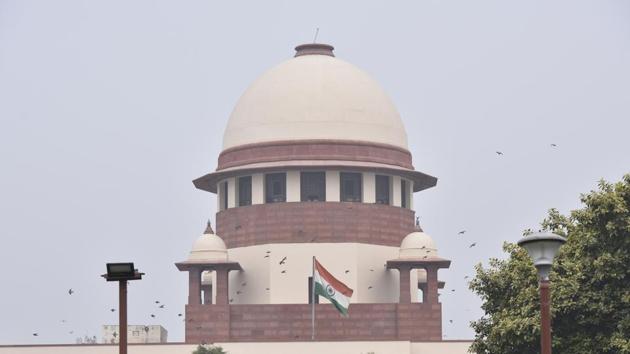
The Supreme Court on Wednesday agreed to examine two contentious laws passed by Uttar Pradesh and Uttarakhand regulating religious conversion through interfaith marriages and sought responses from the respective state governments and the Centre on whether the legislation violated constitutional rights.
But the three-judge bench, headed by Chief Justice of India (CJI) SA Bobde, refused to order a stay. Soon after the SC order, a Muslim organisation, the Jamiat Ulama-i-Hind, applied to intervene in the case and alleged that the two laws were targeting Muslim youth. This application will come up for hearing along with the two petitions after four weeks.
The bench was hearing petitions filed by advocates and a non-governmental organisation, Citizens for Justice and Peace, challenging the constitutional validity of the Uttar Pradesh Prohibition of Unlawful Religious Conversion Ordinance, 2020 and the Uttarakhand Freedom of Religion Act, 2018.
Initially, the top court hesitated to issue notice because separate petitions are pending before the Allahabad high court and Uttarakhand high court, respectively. “Only the society in Uttar Pradesh and Uttarakhand will be affected by this law. Why should the petitioners not approach the respective high courts,” observed CJI Bobde.
CJP told the court that the issue was arising in other states as well. “The state of Himachal Pradesh has re-enacted a similar law (HP Freedom of Religion Act) in 2019 after its earlier law prohibiting conversion from one faith to another was struck down by the Himachal Pradesh high court in 2012. Now the new law has roped in marriage by conversion as a ground to prosecute persons. We have multiple states,” said senior advocate CU Singh, representing the NGO.
{{/usCountry}}CJP told the court that the issue was arising in other states as well. “The state of Himachal Pradesh has re-enacted a similar law (HP Freedom of Religion Act) in 2019 after its earlier law prohibiting conversion from one faith to another was struck down by the Himachal Pradesh high court in 2012. Now the new law has roped in marriage by conversion as a ground to prosecute persons. We have multiple states,” said senior advocate CU Singh, representing the NGO.
{{/usCountry}}The other petition, filed by lawyers Vishal Thakre and Abhay Singh Yadav and researcher Pranvesh, asserted that the problem needed to be addressed by the top court and alleged the two laws violated the basic structure of the Constitution.
The bench agreed to issue notice seeking responses on whether the laws violated fundamental right to practice one’s religion, guaranteed under Article 25 of the Constitution among other rights protected under Article 14 (right to equality), 15 (right against discrimination) and 21 (right to dignity).
The petitioners also asked for a stay on the laws. But the bench, also comprising justices AS Bopanna and V Ramasubramanian, was not convinced because the respective governments had not been heard. “Can a law be stayed if prosecution is oppressive or false,” the bench asked.
The UP law was enacted on November 24 and prescribes a jail term up to 10 years and fine up to Rs 25,000 for conversion under force, fraud, allurement or marriage. The Uttarakhand law prescribes imprisonment of up to two years and a fine for anyone found guilty of conversion by misrepresentation, force, undue influence, coercion, allurement or marriage.