The Supreme Court on Friday refused to stay the survey of the Shahi Eidgah mosque abutting the Krishna Janmabhoomi temple in Mathura, observing that neither is a petition challenging the order of survey before it nor does it consider it necessary to pass a restraining order at this stage.
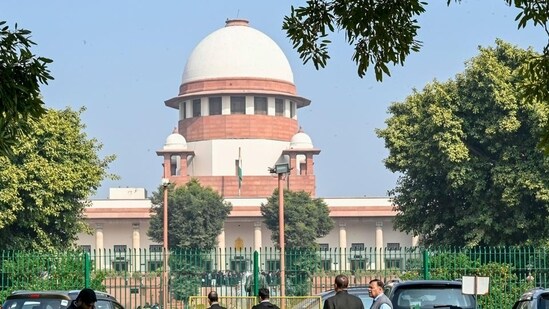
“At this stage, we won’t stay anything. If there is any adverse order, you can come back...Should we be staying a matter without the impugned order being in front of us,” a bench of justices Sanjiv Khanna and SVN Bhatti asked senior counsel Huzefa Ahmadi, who appeared for the Uttar Pradesh Sunni Waqf Board and the Eidgah management committee.
Responding, Ahmadi emphasised that the high court must be asked to stay its hands since a related matter has already been listed by the Supreme Court on January 9. “Why should the high court go ahead when the very issue of whether they can proceed with the matter is pending before this court?” asked Ahmadi.
By an order on November 10, the Supreme Court fixed January 9 for considering the objections of the Eidgah committee and UP Sunni Waqf Board to the high court order deciding to hear nearly 18 suits relating to Krishna Janmasthan-Shahi Eidgah land dispute by transferring them to itself from various civil courts in Mathura.
However, the high court on Thursday went ahead and directed the appointment of an advocate-commissioner to oversee the survey of the mosque, which Hindu petitioners say holds signs proving that it was a once a Hindu temple, opening a new chapter in the decades-old dispute that is part of a raft of cases where Hindu petitioners are pushing for legal change to gain rights over Islamic holy sites.
Read Here: Allahabad High Court allows survey at Mathura’s Eidgah mosque site
{{/usCountry}}However, the high court on Thursday went ahead and directed the appointment of an advocate-commissioner to oversee the survey of the mosque, which Hindu petitioners say holds signs proving that it was a once a Hindu temple, opening a new chapter in the decades-old dispute that is part of a raft of cases where Hindu petitioners are pushing for legal change to gain rights over Islamic holy sites.
Read Here: Allahabad High Court allows survey at Mathura’s Eidgah mosque site
{{/usCountry}}To be sure, there has been no stay order by the apex court against the proceedings before the high court.
Ahmadi, challenging the Thursday high court order, urged the Supreme bench to issue a restraining order to stop the high court from going ahead with the procedural directions regarding the survey on December 18 when the matter will be heard next.
But the top court was not in favour of this. The bench only recorded in its order that the hearing in the Supreme Court is fixed on January 9 and that in case the petitioners have any grievance against a particular order, it was open for them to file an appropriate petition.
“We are not staying anything. What we have recorded is good enough. You bring this order to the notice of the high court. That’s it. We won’t record anything more,” the bench told Ahmadi.
When Ahmadi replied that the high court has not been paying heed to the committee’s request to defer the proceeding since their petition was pending at the top court, the bench said that the committee will have to file a separate petition if they were to challenge the order of survey.
“At present, the issue here is only of the jurisdiction. The merits of the matter are not before us...You file your appeal and we will see,” it added.
During the proceedings, Ahmadi repeatedly pointed out that the committee will find it extremely difficult to secure an urgent hearing from the top court if it is aggrieved by the December 18 order of the high court since the Supreme Court break for winter vacation is from December 18 to December 31.
Read Here | ‘Robbing Muslims of dignity only goal’: Owaisi on Allahabad HC's order on Mathura mosque survey
“Mr Ahmadi, if any urgent order is required, you know the procedure,” the bench retorted.
The Supreme Court is seized of the challenge to a May 26 order of the Allahabad high court, transferring to itself all suits filed by Hindu parties claiming right over the mosque land. The mosque committee has argued that it did not have the financial wherewithal to defend the suits in the Allahabad high court which is 600km away and would prefer having it in Delhi which is only 150 km away.
The May 26 order by the high court had come on a plea by Bhagwan Shrikrishna Virajman at Katra Keshav Dev Khewat Mathura (deity) through the next friend, Ranjana Agnihotri, who is also an advocate, and seven others. “Next friend” is a legal representative of someone incapable of maintaining a suit directly. The petitioners requested that the original trial be conducted by the high court as the matter involved is of national importance.
The mosque, in its petition before the top court, questioned the maintainability of the suits after prolonged delay. It has further argued that the suit is barred by the Places of Worship (Special Provisions) Act, 1991 which protects the “character” of all places of worship existing as on August 15, 1947 (barring the Ram Janmabhoomi land at Ayodhya) and prohibits filing of any lawsuits to alter the character of any place of worship.
On July 21, the bench observed that it would be in the interest of all stakeholders if the matter is decided “at the earliest” because pendency in such “sensitive” cases create “disquiet”. Adding that it would lay down norms for hearing the clutch of suits related to the dispute, the court had directed the high court registrar to send details of all such pending cases. On the day, the Justice Kaul-led bench had also remarked that it would be more appropriate for a high court judge to apply his mind considering the complex nature of the case.
Multiple suits regarding the Krishna Janmabhoomi-Shahi Eidgah Mosque land dispute pending before various courts in Mathura have a common demand to reclaim the 13.37-acre land on which the mosque stands to be returned to the Shri Krishna Janmabhoomi Trust. The mosque abuts the temple and the suits have sought to annul a compromise entered between the mosque committee and Shri Krishna Janmasthan Seva Sangh in 1968.
On Thursday, the Allahabad high court ordered a survey by an advocate-commissioner. The survey will be conducted on the lines of a similar but controversial exercise at the Gyanvapi Masjid in Varanasi last year, when Hindu petitioners claimed that a disputed structure found in the mosque premises was a “shivling”, though Muslims said it was part of a ritual ablution fountain. The modalities of the survey will be discussed at the next hearing on December 18.
The decision comes at a time when a similar legal fight is roiling Varanasi in the Kashi Vishwanath Temple-Gyanvapi Masjid case. In both cases, Hindu groups argue that temples were demolished by Islamic rulers to build mosques, and therefore, the land should be returned to Hindus.
The Gyanvapi case has also been pending before the Supreme Court since May 2022, which has so far refused to stay the proceedings before the Varanasi district judge. In that case too, the civil court first appointed an advocate commissioner and later in July this year, a full scientific survey of the mosque premises by the Archaeological Survey of India (ASI) was ordered to determine if the 17th century structure was built upon a pre-existing temple. The Supreme Court, at different points in time, refused to stay these orders when appealed against by the Gyanvapi mosque committee.
A batch of petitions — some seeking to scrap the 1991 Act and some others asking for tight enforcement of the same law — are pending before the top court since March 2021. The court has asked for the government’s stance in the case; last September, Chief Justice of India Dhananjaya Y Chandrachud, while hearing the Gyanvapi case, observed that the religious character of a site also had to be led by evidence.