
 E-Paper



Allahabad High Court allows survey at Mathura’s Eidgah mosque site
The suit claimed that Shahi Eidgah Masjid was constructed on a part of 13.37-acre plot belonging to the Sri Krishna Janmabhoomi Trust

 Prefer HTon Google


The Allahabad high court on Thursday ordered a survey of the Shahi Eidgah mosque abutting the Krishna Janmabhoomi temple in Mathura, opening a new chapter in the decades-old dispute that is part of a raft of cases where Hindu petitioners are pushing for legal change to gain rights over Islamic holy sites.
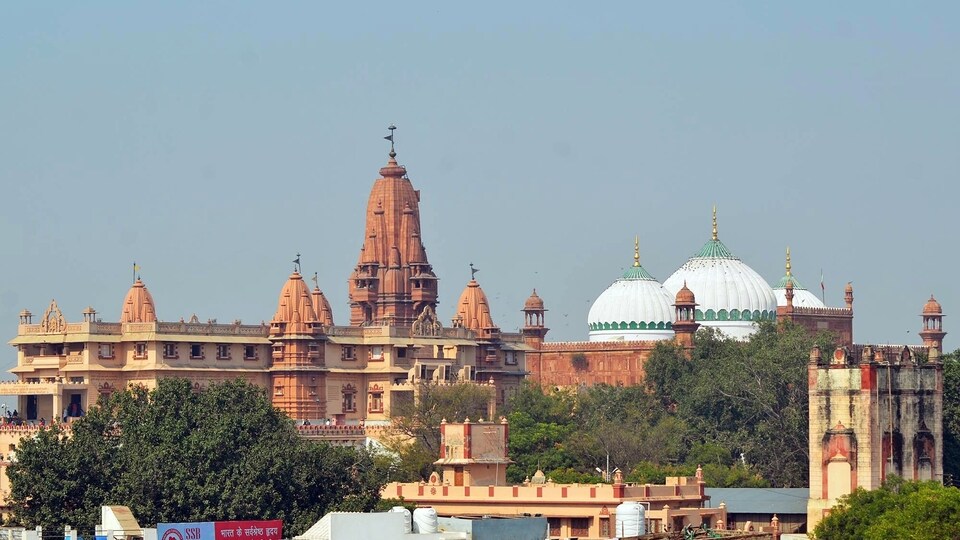
The high court agreed to appoint an advocate-commissioner to oversee the survey of the mosque, which Hindu petitioners say holds signs proving that it was a once a Hindu temple.
The survey will be conducted on the lines of a similar but controversial exercise at the Gyanvapi Masjid in Varanasi last year, when Hindu petitioners claimed that a disputed structure found in the mosque premises was a “shivling”, though Muslims said it was part of a ritual ablution fountain.
Justice Mayank Kumar Jain said the modalities of the survey will be discussed at the next hearing on December 18. “As far as the modalities and composition of the commission is concerned, this court feels it proper to hear the learned counsel of all the parties for such purposes,” justice Jain said.
The petition was filed by a Lucknow-based lawyer and six others as the “next friend” of Bhagwan Sri Krishna Virajman, the presiding deity at the Mathura temple. Next friend is a legal representative of someone incapable of maintaining a suit directly.
Read Here | ‘Robbing Muslims of dignity only goal’: Owaisi on Allahabad HC's order on Mathura mosque survey
The suit claimed that Shahi Eidgah Masjid was constructed on a part of 13.37-acre plot belonging to the Sri Krishna Janmabhoomi Trust. They demanded the mosque be removed and the land returned to the trust because it is the mythical birthplace of Lord Krishna.
The applicants had sought a commission comprising three advocates with a direction to submit the report.
“It is also to be kept in mind that by appointment of a panel of three advocates as commission, either party would not suffer any harm or injury. The commissioner report does not affect the merits of the case,” the judge said.
The decision comes at a time when a similar legal fight is roiling Varanasi in the Kashi Vishwanath Temple-Gyanvapi Masjid case. In both cases, Hindu groups argue that temples were demolished by Islamic rulers to build mosques, and therefore, the land should be returned to Hindus.
Muslim groups reject the contention, saying that the 1991 Places of Worship Act — which locks the religious character of holy sites as they existed on the day of independence, with the exception of the Ram Janmabhoomi-Babri Masjid site — bars any such petitions. Some of these pleas are also pending before the Supreme Court.
The developments in Mathura are also part of what experts have called the new temple movements, where Hindu groups and individuals have approached lower courts to file petitions seeking legal solutions to decades-old religious disputes, instead of using street mobilisations to push for change.
Read Here: Krishna Janmabhoomi petitioners welcome Gyanvapi survey order
The order was described as a huge boost by the Hindu petitioners, who argued that a lotus-shaped pillar — a characteristic they claimed was intrinsic to Hindu temples — existed on the mosque premises, and an image of Hindu deity “Sheshnag” was also present. It was submitted that at the base of the pillar of the mosque, Hindu religious symbols and engravings were visible.
“There exists a lotus-shaped pillar which is a characteristic of Hindu temples and an image of ‘Sheshnaag’, one of the Hindu deities who protected Lord Krishna on the night of his birth, is also present there,” advocate Jain said
The Muslim petitioners – led by the UP Sunni Central Waqf Board – said that the suit was not maintainable and argued that it should be heard first, because the issue of maintainability mist be decided first before going into merit of the case. As per defendants, the suit is barred by Places of Worship Act 1991.
But the court rejected the argument.
“This court is of the view that no straitjacket formula can otherwise be adopted or followed for prioritising which application should be decided first in order. It depends upon the fact and the circumstances of the individual case,” the judge said.
Read Here | Sri Krishna Janmabhoomi-Shahi Eidgah dispute: Will lay down norms for hearing of suits, says SC
“Moreover, there is no provision in the code, which directs the court to give priority to one application over the other. The proceedings for appointment of commission and rejection of plaint are entirely independent proceedings.”
Secretary of the Shahi Idgah Masjid Management Committee and advocate Tanveer Ahmed told PTI that the committee will challenge the high court’s decision in the apex court.
“Whatever legal process is possible will be taken against this decision,” he said.
A key aspect of the case is also the 1991 law, which barred any court from entertaining a matter that sought to alter the religious nature of a place but has proved ineffective in preventing a spate of litigation in recent months.
A batch of petitions — some seeking to scrap the 1991 Act and some others asking for tight enforcement of the same law — are pending before the top court since March 2021. The court has asked for the government’s stance in the case; last September, Chief Justice of India Dhananjaya Y Chandrachud, while hearing the Gyanvapi case, observed that the religious character of a site also had to be led by evidence.
In its 30-page order, the high court said that during the execution of the survey, the sanctity of the campus should be strictly maintained and no harm or injury should be caused to the structure.
Sri Krishna Janmabhoomi case: Appointment of advocate commissioner sought in Mathura for survey of Shahi Eidgah mosque
“The commission is duty bound to submit its fair and impartial report on the basis of the actual status of the property. The commission may also submit its discovery as to the existence of particular signs at the property as referred by the plaintiffs. The representative of the plaintiffs as well as the defendant may accompany the panel of the advocates to be appointed as commission to assist them so that the correct position of the spot may be noted and be brought before the court,” the judge added.
The religious dispute simmered in the first half of the 20th century but a 1968 agreement calmed tempers. On October 12, 1968, an agreement was signed between the Shri Krishna Janmasthan Seva Sansthan and the Shahi Masjid Idgah Trust, which divided the land between the two parties and relinquished any claims of the Hindu parties to the land of the mosque.
But the Hindu side’s petition challenged the settlement and alleged that the pact had no legal validity because the Sri Krishna Janmabhoomi Trust, which the petitioners claimed had the ownership and title of the land, was not party to the settlement.
“The Shri Krishna Janmasthan Seva Sansthan is working against the interest of the deity and devotees and fraudulently entered into a compromise with the Committee of Management of Trust Masjid Idgah (Trust) in 1968 conceding a considerable portion of property belonging to the deity and the trust,” the suit alleged.
The management committee of Shahi Eidgah mosque objected to the petition, arguing that as the compromise agreement was finalised in 1968 and the final judgement and decree the case was passed in 1974, the Hindu petition was time barred.
Since September 2020, when the first plea was filed, eight more petitions have cropped up, including one to bar Muslims from offering namaz in the mosque, another asking for a survey of the mosque premises and a third asking for security officers to be appointed to oversee the complex.
In May this year, the high court transferred to itself all the suits pending before the Mathura court in connection with the case.


