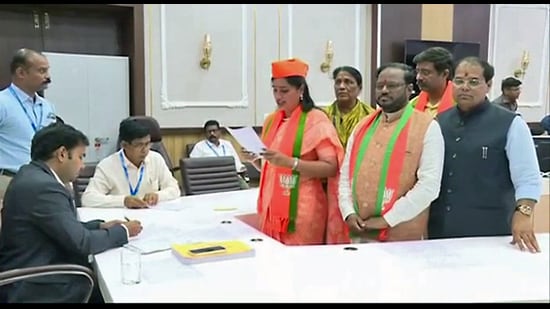
The Supreme Court on Thursday restored the caste certificate of independent member of Parliament Navneet Rana from Maharashtra’s Amravati seat ahead of the Lok Sabha elections, in which she is fighting on a ticket from the Bharatiya Janata Party (BJP) from the same reserved constituency.
The top court allowed the appeal filed by Rana challenging an order of the Bombay high court on June 8, 2021 that set aside the caste certificate issued to her in 2017 by a caste scrutiny committee on a finding that it was obtained fraudulently. The high court order was stayed by the top court, allowing Rana to continue as an MP.
Taking exception to the high court conducting a “roving inquiry” into the caste credentials of the petitioner as “unwarranted” and “uncalled-for”, a bench of justices JK Maheshwari and Sanjay Karol found no irregularity in the decision of the scrutiny committee in declaring her to be of “Mochi” caste on November 3, 2017.
“We are of the considered opinion that high court inadvertently undertook an erroneous exercise of appreciating evidence in exercise of its jurisdiction under Article 226 of Constitution of India and swayed itself into a roving inquiry which was not expected as per settled legal position,” the bench said.
After the SC judgment, Rana was quoted by news agency ANI as saying, “Those who raised questions on my birth got an answer today. I thank the Supreme Court. The truth always wins. This is a victory of those who walk on the path shown by Baba Saheb Ambedkar and Chhatrapati Shivaji Maharaj.”
{{/usCountry}}After the SC judgment, Rana was quoted by news agency ANI as saying, “Those who raised questions on my birth got an answer today. I thank the Supreme Court. The truth always wins. This is a victory of those who walk on the path shown by Baba Saheb Ambedkar and Chhatrapati Shivaji Maharaj.”
{{/usCountry}}Both Rana and her MLA husband Ravi Rana had stirred controversy in April 2022 after they announced their plan to recite Hanuman Chalisa in front of the residence of then chief minister Uddhav Thackeray. The move was meant to be a taunt aimed at the Shiv Sena leader for diluting his commitment to Hindutva and reminding him of his party’s Hindutva’s roots. The Rana couple withdrew their plan but the announcement led to gathering of Shiv Sainiks outside their residence at Khar. They were even arrested for promoting enmity and sedition punishable under sections 153A and 124A of the Indian Penal Code (IPC). The trial in the case is still pending.
The court also examined the entire decision-making process of the scrutiny committee and found that all documents were duly considered, there was application of mind by giving reasons, and the petitioner along with the complainants, including former MP Anandra Vithoba Adsul were heard. In addition, a team of the committee visited Punjab (as Rana claimed her grandfather migrated from that place to Maharashtra) for home enquiry and the vigilance report satisfied genuineness of documents submitted by her.
Considering the peculiar facts and circumstances, the top court said: “If the findings of the scrutiny committee are based on the materials specified (under State Rules) followed by its subjective satisfaction, then exercise of jurisdiction under writ of certiorari (under Article 226 of Constitution) to quash the order of validation of caste claim by scrutiny committee is unwarranted and uncalled-for.”
The 44-page judgment, authored by justice Maheshwari, added: “The instant appeals stand allowed and the impugned judgment passed by the high court stands set aside. The validation order dated November 3, 2017 passed by the scrutiny committee is restored.”
Rana questioned the high court order on the grounds that it could not have conducted a fact-finding enquiry. She further submitted that in any event, if any shortcoming was found in the order of the scrutiny committee, the matter should have been sent back for the committee’s consideration.
The top court said, “Assessment of adequacy or sufficiency of evidence in the case at hand, fell within the exclusive jurisdiction of the Scrutiny Committee and reagitation of challenge on such grounds ought not to have been entertained by high court in a routine manner.”
It further stated, “From the perspective of settled principles of law for invocation of jurisdiction under Article 226 of Constitution of India (high court’s power to issue writs), particularly in relation of writ of certiorari, it leaves us with no scope of doubt that the high court has clearly overstepped by re-appreciating the evidence in absence of any allegation of malafide or perversity.
The committee had relied on her grandfather’s school-leaving certificate and a rent agreement of 1932 mentioning his caste to be Sikh Mochi. Senior advocate Kapil Sibal, along with advocate Shadan Farasat, had appeared for complainant Adsul and argued that the Sikh Mochi was not recognised as scheduled caste in Maharashtra.
The court said, “In the instant case, the appellant did not claim ‘Mochi’ caste based on her caste in some other state. Rather, the claim was for ‘Mochi’ based on genealogical caste history of appellant’s forefathers.”
The high court order had earlier said that Rana obtained the caste certificate fraudulently and then had it validated fraudulently from Caste Scrutiny Committee by producing fabricated documents. It had even put a fine of ₹2 lakh, and directed her to surrender the caste certificate in six weeks.