The Supreme Court on Monday demanded accountability from Delhi authorities over widespread violations of the firecracker ban during Diwali, asking the police and the administration to share details on how they will prevent a repeat next year and whether the Capital needs a permanent prohibition of such celebration.
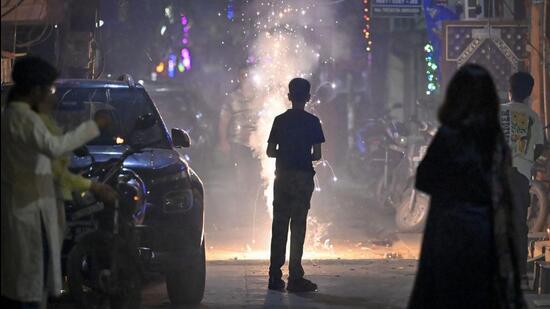
The intervention follows Diwali celebrations on Thursday when Delhi residents largely ignored restrictions, sending air pollution levels to a level that was 16 times the safe limit.
“There are widespread reports in newspapers that the ban on firecrackers was not implemented. We want Delhi government and Delhi police to immediately respond. We want them to create a mechanism so that this doesn’t happen next year,” said the bench, giving the government and the law enforcement agency a week to respond.
“The ban on firecrackers is one of the important measures to reduce pollution. If that is not implemented, it will create a chaotic situation,” observed the bench headed by Justice Abhay S Oka. The court directed both the Delhi government and Police Commissioner to place on record not only the ban orders for this year but also detail specific enforcement actions taken during the festival.
The bench also asked Punjab and Haryana to explain an uptick in farm fire counts on Diwali night. After shortly lived respite immediately after Diwali, the national capital’s sank into the deep red this week, with smoke from farm fires making up close to 20% of the ultrafine pollutants on Sunday. On Monday, the air quality at 16 of the 39 stations were recorded in the “severe” pollution zone.
{{/usCountry}}The bench also asked Punjab and Haryana to explain an uptick in farm fire counts on Diwali night. After shortly lived respite immediately after Diwali, the national capital’s sank into the deep red this week, with smoke from farm fires making up close to 20% of the ultrafine pollutants on Sunday. On Monday, the air quality at 16 of the 39 stations were recorded in the “severe” pollution zone.
{{/usCountry}}Data presented by the Centre for Science and Environment to the court showed midnight PM2.5 concentrations were higher than the previous two years, with a 34% increase from 2022 levels. At locations like Anand Vihar, levels touched 992 µg/m³ -- more than 16 times the national safety standard of 60 µg/m³. Other areas like Nehru Nagar and ITO recorded dangerous peaks of 898 µg/m³ and 944.5 µg/m³ respectively, HT reported on Friday citing its own analysis of realtime monitoring stations.
What came to the city’s rescue was a bit of meteorological luck: unseasonably warm weather conditions and steady winds of 10-15 km/hour helped disperse pollutants the following day, although the initial impact of widespread firecracker use was evident in the sharp spike in pollution levels between 9pm and 2am on Diwali night.
The bench, which included justice Augustine George Masih, issued stern directions: “We call upon the Commissioner of Delhi police to indicate steps taken by police to enforce complete ban on use of firecrackers. The affidavit must state what effective steps they propose to take next year to ensure the ban on firecrackers is fully implemented. This will include necessity of public awareness to be undertaken in this regard.”
The court asked authorities to file responses within a week on whether a perpetual ban on firecrackers could help Delhi “breathe free.” The current ban, imposed by the Supreme Court in October 2018, restricts both sale and production of firecrackers in the National Capital Region (NCR). This order was originally passed in response to a petition filed by three minors led by Arjun Gopal, seeking restrictions due to rising pollution levels.
The neighbouring NCR cities of Gurugram, Noida and Ghaziabad appeared to have had protocols contrary to this legal position – with all three cities conditionally allowing use of so-called green firecrackers for limited hours.
Neither were the conditions adhered to in these cities nor is there adequate control, enforcement or testing of products that have been spotted as simply being labelled “green”.
Senior advocate Aparajita Singh, serving as amicus curiae, emphasised the gravity of the situation, stating, “There is no doubt the order of the court has been violated with impunity.” The problem was exacerbated by a dramatic increase in farm fires, with Punjab and Haryana reporting 605 incidents on Diwali (October 31) compared to 160 the previous day, creating what Singh termed “a deadly combination” with firecracker pollution.
“There cannot be any dispute that the ban on crackers was hardly implemented,” the court observed. “The effect of non-implementation of ban is apparent from CSE report that pollution level in Delhi on Diwali was much higher than 2022 and 2023. The same report also indicates that farm fires were on increase during Diwali.”
The bench also highlighted concerning changes in enforcement mechanisms. Recent amendments under the Jan Vishwas (Amendment of Provisions) Act, 2023, replaced imprisonment terms of up to five years with fines ranging from ₹10,000 to ₹15 lakh for environmental violations. However, even these penalties remain unenforceable as implementing rules haven’t been framed, rendering the Commission for Air Quality Management (CAQM) regulations “toothless.”
Additional Solicitor General Archana Pathak Dave assured the court that rules under both the CAQM Act and Environmental Protection Act would be gazetted this week, stating that while translation work was pending, the vetting process was complete.
In related developments, the court expressed dissatisfaction with the implementation of its earlier order on colour-coded vehicle stickers, noting that only 50% of vehicles in NCR had complied with the December 2023 directive. “Our order has not been implemented at all,” the bench remarked, giving NCR states and Delhi one month to report compliance.
The court also addressed the Centre’s response to Punjab’s request for additional funds to help small farmers manage stubble without burning. “Once we direct you to consider their demand, you have to decide it by either accepting or rejecting it. Instead, you exercise advisory jurisdiction by telling them to follow Haryana. It can’t be kept pending in this manner,” the court said, giving a two-week deadline for a decision.
The matter will be heard again on November 14, when the court will review comprehensive measures to address Delhi’s persistent air quality challenges. These typically worsen during winter due to a combination of factors including road dust, construction activities, vehicle emissions, and biomass burning, all exacerbated by winter weather patterns and increased farm fires in neighbouring states.
The case originated from a petition by environmental activist MC Mehta seeking action against various pollution sources in Delhi, highlighting the ongoing struggle to balance traditional celebrations with environmental concerns in one of the world’s most polluted capitals.