The Supreme Court on Thursday agreed to urgently hear a fresh challenge to the ongoing special intensive revision (SIR) of Delhi’s electoral rolls, with the petition questioning why the names of nearly 33.13 lakh voters issued notices for “logical discrepancies” or lack of mapping have not been made public and what precisely triggered such notices.
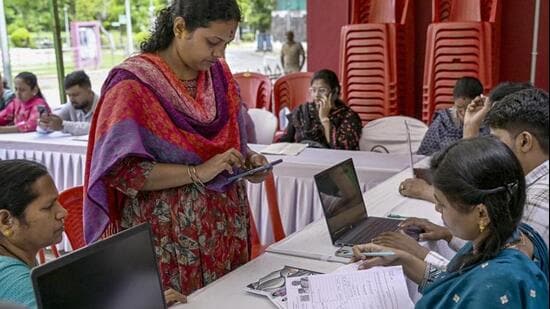
Chief Justice of India Surya Kant said that the plea would be taken up on September 22 along with other SIR matters already pending before the court, while giving the fresh petition precedence.
The petition, filed by activists Anjali Bhardwaj and Amrita Johri through advocate Prashant Bhushan, comes against the backdrop of the exclusion of 47.56 lakh names from Delhi’s draft electoral roll published on August 31.
Mentioning the matter before the CJI, Bhushan said the 47 lakh-plus exclusions were only one part of the exercise, with the authorities now proposing to issue notices to another 33 lakh voters whose names figure in the draft roll but have been flagged under the categories of “no papping” and “logical discrepancies”.
“They have not disclosed the names of people which is why some people get notices and some do not. They have also not disclosed the basis of putting them under the logical discrepancy category,” Bhushan contended.
The CJI said the matter would be heard on Tuesday, September 22, when other SIR-related cases are also listed, adding that the fresh plea “will certainly have precedence” as it was a new matter.
{{/usCountry}}The CJI said the matter would be heard on Tuesday, September 22, when other SIR-related cases are also listed, adding that the fresh plea “will certainly have precedence” as it was a new matter.
{{/usCountry}}Also Read: Nearly 1.1mn Delhi voters’ names deleted from January 2025 to June 2026, before SIR began
The challenge under Article 32 alleges that the failure of the Election Commission of India and the Delhi chief electoral officer to publish the names of voters issued notices, along with the specific reasons for doing so, violates their constitutional and fundamental rights.
The petition, filed through advocates Neha Rathi and Kajal Giri, has sought publication of a consolidated and searchable list of all electors issued notices, along with their addresses and the precise reason or category for each notice. They have also sought disclosure of the criteria, definitions, algorithmic parameters and operational guidelines used to classify voters under “Logical Discrepancies”.
The issue assumes significance because the draft roll published on August 31 contains 97,53,577 electors -- around 32.8% fewer than the 1,45,10,299 names on Delhi’s rolls before the revision. Of the 47,56,722 names excluded from the draft roll, the Delhi CEO’s data shows that 57.2% were men and 42.8% women. The exclusions were made under the ASDD category -- absent, shifted, dead or duplicate.
Separate from these exclusions are 33,12,919 voters whose names have remained in the draft roll but have been flagged for possible discrepancies. Of these, 13,79,785 have been categorised as having “no mapping” with the 2002 electoral roll, while 19,33,134 have been classified under “logical discrepancies”.
The petitioners’ grievance is not merely about the existence of these categories but about the information supplied to voters facing scrutiny. They contend that the term “logical discrepancies” has not been defined and that neither the original SIR order nor the Election Commission’s subsequent communications placed on the Delhi CEO’s website specify the criteria or parameters by which a voter is placed in this category.
According to the petition, notices issued to voters contain only generic descriptions of the alleged discrepancy without identifying the underlying material that would enable the elector to understand and answer it.
Also Read:Automated system flags ‘unusual’ age gaps, family links in Delhi SIR
The plea has also relied on the Election Commission’s May 14, 2026 communication, which, according to the petition, requires electoral registration officers to issue notices where an elector could not be linked to the previous roll or where the linkage was found to contain discrepancies. The communication also requires publication of the names of persons issued such notices on the chief electoral officer’s website and display at relevant local offices, the petition states.
The Delhi exercise has already generated a sizeable second layer of scrutiny beyond the names excluded from the draft roll. Officials have said the “logical discrepancies” broadly concern inconsistencies in electoral database records, including different spellings of names in the current and 2002 rolls, while other flagged anomalies include unusually small or large age gaps between an elector and a parent and unusually short gaps between the birth dates of siblings.
The authorities have maintained that being issued a notice does not, by itself, mean that a voter has been declared ineligible. Such voters would get an opportunity to respond and furnish documents or clarifications before the final roll is prepared.
The claims and objections process is scheduled to continue until September 30, with disposal of notices expected by October 29 and publication of the final electoral roll on November 4.