Himanshu Bhardwaj has been keenly waiting for schools to reopen — no, he is not a vociferous votary of in-class teaching, but a manufacturer and trader of school uniforms with massive unsold stocks. “I never thought schools could ever be closed for so long and we could ever go out of business,” says Bhardwaj, sitting inside his shop in east Delhi’s Gandhi Nagar.
The shop’s shelves are laden with coats, shirts, trousers of various sizes; fabrics of different patterns and colours: plain, twill, matty, oxford checks, stripes in blue, white, grey, green and other school colours. Behind him on the wall are showcased ties and belts with logos of schools as far away as Assam and West Bengal. “The lockdown happened just when we were readying to dispatch uniform to them. About 40,000 summer uniforms are lying unsold in my godown,” says Bhardwaj.
Bhardwaj is not the only one.
The continued closure of schools due to the Coronavirus crisis -- -- since March 19 in Delhi -- has caused unprecedented disruption in the country’s school uniform market, which, according to the industry estimates is worth 18,000 crores. India has one of the largest K-12 (kindergarten to class 12) school systems in the world with more than 1.4 million schools with 250+ million students, according to a FICCI report.
The Delhi-NCR and Solapur in Maharashtra are the two biggest school uniform manufacturing hubs in the country. The Gandhi Nagar market in the capital alone boasts of about 100 school uniform traders and manufacturers, who attract vendors and retailers from all across the country, providing direct and indirect employment to about 1 lakh people in the city—cutters, tailors, stitchers, embroiders—between August and March.
{{/usCountry}}The Delhi-NCR and Solapur in Maharashtra are the two biggest school uniform manufacturing hubs in the country. The Gandhi Nagar market in the capital alone boasts of about 100 school uniform traders and manufacturers, who attract vendors and retailers from all across the country, providing direct and indirect employment to about 1 lakh people in the city—cutters, tailors, stitchers, embroiders—between August and March.
{{/usCountry}}In fact, August is the time when manufacturing for winter uniforms starts, but this year most tailoring units, which are concentrated in east Delhi, Noida and Sahibabad are shuttered.
“We start production in January for the new session in April, and in August for the winter session. But with large stocks of summer uniforms having remained unsold, we are facing a cash crunch, and there is no way we can start production till the existing stocks are cleared and we receive payment. If the schools open in December, there would not be any winter uniforms in the market,” says Anil Jain, sitting inside his shops in Gandhi Nagar. There are hundreds of packed white lab suits lying behind him.
Jain is one of the few traders who have chosen to keep his shop open in the market where a majority of shops of uniform traders and makers have remained closed since March. Jain says he keeps the shop open more to kill boredom at home than in hope of getting any business. None of the 150 schools he has made pre-ordered uniform with their emblems has picked up their stocks, he says. “Many of them, especially budget schools, have stopped taking my calls.”
The average cost of uniform in wholesale is anything between Rs 300 to Rs 900, depending on the fabric, size and the customisation required. “Till January, I had so many vendors and school representatives exploring new uniform designs flipping through these catalogues,” says Bhardwaj, pulling out a catalogue of a well-known uniform fabric brand. One of his shelves is packed with catalogues with fabric samples and uniform designs.
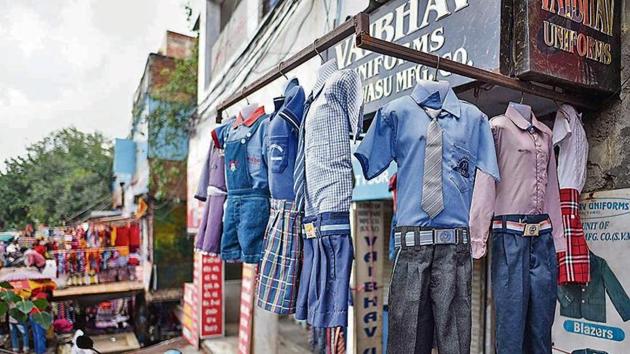
Gandhi Nagar has over 150 tailoring units, each employing 20 to 70 people, with different specialties. “There were people who would cut, stitch, and there were those who specialised in embroidering logos on the uniform,” says Vivek Sharma. Hanging from the front of his shop are children’s mannequins in school uniforms made by his firm.
“I employed about 50 people, who are now jobless,” says Jain, who has been in the school uniform business for the past 25 years
Delhi also has many traders and manufacturers who supply belts and ties to uniform manufacturers all over the country. Sadar Bazar-based Sushil Verma, for example, has been making ties and belts for uniform manufacturers in Solapur and Delhi. He is sitting on a large stock of undelivered belt and ties. “I am afraid a lot of them are white belts with school logos printed on them. They might fade,” says Verma. “I used to make about 2,500 belts a day, but have not produced a single belt or tie since March.”
If Gandhi Nagar has manufacturers and traders, Katra Choban in Chandni Chowk is the hub of uniform fabric dealers —and they say their business is facing a crisis like never before.
“Our sales are down by 90%. Most uniform manufacturers have withheld our payment because they have not been able to get payment from school vendors. We have unsold stocks worth lakhs, and have not placed any new order with fabric manufacturing firms,” says Sanjeev Malhotra, partner, Prakash Lal Rakesh Kumar, one of Delhi’s better- known and oldest uniform fabric dealers. His customers include uniform vendors of some of Delhi’s biggest and oldest schools.
Most dealers procure fabric from mills in Bhilwara in Rajasthan and Bhiwandi near Mumbai, home to some of India’s biggest textile mills.
“School uniform fabric accounts for most of our output; our production for school uniform fabric is down by 80%. But we have seen a slight increase in demand from the health sector,” says Kishore Kothari, director, Valji Uniform, a Mumbai-based firm, which is one of India’s largest uniform fabric manufacturers. “But the industry will see a quick recovery as soon as schools reopen.”
Bharat Arora, general secretary, Action Committee of Unaided Recognised Private Schools, an association of private schools in Delhi, says there is no requirement of uniform as long as schools are closed. “Children are free to wear the dress of their choice as they take online classes at home. Even otherwise, while some schools appoint vendors for uniforms for the convenience of parents, the latter have always been free to buy it from wherever they want,” says Arora. “The schools decide what their uniform should be, but not where should the parents buy them.”
Aparajitha Gautam, president of Delhi Parents Association, said some schools had initially asked parents to make their children wear uniforms while attending online classes. “We protested and asked the parents not to follow such directions as they are already facing financial stress in the current situation. There is no point buying a new uniform when the schools are closed,” she said.
The North Delhi Municipal Corporation, like other two corporations in the city, gives Rs 1,100 per student to parents to buy school uniforms for their children. Nearly 2.75 lakh students are enrolled at 714 primary schools run by the civic body. The corporation, which spends around Rs 30 crore on school uniforms, has released the funds to parents to buy uniforms. “Every year, this fund is released in April but due to lockdown this year, it was given in July and August first week. Though schools are yet to open, we have released the money so that the parents can buy uniforms as soon as the schools reopen,” says Ira Singhal, deputy commissioner of the North Delhi Corporation.
Back in Gandhi Nagar, traders are not too optimistic about the reopening of schools. If Bhardwaj has started stocking women’s wear such as salwar suits, kurtis – not the right garments, he admits, for a firm called NHPS School Uniform; Sharma has started dealing in pyjamas and T-shirts. “I have never sold anything other than school uniforms, but we need to look beyond uniform to survive at least till the time schools reopen, ” says Sharma.