External affairs minister S Jaishankar on Saturday slammed Pakistan Prime Minister Shehbaz Sharif for “misrepresenting facts” at the United Nations General Assembly, calling Islamabad a “serial practitioner of terrorism.”
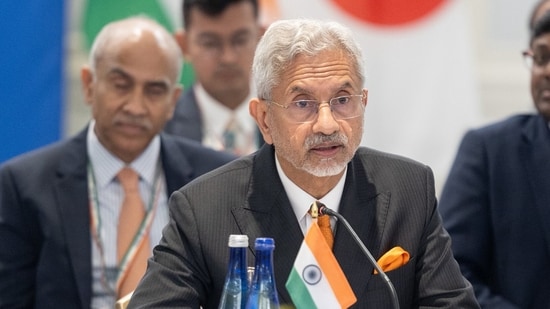
Without naming him, the external affairs minister said Sharif had invoked arguments to “normalise terrorism” and “claim immunity” from its consequences, while asserting India's right to self-defence.
Sharif, during his address, spoke about the four-day military confrontation between India and Pakistan in May 2025, claiming that Islamabad exercised its “inherent right of self-defence” under Article 51 of the United Nations Charter during the confrontation, and praising Pakistan's armed forces for their response.
Also Read | 'Pakistan's duplicity will neither benefit it nor the world': India slams Shehbaz Sharif's UN speech
Responding to this, Jaishankar said, “Yesterday, a serial practitioner of terrorism misrepresented facts before this assembly. Arguments were invoked to normalise terrorism and claim immunity from its consequences. That will not stand. Our right to defend ourselves will be exercised.”
"Friendship and goodwill cannot coexist with terrorism. It is for the perpetrator of terrorism to mend his ways," the external affairs minister added.
{{/usCountry}}"Friendship and goodwill cannot coexist with terrorism. It is for the perpetrator of terrorism to mend his ways," the external affairs minister added.
{{/usCountry}}Also Read | 'Countries far from conflicts being penalised': Jaishankar invokes PM Modi's remark at UNGA
Following the Pahalgam terror attack in April, 2025, which led to the deaths of 26 civilians, India launched Operation Sindoor on May 7 last year, wherein it struck terror bases located in Pakistan and Pakistan-occupied Kashmir. The military escalation ended with a ceasefire which took effect on May 10.
Deep Dive
What was the outcome of Operation Sindoor launched by India?
Why did Shehbaz Sharif claim Pakistan exercised its right of self-defense?
How did India respond to Sharif's claims at the UNGA?
In his address, the Pakistan PM had also credited United States President Donald Trump, claiming his “timely intervention” had come at a decisive moment.
“His timely intervention came at a decisive juncture when two nuclear-armed neighbors stood at the brink of an all-out war. And, who knows, Mr. President, the extent of devastation that could have taken place had President Trump not stepped in at this critical moment with clarity of thought and action. Mr President, we must therefore ensure that South Asia never reaches that precipice ever again,” Sharif said.
To be sure, New Delhi has consistently maintained that the May 2025 ceasefire between India and Pakistan was reached through direct communication between the two sides, with no role played by any third party.
India exercised Right of Reply after Pakistan PM's address
After Sharif's remarks at the UN, India exercised its Right of Reply, describing Pakistan as a “puppet regime”.
First Secretary in India's Permanent Mission to the UN Petal Gahlot strongly rejected Pakistan's remarks on India and Jammu and Kashmir, while also taking aim at Islamabad's record on terrorism, democratic rights and treatment of minorities.
“At the heart of the issue is the long-standing practice of cross-border terrorism by Pakistan. We demonstrated last year that terrorists will have nowhere to run and nowhere to hide. Our right to defend ourselves against terrorism will be exercised and continued. Terrorism by Pakistan will have consequences,” Gahlot said.
"We are confident that this Assembly will recognise Pakistan and its policies for what they really are, not what its representative mendaciously projects it to be. Reiterating falsehoods year after year does not make them true. Pakistan's terrorism, deceit and duplicity will neither benefit it nor the world," Petal Gahlot told the Assembly.