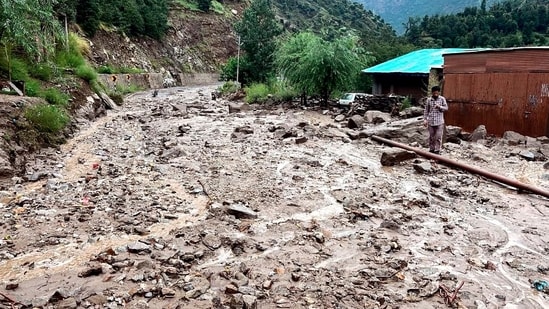
A week after cloudburst hit Chisoti in Jammu and Kashmir, the recovery of almost as many severed limbs as intact bodies have left villagers and doctors at the Atholi sub-district hospital shaken.
Dr Rakesh Kotwal, posted at the Atholi sub-district hospital, said that the final toll could be much higher. (X/ @SSPKishtwar)
{{^htLoading}} {{/htLoading}}
The hospital is located about 30 km from the affected area.
Earlier this week on Monday, an intact body and a severed leg were recovered during rescue operations, Times of India reported. A day later on Tuesday, four more bodies and two severed feet were recovered, taking the death toll in the disaster to 68.
Kishtwar district commissioner Pankaj Sharma said that the bodies and limbs recovered had been sent to GMC Kishtwar for DNA profiling, adding that DNA samples of kins had been collected and were being matched with the bodies recoevered from the debris.
Sharma said that while there was no clear picture of those missing initially, in the days after the floods, the kin of the missing pilgrims had come forward and shared information with the command and control centre set up by the administration.
{{^htLoading}} {{/htLoading}}
{{^usCountry}}
“Initially, 137 people were reported missing, out of whom 62 were rescued alive,” Sharma said.
{{/usCountry}}
{{#usCountry}}
“Initially, 137 people were reported missing, out of whom 62 were rescued alive,” Sharma said.
{{/usCountry}}
However, Dr Rakesh Kotwal, posted at the Atholi sub-district hospital, said that the final toll could be much higher. “The way things are, the toll will not stop here,” Times of India quoted Kotwal as saying.
Flash floods, triggered by a cloudburst, hit Jammu and Kashmir's Kishtwar on August 14. A large group of pilgrims were gathered at the Chisoti village, which is a key stop on the pilgrimage to the Hindu shrine Machail Mata Mandir, and were collecting food from a langar (community kitchen) when the floods washed them away.
The floods also flattened a makeshift market, damaged 16 houses and government buildings, three temples, a 30-metre-long bridge and four water mills, PTI reported.
{{^htLoading}} {{/htLoading}}
The rescue efforts are underway, with personnel from the National Disaster Response Force (NDRF), State Disaster Response Force (SDRF), CISF, Border Roads Organisation (BRO), civil administration, army and police engaged, along with local volunteers.
Follow the latest breaking news, major developments and agenda-setting stories from India and around the world with the newsdesk at Hindustan Times. Operating round the clock, the desk brings together experienced editors, reporters and correspondents to deliver fast, accurate and contextual reporting across subjects that influence public policy, governance, business, society and international affairs. The HT News Desk covers politics, elections, government policies, the economy, business and markets, science and technology, the environment, law and order, infrastructure, education, climate issues and geopolitics, while closely tracking developments across states, institutions and global capitals. The team also leads coverage of major breaking news events, policy announcements, court proceedings, natural disasters, public emergencies and significant international developments. Reports published by the newsdesk are based on information gathered from reporters on the ground, official statements, government agencies, court records, regulatory filings, recognised institutions and other authoritative sources. Stories undergo editorial scrutiny and verification processes to ensure accuracy, fairness and relevance, and are updated as events evolve and additional information becomes available. Whether covering a key political decision in New Delhi, an economic policy shift affecting millions, a landmark court ruling or a major global event, the HT News Desk aims to provide readers with reliable, fact-based journalism that delivers not only the latest developments but also the context and analysis needed to understand their wider implications.
Get Latest News, breaking headlines, and top India News, and today real-time updates from across the nation. Stay informed on politics, government policies, crime, Today Weather, and major developments on Hindustan Times
Get Latest News, breaking headlines, and top India News, and today real-time updates from across the nation. Stay informed on politics, government policies, crime, Today Weather, and major developments on Hindustan Times
Home/India News/Severed limbs leave Kishtwar’s Chisoti shaken as several remain missing a week after cloudburst
{{^htLoading}}
Advertisement
{{/htLoading}}
SHARE THIS ARTICLE ON
{{#usCountry}}{{/usCountry}}
Notifications
Get breaking alerts directly from the newsroom
Notifications are on!You'll be notified when news breaks