The Supreme Court on Friday granted bail to former Delhi deputy chief minister Manish Sisodia in the Delhi excise policy cases probed by the Central Bureau of Investigation (CBI) and the Enforcement Directorate (ED) holding that his long incarceration of 17 months coupled with his continued detention in a case where there is no hope of trial ending anytime soon impinge on his fundamental right to liberty and speedy trial under Article 21 of Constitution of India.
The court also criticised the Delhi high court and lower courts for “playing safe” and not following the tenet of bail being the norm and jail, the exception.
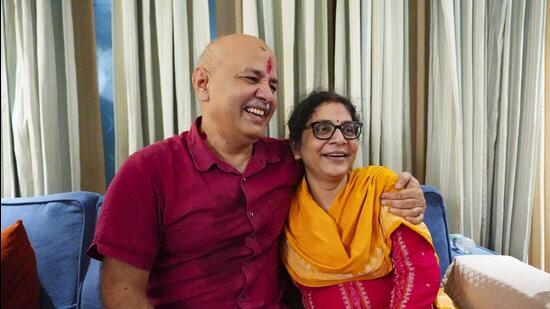
Sisodia walked out of the Tihar Jail on Friday evening where Aam Aadmi Party (AAP) leaders and supporters had gathered to greet him.
A senior AAP leader said Sisodia, who held several important portfolios such as finance, education and PWD, will be re-inducted into the cabinet. “CM Arvind Kejriwal is still in jail. As of now there is no clarity on whether the induction will take place before he [Kejriwal] gets bail or after he gets bail,” the leader said on condition of anonymity.
The Bharatiya Janata Party, meanwhile, hit out at the AAP, saying that Sisodia has only been given bail, but was yet to be cleared of the charges against him.
Video: AAP's Atishi breaks down as Manish Sisodia gets bail after 17 months
{{/usCountry}}Video: AAP's Atishi breaks down as Manish Sisodia gets bail after 17 months
{{/usCountry}}Setting aside the May 21 order of the Delhi high court which denied him bail, a bench headed by justice BR Gavai noted a disturbing trend among high courts and trial courts to “play safe” in matters of bail as the principle “bail is rule and jail is exception” is hardly being followed.
“In a matter pertaining to the life and liberty of a citizen which is one of the most sacrosanct rights guaranteed by the Constitution of India, a citizen cannot be made to run from pillar to post,” said the bench, also comprising justice KV Viswanathan, and said that sending Sisodia back to the trial court to seek bail would be “travesty of justice”.
“Relegating the appellant to again approach the trial court and thereafter the high court and only thereafter this court, in our view, would be making him play a game of ‘snakes and ladder’. The trial court and the HC have already taken a view and in our view relegating the appellant again to the trial court and the High Court would be an empty formality,” the order said.
The bench said that delay in holding trial despite Sisodia being in jail for 17 months was a factor that ought to have been considered by the lower courts : “In our view, keeping the appellant behind the bars for an unlimited period of time in the hope of speedy completion of trial would deprive his fundamental right to liberty under Article 21 of the Constitution.”
With over 493 witnesses listed by both ED and CBI and around 69,000 documents to be examined during trial, the bench said, “ there is not even the remotest possibility of the trial being concluded in the near future”.
Read Here: Manish Sisodia granted bail on these 4 conditions in Delhi excise policy case
The court directed Sisodia to furnish bail bonds of ₹10 lakh with two sureties with an added condition to surrender his passport and appear twice a week (Monday and Thursday) before the investigating officer during the period of bail. In granting relief, the court ruled out the possibility that Sisodia was a flight risk noting his deep roots in society and ruled out any possibility of tampering evidence as most of the evidence was in documentary form and already been seized.
Sisodia’s release is likely to energise his Aam Aadmi Party ahead of elections later this year in Haryana. Elections in Delhi are due in early 2025. Delhi chief minister Arvind Kejriwal continues to be in jail in connection with the same case.
Senior advocate Abhishek Manu Singhvi, appearing for Sisodia, complimented the bench. “This was a very prompt judgment,” he said, pointing to the fact that the order came just three days after orders were reserved on Tuesday. The bench replied: “In matters of liberty, every day counts.”
The judgment echoed this sentiment, quoting previous judgments which held the right to speedy trial and the right to liberty sacrosanct .
“From our experience, we can say that it appears that the trial courts and the High Courts attempted to play safe in matters of grant of bail,” said justice Gavai, authoring the 38-page judgment. The order further said, “It is high time that the trial courts and the high courts should recognize the principle that bail is rule and jail is exception.”
Read Here: Ruling on Sisodia calls for judicial reforms in bail process
To be sure, this was the third bail plea moved by Sisodia before the top court. Dismissing his first bail plea on October 30, 2023, the top court said it was conscious about his right to speedy trial and left a window open that in the event the trial not being concluded in six to eight months, or moving slowly, he would have the right to revive his bail plea in three months.
This set the stage for his second plea , which was taken up by the top court on June 4 when ED informed the court that its final charge sheet would be filed before July 3.
The third bail plea was filed on July 6. In his arguments, additional solicitor general (ASG) SV Raju, appearing for ED, cited the June 4 order to suggest that any fresh plea for bail should be moved before the trial court.
The bench turned down the ED suggestion and said, “It will be a travesty of justice to construe that the carefully couched order preserving the right of the appellant to revive his prayer for grant of special leave against the high court order, to mean that he should be relegated all the way down to the trial court. The memorable adage, that procedure is a hand maiden and not a mistress of justice rings loudly in our ears.”
ED had denied there was delay on its part alleging that the accused kept filing applications for inspecting “un-relied documents” for three months. The top court replied by saying that considering the “huge magnitude” of the case involving 69,000 documents, it cannot be said that accused is not entitled to a reasonable time for inspection of documents.
Further, on going through the record, the bench found that Sisodia had filed 13 applications in the CBI case and 14 in the ED matter, with all being allowed and none being found frivolous by the trial court. It said, “In that view of the matter, we find that the finding of the trial judge that it is the appellant (Sisodia) who is responsible for delaying the trial is not supported by the record.”
ASG Raju submitted that for granting bail under Section 45 of the prevention of money laundering act (PMLA), a conclusion must be drawn that no prima facie case is made out against the accused.
The court cited its past decisions that held right to bail in cases of delay coupled with incarceration for a long period to be read into Section 45 of PMLA. The judgment further pointed out a line of decisions that had held Article 21 to apply irrespective of the nature of crime. “As observed time and again, the prolonged incarceration before being pronounced guilty of an offence should not be permitted to become punishment without trial,” the bench said.
After the judgment was pronounced, Raju insisted on a condition to restrain Sisodia from visiting the secretariat or the Chief Minister’s office. He reminded the bench that a similar condition was imposed while granting bail to Delhi chief minister Arvind Kejriwal. However, the bench refused to pass such an order and said it will be open for the federal agency to seek cancellation of bail for violation of any bail conditions.
The order said, “The appellant is directed to be released on bail in connection with ED Case and FIR registered against the appellant by the CBI on furnishing bail bonds for a sum of ₹10 lakh with two sureties of the like amount.” He was further directed not to try to influence the witnesses or tamper with the evidence.
Sisodia was arrested in February 2023 for his alleged role in the conspiracy to introduce the now-scrapped excise policy to benefit private retailers by increasing commission rates from 5% to 12%. He has denied all charges.