One more cheetah, a female named Dhatri, died at the Kuno National Park in Madhya Pradesh on Wednesday, making it the sixth adult and ninth overall to die since March, an official from the state forest department said.
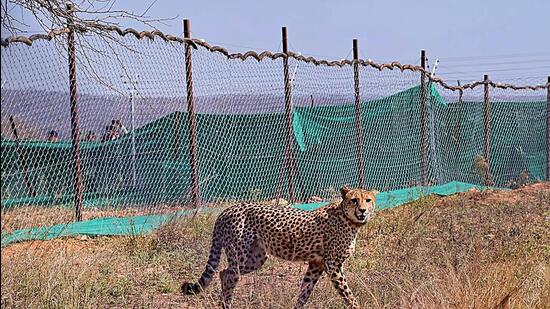
Initial investigation suggested the cause of cheetah death could be septicaemia (blood poisoning caused by bacteria) following infection around its neck possibly caused by use of radio collar in wet and humid weather in Kuno, the official said, requesting anonymity. “The exact cause of the death will be ascertained after the post-mortem [examination] report comes,” the official added.
So far, six adult cheetahs have died in Kuno since translocation of 20 big cats in two batches from Namibia and South Africa in September last year and February 2023, respectively. Besides, three of the four cubs born in India have also died.
Madhya Pradesh forest department officials said they were unable to trace two female cheetahs, Dhatri and Nirva, who were among the 10 released in wild since March, as their radio collars stopped working. The officials were trying to bring them back to the six square km enclosure for medical check-up following death of two cheetahs, Tejas and Suraj, last month. The hunt is on to trace Nirva, an official said.
“All the (remaining) 14 cheetahs — seven males, six females and one female cub — kept in bomas in Kuno National Park are healthy and their health is being regularly monitored by the team comprising of Kuno wildlife veterinarians and the Namibian expert,” Madhya Pradesh chief wildlife warden, Aseem Shrivastava, said in a statement.
{{/usCountry}}“All the (remaining) 14 cheetahs — seven males, six females and one female cub — kept in bomas in Kuno National Park are healthy and their health is being regularly monitored by the team comprising of Kuno wildlife veterinarians and the Namibian expert,” Madhya Pradesh chief wildlife warden, Aseem Shrivastava, said in a statement.
{{/usCountry}}“On Wednesday morning, one of the female cheetahs Dhatri ( old name:Tiblisi) was found dead. To determine the cause of the death, a post-mortem is being conducted,” Shrivastava added.
Eight cheetahs were brought to Kuno from Namibia on September 17 last year, after a decades-long effort to restore a species that was declared extinct from the country in 1952. Another 12 cheetahs were translocated from South Africa on February 18 this year. Of the 20 cheetahs, 10 were released into the wild, of whom four have died so far. The remaining, mostly captive bred, were kept in the six square km enclosure, and two of them have died. Of the four cubs born in India to a Namibian cheetah, three have died. At present, Kuno has 15 cheetahs, including a cub.
The fresh death has come days before the Supreme Court is expected to hear the case related to the Cheetah Project. The apex court on July 20 said the death of eight cheetahs (till then) in the Kuno National Park in less than a year did not present a “good picture”, and asked the Union government to explore the possibility of shifting the animals to different sanctuaries.
Experts from South Africa and Namibia have also written to the top court that they were ignored and Kuno National Park shared very little information with them. “It was only after we raised alarm over the deaths that we were called to cheetah steering committee,” said South African cheetah expert Adrian Tordiffe.
The experts have told the cheetah steering committee that since all cheetahs, except one female, are in the enclosure, it would be a better option to keep them there for monitoring of their health. “We selected very wild cheetahs from South Africa with the thinking that they would be more likely to avoid human settlements in India,” Tordiffe said. “Perhaps that was a mistake and more habituated tame cheetahs might still be fine.”
Arjun Gopalaswamy, founder and chief scientist of Carnassials Global, a Bengaluru-based ecological firm, said the project is back to where it had started with all except one cheetah back in the enclosure. “It seems the action plan overlooked key research on cheetah behaviour and ecology, making the strategy inherently prone to high mortalities,” he added.
The cheetah steering committee, headed by Rajesh Gopal, former member secretary of National Tiger Conservation Authority (NTCA) and Shrivastava, has thus far not responded to any of the issues raised by experts.