
 E-Paper



Chemistry Nobel| Solids full of holes: Crux of a Nobel find
Researchers have used metal-organic frameworks to harvest water from desert air, but that is by no means their only use.

 Prefer HTon Google


It is like piecing together a Lego structure, but with molecular components. Metal-organic frameworks, or MOFs, the subject of the research behind this year’s Nobel Prize for Chemistry, are a class of materials built with clusters of metal ions, connected through organic linkers — and with vast, useful spaces in between.
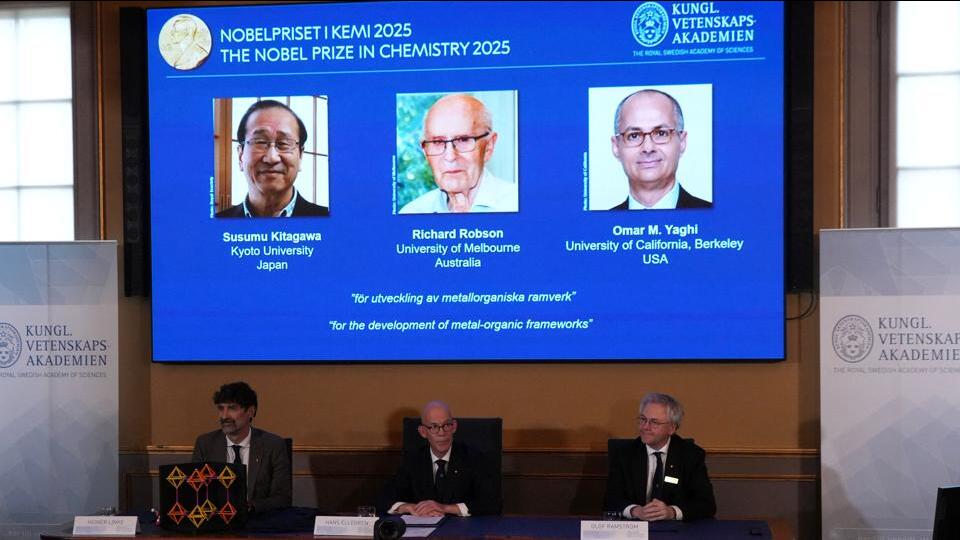
A real-estate agent, for example, may describe one kind of MOF as “an attractive and very spacious studio apartment, specifically designed for your life as a water molecule”, the Royal Swedish Academy of Sciences suggested on Wednesday while awarding the Chemistry Nobel to Richard Robson (currently with the University of Melbourne), Susumu Kitagawa (Kyoto University) and Omar M Yaghi (University of Berkeley). Working separately, the three laid the foundations for this form of molecular architecture between the 1980s and the 2000s.
Researchers have used MOFs to harvest water from desert air, but that is by no means their only use. Laboratories around the world have used MOFs for extracting pollutants from water, capturing carbon dioxide, storing hydrogen, and catalysing reactions.
Early work
The idea struck Robson in the 1970s while building molecular models for his students, with wooden balls serving as atoms bonded together. What would happen, he wondered, if he linked together different types of molecules rather than atoms? It took him over a decade before he came up with his first such structure, inspired by the structure of a diamond, but in place of carbon atoms he used copper ions connected with an organic group (nitrile), a regular crystalline structure with a vast number of cavities.
In 1989, Robson suggested this could offer a new way to construct materials, which could be given unprecedented properties. His own molecular constructions, however, tended to fall apart.
Eight years later, Kitagawa independently presented an MOF intersected by open channels, which could be filled with different gases. The material could release these gases without affecting its stable structure. In 1998, he proposed that such frameworks can be created from many types of molecules. Along with other researchers, Kitagawa started developing flexible MOFs.
Kitagawa was the first to show structural flexibility and dynamism in an MOF, said Professor Tapas Maji of the Jawaharlal Nehru Centre for Advanced Scientific Research, Bengaluru, a specialist in advanced materials who did his postdoctoral research in Kitagawa’s laboratory during 2002-2005, and co-authored several papers with him.
“These structures can be adaptable and flexible or breathe in response to external stimuli. The expanding or contracting, opening or closing of pores under different stimuli can lead to very specific applications like selective adsorption and separation of particular gas molecules or industrially important chemicals. This flexibility is critical to the design of MOF materials for real-world applications, particularly in energy, environment and sustainability,” Maji told HT.
Size of a field
Separately, Yaghi was building his own MOFs. One of his constructions, based on cobalt, could host guest molecules in its spaces and then be heated to 350°C without collapsing. It was Yaghi who coined the name “metal–organic framework” in an article in Nature.
A big milestone came in 1999 with Yaghi presenting a material called MOF-5, which has become a classic in the field. Just a couple of grams of MOF-5 holds an area as large as a football pitch. That might sound counterintuitive, but Professor Rahul Banerjee of the chemical sciences department at the Indian Institute of Science Education and Research (IISER), Kolkata, explained with an analogy of his own. Banerjee worked with Yaghi during his postdoctoral research at University of California Los Angeles in 2006-08.
“When you carefully tie bamboo sticks together, you can build a Durga Puja pandal, a wedding canopy, a stage for a political gathering, or even a shelter during the rains. By connecting simple pieces with purpose, you create a large, open, functional structure,” Banerjee told HT.
“At the molecular level, chemists like Yaghi take simple molecular ‘sticks’, metal ions, and organic linkers and stitch them together to create vast, ordered frameworks full of nanoscopic rooms and passages. These internal surfaces can host or absorb guest molecules, such as gases or small chemicals. So even though a few grams of MOF-5 might look like a fine powder, inside it is an intricately connected city of invisible rooms. If we could unfold all those internal walls, the total area would cover a football field,” he said. MOFs are sometimes called molecular “sponges”, he said.
What the future holds
Since Yaghi’s work, researchers have developed newer and newer MOFs with various purposes. Yaghi’s own group has harvested water from the desert air of Arizona.
Banerjee said the unprecedented porosity offered by MOFs and their tunable chemistry make them ideal candidates for tackling several global challenges, including clean energy storage and separation by trapping and releasing gases such hydrogen, methane, or carbon dioxide, water harvesting, and catalysis.
“MOFs exemplify how atomic-level design can translate into large-scale impact — bridging fundamental chemistry and societal applications,” he said. “Professor Yaghi’s Nobel recognition is a celebration of the idea that chemistry can be reticular, predictive, and beautifully modular.”


