The passage of the Citizenship Amendment Act or CAA last month triggered protests in Assam amid fears that the law would encourage a fresh inflow of immigrants into the region. Songs and poems have been an important part of the demonstrations, marches, hunger strikes and torch rallies that have marked the continuing protests against the law in the state.
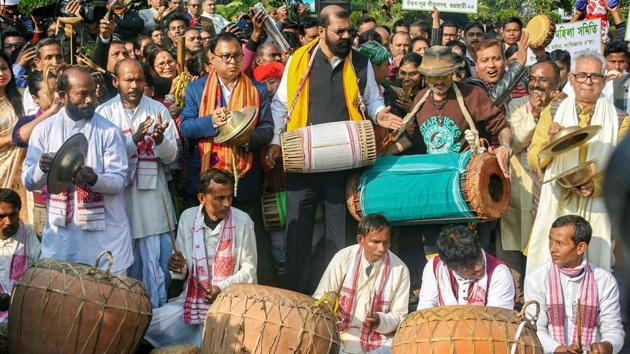
Slogans like ‘joi Aai Asom (glory to Mother Assam) and ‘aah oi aah, ulai aah (come out, come out all)’, which galvanised masses during the 1979-1985 agitation for the expulsion of undocumented immigrants, and poems of Assam’s cultural icons Bhupen Hazarika, Jyoti Prasad Agarwala, and Bishnu Rabha are keeping the protesters enthused.
New songs and poems have also been written urging Assamese to protest against the legislation, which seeks to fast-track citizenship for non-Muslims, who have entered India from Afghanistan, Pakistan, and Bangladesh before 2015.
Opponents of the CAA in Assam insist it violates a 1985 accord, which was signed following the agitation to detect and deport undocumented immigrants irrespective of their faith with March 24, 1971, as the cut-off date for their detection. A process in line with the accord was carried out in Assam and led to the exclusion of around 2 million people from the National Register of Citizens in the state last year. In Assam and the rest of the Northeast, protesters are seeking a repeal of the legislation and for keeping out all foreigners.
Padma Shri winner Eli Ahmed, 85, who wrote poems opposing undocumented immigrants during the agitation, said when something moves creative people, it leads them to express it in their own way. He added there has been a “creative outburst” in Assam as the Centre has imposed the CAA despite protests.
{{/usCountry}}Padma Shri winner Eli Ahmed, 85, who wrote poems opposing undocumented immigrants during the agitation, said when something moves creative people, it leads them to express it in their own way. He added there has been a “creative outburst” in Assam as the Centre has imposed the CAA despite protests.
{{/usCountry}}Ahmed wrote a letter to Prime Minister Narendra Modi in 2018 urging him not to enact the legislation.
Organisations like the All Assam Students Union and Asom Jatiyatabadi Yuva Chatra Parishad are spearheading the anti-CAA protests, which have seen also active participation of singers, actors, and writers.
Songs are being sung and poems recited at the protests and also widely circulated on social media.
“When we see what is happening in Assam due to an influx of illegal immigrants, we feel the need to highlight it and oppose it. People of Assam do not want the CAA and that is why I have written songs against it,” said singer- composer Bipin Chawdang.
Chawdang’s songs like ‘nagorikotwo songsudhoni bidheyok khon nelage (we do not want the CAA)’ and ‘jatir maatir gaan (song of my people and land)’ are a rage among anti-CAA protesters. He has been touring the state to perform at protest venues.
Another singer-composer, Manas Robin, said during the agitation, whenever Hazarika’s song ‘aah aah ulai aah, sojag jonota (come out, come out, alert masses) was played, it inspired people to take to the streets. “It seems we have been able to do something similar this time too.”
Robin’s song ‘badane anile maan’ compares the move to provide citizenship to foreigners under the CAA to the 19th-century invasions of Assam by the Burmese with the help of Badan Chandra Barphukan, a leading chief who betrayed the Ahom kingdom of Assam’s Brahmaputra Valley. It has featured at most protest demonstrations.
An anti-CAA poem titled ‘aah oi aah, ulai aah (come out, come out all)’ by Pranab Kumar Barman exhorting the people to come out to save their land and language is also being widely recited and circulated.
“Assamese are very creative people and many events in our history have found mention in songs, poems... This was seen during the Assam agitation and we are witnessing it again,” said Banani Chakravarty, an Assamese professor at the Gauhati University. “Most songs and poems opposing the CAA, which have been composed in recent weeks... are spontaneous creations. I feel songs have a more powerful impact and help in connecting the common masses better than speeches.”