In about two years from now, the Chenab river in Jammu and Kashmir will be spanned by the world’s highest railway bridge that is expected to be 35 metres taller than the Eiffel Tower.
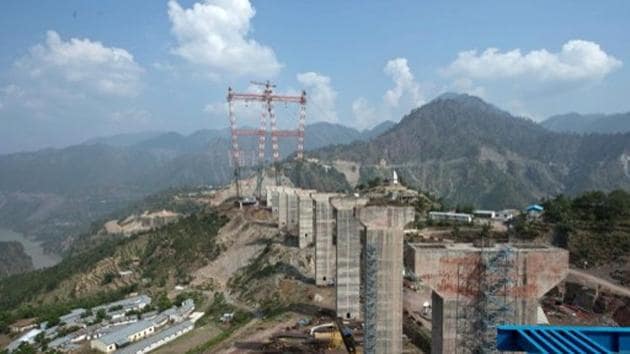
The massive arch-shaped structure, being constructed at a cost of around Rs 1,100 crore in the hostile terrain, will use over 24,000 tonnes of steel and will rise 359m above the river bed.
Designed to withstand wind speeds of up to 260km per hour, the 1.3km long “engineering marvel” will connect Bakkal (Katra) and Kauri (Srinagar).
The bridge forms a crucial link in the 111-km stretch between Katra and Banihal, which is part of the Udhampur- Srinagar-Baramulla rail link project.
“The construction of the bridge is the most challenging part of the Kashmir rail link project and once completed, it will be an engineering marvel,” said a senior railway ministry official involved with the project.
{{/usCountry}}“The construction of the bridge is the most challenging part of the Kashmir rail link project and once completed, it will be an engineering marvel,” said a senior railway ministry official involved with the project.
{{/usCountry}}Slated to be completed by 2019, it is expected to become a tourist attraction in the region. There will also be a ropeway in the bridge for inspection purposes.
Once completed, it will surpass the record of the Beipan river Shuibai railway bridge (275 m) in China.
Steel was the material of choice to construct the humongous structure as it is more economical and able to resist temperatures of -20 degrees Celsius and wind speeds of above 250 kmph.
The Railways will also install sensors on the bridge to check the wind velocity. As soon as the wind speed exceeds 90 kmph, the signal on the track will turn red, preventing train movement.
In order to enhance safety and security, the bridge will be made of 63mm thick special blast-proof steel as the Jammu and Kashmir region is prone to frequent terror attacks.
The concrete pillars of the bridge will be designed to withstand explosions and painted with a special corrosion- resistant paint, which lasts for 15 years.
According to the plan, a ring of aerial security will be provided to safeguard the bridge. An online monitoring and warning system will be installed on the bridge to protect the passengers and train in critical conditions. Footpaths and cycle trails will be built adjacent to it.
It is expected to contribute to the economic development of the state and help in improving accessibility.