E-Paper



States urge Centre to amend, clarify grassland ecosystems under afforestation law
States urge Centre to recognise grasslands under forest law, flag role in biodiversity, climate resilience and livelihoods at NBWL meeting

 Prefer HTon Google


Several states with significant grassland cover have called for amendments to India’s forest conservation law to recognise grassland restoration under compensatory afforestation — a legal mechanism currently designed for tree-planting that can, perversely, damage the very grassland ecosystems it might be deployed to protect.
The demand was made at the 90th Meeting of the Standing Committee of the National Board for Wildlife (SC-NBWL) on March 21, 2025, by Karnataka, Rajasthan, Gujarat, Madhya Pradesh and Jammu and Kashmir, according to documents seen by HT.
The states said suitable amendments or clarifications under the Van (Sanrakshan Evam Samvardhan) Adhiniyam, 1980 were needed to bring grassland restoration within the compensatory afforestation framework, while balancing conservation priorities with grazing requirements and the livelihood needs of communities dependent on these lands. They cited the conservation needs of species including the Great Indian Bustard, the Lesser Florican and the Indian Rhinoceros as part of their case.
A senior environment ministry official cautioned that the recommendation must be read carefully. “The recommendation by these states is in the context of plantations. Compensatory afforestation plantations may alter the ecological characteristics of grasslands. So, they should be taken up cautiously. The SC NBWL has also agreed on that,” the official said, adding that grasslands within recorded forest areas are already protected under existing law.
The meeting also heard a detailed presentation from the Centre of Excellence on Sustainable Land Management (CoE-SLM) under the Indian Council of Forestry Research and Education (ICFRE), commissioned at the 89th meeting of the SC-NBWL.
Officials told the committee that grassland extent in India is consistently under-reported because large areas are misclassified in government records as wasteland or scrubland, and that estimates vary significantly across different land-use classification systems. A vegetation-type and dominant-species based approach to mapping was recommended.
Drylands — of which grasslands and rangelands are a significant component — cover approximately 228 million hectares, or about 69% of India’s land area. CoE-SLM officials said the climate-relevant ecosystem service value of these landscapes is high, with a carbon sequestration potential of 2.3 to 7.3 billion tonnes of CO2 equivalent per year.
In other words, the landscapes being lost to misclassification and plantation encroachment are among the most carbon-dense in the country.
Nearly a third of terrestrial carbon is held in these ecosystems, with roughly 90% stored below ground. Restored grassland in Banni alone, officials said, can sequester about 525 tCO2 eq per hectare.
India’s nationally determined contributions under the Paris Agreement target carbon sinks of 2.5-3 billion tonnes of CO₂ equivalent by 2030, rising to 3.5-4 billion tonnes by 2035.
The committee decided that CoE-SLM will submit a detailed project report for an Atlas of Grasslands of India, covering status and associated biodiversity, and seek funding under the Compensatory Afforestation Fund.
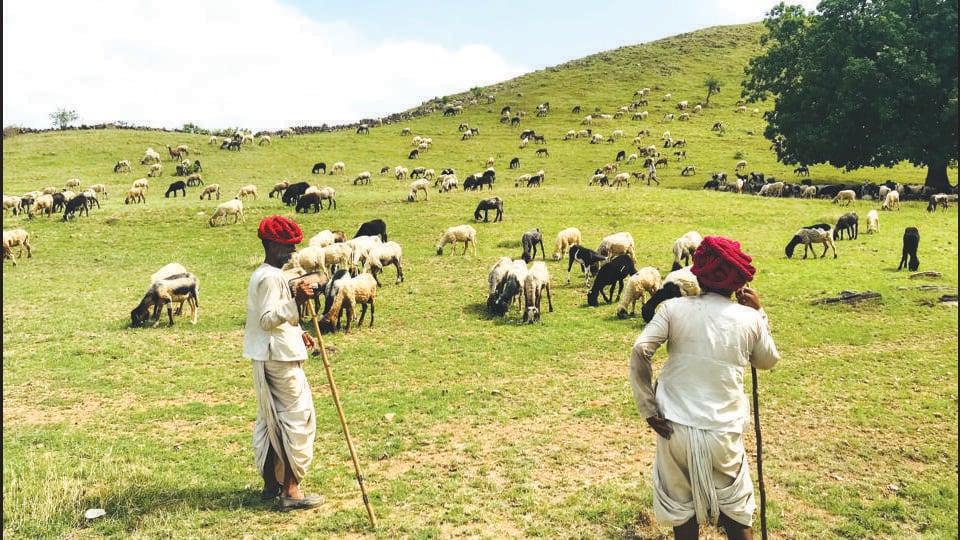
The meeting also took up the condition of pastoral communities whose seasonal migration routes pass through protected forests and sanctuaries. Communities including Gujjars, Bakkarwals, Bhotia, Van Gujjars, Mongpa, Rebari/Raika, Dhangar and Gollas move across multiple administrative jurisdictions, creating practical constraints that existing frameworks do not adequately address. The committee noted severe degradation of pasture lands, driven partly by the over-concentration of livestock around protected areas as traditional grazing routes shrink.
The Wildlife Institute of India (WII) will now undertake a study on nomadic communities in Rajasthan, Gujarat, Maharashtra, Uttar Pradesh and Uttarakhand, with a focus on conservation issues, to be funded under the National CAMPA and completed within six months.
The Banni grasslands are an important example of how pastoral communities conserve these for common use. In the Banni Pashu Uchcherak Maldhari Sangathan Vs Union of India and Ors case, after being approached by 16 Gram Panchayats, the National Green Tribunal in 2021 directed the removal of encroachments from the Banni grasslands to uphold the rights of the Maldhari tribal communities under the Forest Rights Act, 2006. In 2015, Community Forest Rights were recognised for 47 Maldhari villages over the Banni, which constitute 45% of the state’s pastures.
The SC-NBWL also noted that the introduction of cheetahs in Banni is under way, with habitat improvement, prey augmentation and infrastructure development in progress; an expert committee will visit shortly to recommend next steps.
The pressure on grasslands comes from multiple directions. According to the International Food Policy Research Institute, India has approximately 66.5 million hectares of common land, of which 9.1 million hectares is permanent pasture and grazing land.
A notification dated February 22, 2024 — reported by HT — opened degraded land, including open forests, scrubland and common land, to corporate and private plantations for the generation of green credits tradeable under CSR frameworks, raising concern among conservationists about land-use change in landscapes that often harbour significant biodiversity. Whether anxiety about that notification informed the states’ push at the SC-NBWL for stronger grassland recognition was not stated on the record.
(The reporter is a recipient of Promise of Commons Media Fellowship, on the significance of Commons and its community stewardship)