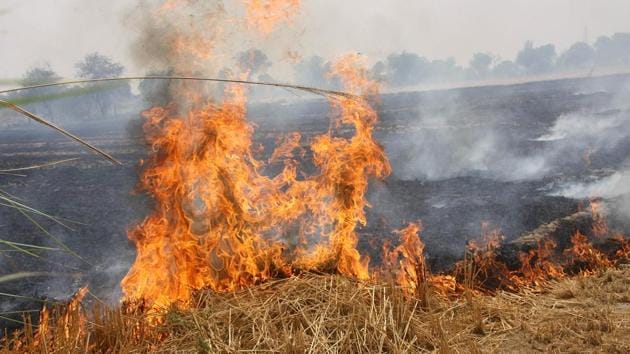
The Haryana police on Thursday booked four farmers for allegedly setting paddy residue on fire in Karnal’s Sangohi and Kurali villages.
Aditya Dabas, Haryana’s deputy agriculture director, said his department filed police complaints against the four, Jaspal Singh, Devender Singh, Karanjit Singh, and Iqbal Singh.
Officials said the matter came to light when Karnal deputy commissioner Vinay Pratap Singh visited some villages as part of an awareness drive against farm fires. He called officials of the agriculture department and asked them to take action against the farmers, the officials added.
The deputy commissioner said there were clear directions for action against farmers found burning crop residue. He warned officials of the agriculture and revenue departments of stringent action if they fail to report such violations in their respective areas.
Officials said farm fires were common in about 10 villages of Karnal’s Indri block as farmers there sow early varieties of paddy. They burn the residue to prepare their fields for the next crop.
Hundreds of instances of farm fires have been recorded in Punjab and Haryana. This has forced officials in Delhi and adjoining states to consider measures like staggered office timings and impounding of old harvesting machines to stave off an air quality crisis that has become an annual phenomenon in the region.
The first of the farm fires come less than a week after the Punjab and Haryana high court ruled that the two states cannot fine farmers for burning crop residue. Burning the residue is a common practice in the autumn season when fields need to be quickly cleared of summer harvests to make way for winter crop sowing.
{{/usCountry}}The first of the farm fires come less than a week after the Punjab and Haryana high court ruled that the two states cannot fine farmers for burning crop residue. Burning the residue is a common practice in the autumn season when fields need to be quickly cleared of summer harvests to make way for winter crop sowing.
{{/usCountry}}