
 E-Paper



Supreme Court allows Hindus, Muslims to offer Friday prayers at MP's disputed Bhojshala
The apex court also directed that a list of persons from the Muslim community coming to offer namaz at the site be submitted to the district administration.

 Prefer HTon Google


The Supreme Court on Friday allowed Hindu prayers from sunrise to sunset at the disputed Bhojshala-Kamal Maula mosque in Madhya Pradesh's Dhar district on the occasion of Basant Panchami, while also permitting Muslims to offer namaz from 1 pm to 3 pm on the day.
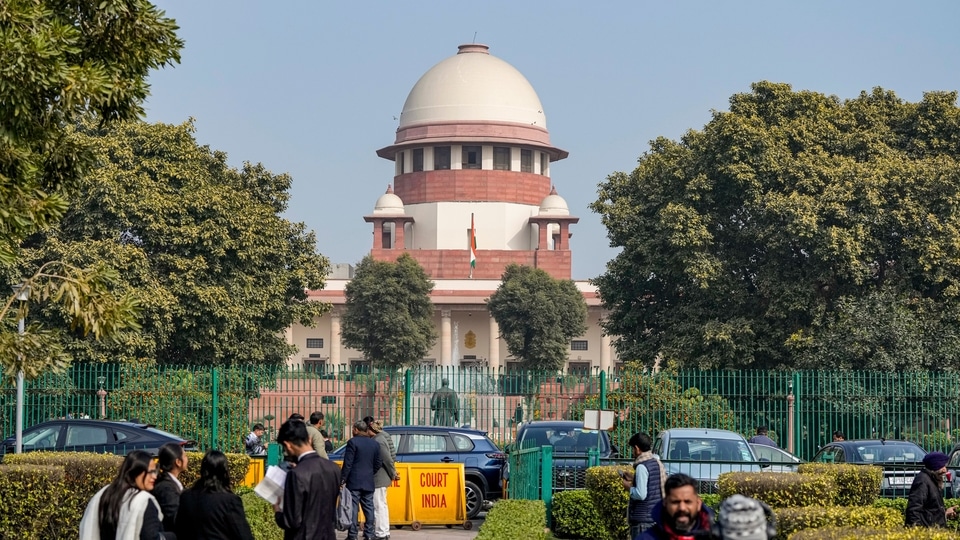
The previous day, the apex court had directed that a list of persons from the Muslim community coming to offer namaz at the site be submitted to the district administration.
Hindu and Muslim groups sought approval for prayers at the long-disputed Bhojshala complex on Friday, January 23, when Saraswati Puja will be celebrated on Basant Panchami, news agency PTi reported.
ALSO READ | ASI report links MP’s Bhojshala with temple
A top court bench of Chief Justice of India Surya Kant and Justices Joymalya Bagchi and Vipul M Pancholi appealed to both sides to maintain mutual respect and cooperate with the state and district administration in maintaining law and order.
The Supreme Court also directed the district administration to make proper law and order arrangements at the site for the prayers.
Bhojshala-Kamal Maula mosque dispute
Hindus consider the Bhojshala, an Archaeological Survey of India (ASI)-protected 11th-century monument, to be a temple of Vagdevi (goddess Saraswati), while the Muslim community refers to it as the Kamal Maula mosque.
The dispute dates back to the early 1990s. In 1997, the then-Congress government banned the entry of common citizens, even as it allowed Muslims to offer namaz at the centre of the Bhojshala dome.
Amid these tensions, an arrangement was made by the ASI on April 7, 2003, under which Hindus could perform puja on the Bhojshala on Tuesdays and Muslims could offer namaz in the complex on Fridays.
The structure was first declared protected by the erstwhile Dhar state in 1909. Then, in 1951, the complex was declared a monument of national importance under the Ancient and Historical Monument and Archaeological Sites and Remains (Declaration of National Importance) Act, 1951.
Currently, it is protected by ASI under the Ancient Monuments and Archaeological Sites and Remains Act, 1958. Monuments under this law are not covered by the 1991 act.
In May 2022, the Hindu Front for Justice filed a plea against the offering of namaz and ASI's 2003 order that prohibited Hindus from offering daily puja there.
ALSO READ | SC refuses to interfere with MP HC order asking ASI to survey Bhojshala
The Indore bench of the Madhya Pradesh high court directed the ASI to conduct a scientific survey of the complex under a five-member committee and submit a report within six weeks, a deadline later extended to 14 weeks.
The ASI carried out a survey for 14 weeks between March 22 and June 30 at the direction of the high court and said the existing structure was built over the base of an earlier monument in the 11th century, adding that the mosque probably came up in the 14th century.
ASI also stated that the original basalt structure was found during its digging.
ALSO READ | HistoriCity | The syncretic past of the Kamal Maula mosque-Bhojshala complex
“Existing structure appears to have been made hurriedly without paying much attention to symmetry, designs, material, etc. Although most of the superstructure is made of limestone, but some parts of the earlier basalt structure, and one pillar base of marble were also reused,” the report said.
The report mentioned a number of images and sculptures made of basalt, marble, schist, soft stone, sandstone and limestone.
In the 150-page report, the survey claimed to have found 94 scriptures, 106 pillars, 82 pilasters, 31 ancient coins, 150 inscriptions, including images of Ganesh, Brahma with his consorts, Narasimha and Bhairava. The report also hinted that it may have been a temple dedicated to goddess Saraswati, a belief held by many Hindus.
“Based on scientific investigations, survey and archaeological excavations, study and analysis of retrieved finds, study of architectural remains, sculptures, inscriptions, art and sculptures, it can be said that the existing structure was made from the parts of earlier temples,” the 150-page report said.
“Fragments of these inscriptions, sculptures, and architectural members suggest that superstructure of this stone structure was later modified and converted into a mosque," it added.


