NEW DELHI: The Supreme Court on Friday sought responses from the election-bound states of Madhya Pradesh and Rajasthan on a petition that questioned pre-election freebies being distributed out of state treasuries at a time when they are reeling under huge debt.
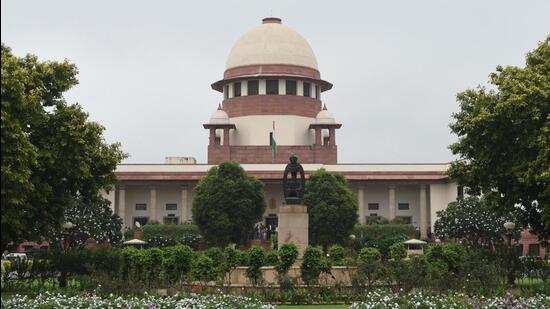
A bench headed by Chief Justice of India (CJI) Dhananjaya Y Chandrachud also sought responses from the Centre and the Election Commission of India (ECI) while observing that before elections, all kinds of promises are made over which courts have little control.
As the issue is already pending before the top court in a petition filed by Delhi Bharatiya Janata Party (BJP) leader Ashwini Kumar Upadhyay, the bench, also comprising justices JB Pardiwala and Manoj Misra, directed the present petition to be heard along with Upadhyay’s plea.
The court was hearing a petition filed by Bhattulal Jain, a resident of Madhya Pradesh who sought a declaration from the court that such promises of benefits or distribution of cash benefits to lure voters amount to “bribery” and “undue influence”, which are punishable offences under sections 171B and 171C of the Indian Penal Code. He further sought a direction to the state authorities not to misuse the consolidated fund of India in the name of public purpose.
Dealing with the prayers, CJI Chandrachud remarked: “Before elections, all kinds of promises are made. There cannot be any control over it.”
{{/usCountry}}Dealing with the prayers, CJI Chandrachud remarked: “Before elections, all kinds of promises are made. There cannot be any control over it.”
{{/usCountry}}The bench also told the petitioner that it should approach the high court since the plea appeared to be seeking directions only against the Madhya Pradesh government.
Advocate Tripurari Ray appearing for the petitioner along with advocate Varun Thakur told the court that the petition sought directions against Rajasthan as well. He produced data from the Reserve Bank of India on the outstanding debt figures in MP and Rajasthan which crossed ₹3.78 lakh crore and ₹5.37 lakh crore respectively as of March 31 this year.
“There can be nothing more atrocious than the government distributing cash before polls,” Ray said.
Wondering where the government intends to get money for financing freebies, the petitioner further argued, “All this begins just six months before elections are to take place. Ultimately, the burden is on us, the taxpayers.”
In June, the MP government launched the Ladli Behna Yojana under which the state promised to dole out ₹1000 per month to all married women (including divorcees and widows), an amount that would gradually be raised to ₹3,000. The Rajasthan government announced free smartphones to women early this year along with free electricity up to 100 units and a subsidy on LPG cylinders.
The petition said, “No government can declare free electricity, free water, or loan waiver without the approval of the legislative assembly… Governments should first submit blueprint before announcing such projects and get approval from the assembly. Since the money belongs to taxpayers, they should have the right to monitor its use.”
The court granted four weeks to the two states along with Centre and the ECI to file their responses and directed that the matter be heard along with a batch of petitions along with Upadhyay’s plea that was directed to be listed before a three-judge bench and has not come up for hearing since November last year.
In that set of petitions, the court was asked to consider whether such pre-election promises disturb the level-playing field during elections. Another issue that arose in the petitions was with regard to such promises aimed to lure votes regardless of the financial implications on the state’s economy.
In one of the orders passed in the pending petitions on August 26 last year, the court framed certain preliminary questions to know whether judicial intervention is permissible in such matters falling within the state’s policy domain, the possibility of passing any enforceable order, and to explore the possibility of having an expert body to suggest measures to curb such practices.
When these matters were heard, a demand was raised by petitioners to reconsider a 2013 decision of the top court in S Subramaniam Balaji vs Tamil Nadu, which said that pre-election promises do not amount to corrupt practices, a ground for declaring an election invalid, under Section 123 of the Representation of Peoples Act.
In that order, the court, while leaving the matter to be decided by a three-judge bench, also said, “Freebies may create a situation wherein the state government cannot provide basic amenities due to lack of funds and the state is pushed towards imminent bankruptcy. In the same breath, we should remember that such freebies are extended utilizing taxpayers’ money only for increasing the popularity of the party and electoral prospects.”