
 E-Paper



SC narrows caveat, says states can withdraw FIRs on protesters; CJP reacts
The court, in its July 28 order, had said that cases could be withdrawn against student protesters, except those with criminal antecedents.

 Prefer HTon Google


The Supreme Court on Monday reiterated and clarified aspects of its July 28 order on the release and withdrawing of police complaints against students who took part in the Cockroach Janta Party protest at Jantar Mantar.
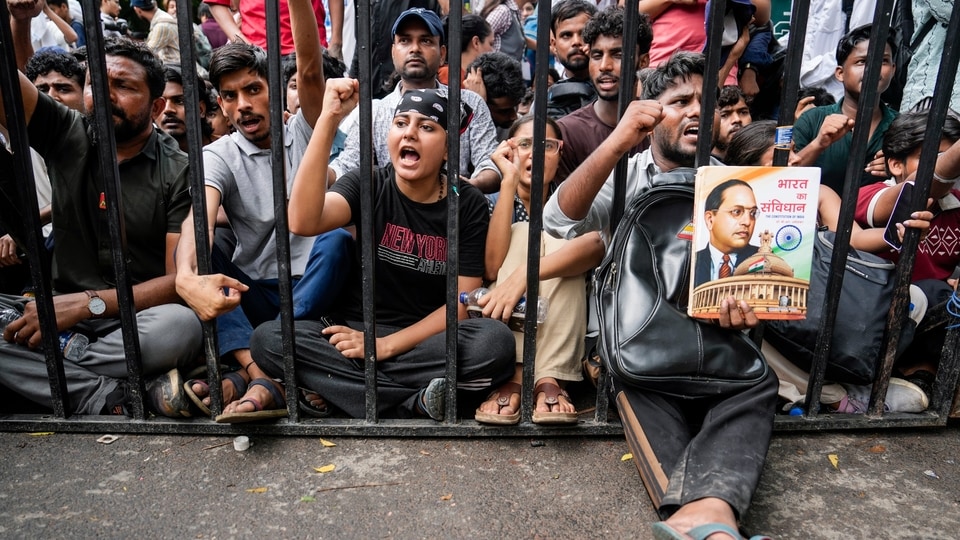
The apex court held that the National Capital Territory of Delhi and other states were at liberty to withdraw the FIRs against student protesters, and clarified the scope of “criminal antecedents”, mentioned in its earlier order, news agency ANI reported.
The court had, on July 28, said in an interim order passed on student protest cases that cases could be withdrawn against protesters, except those with criminal antecedents. The court on Monday narrowed its scope to only grave and heinous offences.
“The NCT of Delhi or any other State shall be at liberty to close or withdraw any such criminal case, in accordance with law. 'Criminal antecedents' used in paragraph 8(5) would mean grave and heinous offences,” a bench led by Chief Justice of India Surya Kant said while hearing a batch of petitions alleging police excesses during the recent student protests. This came after senior advocates appearing for one of the petitioners argued that the term ‘criminal antecedents’ was being interpreted in a broad manner, and had led to unnecessary arrests.
Responding to this, Solicitor General of India (SGI) Tushar Mehta, representing the Centre and Delhi, said peaceful protesters must not be equated with hardened offenders, while assuring that anybody who is not a hardened criminal would not face any legal action.
“Those who are protesting in a legally permissible way... except those who have criminal antecedents, everything can be taken care of,” he said, according to ANI.
‘SC has removed confusions, expect govt to honour assurances’: Saurav Das
Reacting to the SC clarification, CJP spokesperson Saurav Das said that the states and government must now “honour” the assurances provided regarding the FIRs on students. “Now that the Supreme Court has removed confusions, we expect the Government of India and all BJP/NDA-ruled states to immediately honour the assurances given on 25 July to the young of this country,” Das said in a post on X.
He asserted that the CJP had “stood by every student and every protester”, adding that the outfit would also “closely monitor developments across states.” Das said that the CJP had provided “legal assistance, medical support, and every other form of help within our means”, and that this would remain unchanged in the future.
“We thank all lawyers across the country who continue to help the protesters. We also continue to closely monitor developments across states and remain in constant dialogue with senior representatives of the Union Government. We expect the assurances to be implemented in both letter and spirit,” Das added.
SC mulls single-member SIT, judge-led panel to probe police excesses
Meanwhile, while hearing the petitions against alleged police excesses and those seeking accountability for the use of force against protesters, the apex court said it was considering either a single-member SIT or a judge-led panel to probe the same. The SC bench signalled that it was mulling an independent mechanism to examine allegations of police excesses.
"We are thinking of two options... one is SIT by a sole senior police officer... the other... we don't want to have the nomenclature of SIT. Whatever we will constitute would be by a Judge. We won't call it an SIT," ANI cited the court as saying. CJI Surya Kant asserted that this proposed mechanism would examine allegations against both the authorities and the protesters.
The court further urged the devising of a mechanism on the issue of the closure of cases or criminal proceedings against those detained. The SC bench suggested gathering information on FIRs from all states, and then segregating them to determine those with and without any antecedents. “One mechanism... gather information on FIRs from all States and in Delhi. Then segregation, without antecedents and hardened criminals. After this categorisation, then take up some recourse,” the SC suggested.


