The Supreme Court is expected to unveil its online Right To Information (RTI) portal next week, making it more convenient for people to access information about the top court, which is a public authority under the transparency law. At present, RTI applications with respect to the Supreme Court are to be filed through post.
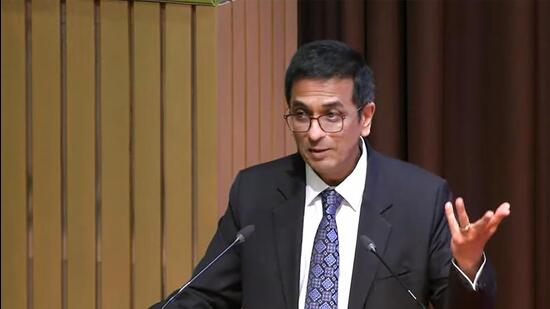
Chief Justice of India (CJI) Dhananjaya Y Chandrachud made the announcement on Monday when a case relating to the online RTI portal for high courts and lower judiciary was mentioned before him.
The CJI was emphatic that the Supreme Court should lead by example, and that it may not be proper to issue judicial directions to the high courts and district courts when the top court is itself wanting in the aspect concerned.
“We are most likely to launch the online RTI portal next week. We are completely ready. Some security audits were there. We will launch it next week,” declared justice Chandrachud.
The CJI added: “So for the high courts to be concerned, we have to lead from the front and then we can push them on the administrative side. We can only ask them to do something after we have done it.”
The court then posted the petition for a hearing after three weeks, assuring the petitioners’ lawyer that the Supreme Court’s RTI portal would have gone live by then.
{{/usCountry}}The court then posted the petition for a hearing after three weeks, assuring the petitioners’ lawyer that the Supreme Court’s RTI portal would have gone live by then.
{{/usCountry}}Last week too, a bench led by CJI Chandrachud had taken up a similar petition, demanding an online RTI portal for the Supreme Court. In that case filed by two law students praying that an online RTI portal be set up for the apex court, advocate Prashant Bhushan appeared for the petitioners.
When this matter was taken up on Friday, the CJI had told Bhushan: “The RTI portal is ready and it can go live at any time now… In fact, it will make our lives easier too. You can receive queries online and they can be answered conveniently. Otherwise, there are postal communications and they have to be physically placed before the competent authority.”
After Bhushan expressed satisfaction with the steps taken by the top court, the bench had wrapped up the petition, recording in its order: “The online portal of the Supreme Court for streamlining the responses under the Right to Information Act, 2005 is practically ready for being launched. In this view of the matter, the grievance of the petitioners has been duly met. The petition is accordingly disposed of.”
Justice Chandrachud is also the chairman of the e-committee, which works towards adoption of the Information and Communication Technology (ICT) by the judicial system in India. One of the prime objectives of the e-committee is to automate processes, easing accessibility of information to its stakeholders.
In a 2019 verdict, the Supreme Court had called it “undebatable” that it is a public authority under the RTI Act, as it declared that the office of the Chief Justice of India would be covered under the ambit of the law.
“The Supreme Court of India, which is a ‘public authority’, would necessarily include the office of the Chief Justice of India and the judges in view of Article 124 of the Constitution. The office of the Chief Justice or for that matter the judges is not separate from the Supreme Court, and is part and parcel of the Supreme Court as a body, authority and institution,” it had held.
Article 124 stipulates that there shall be a Supreme Court of India consisting of a Chief Justice of India and other judges.