
 E-Paper



Tamil Nadu pitches for timeframe for Governors to decide on bills
When a bill is passed by a majority and sent for the assent of the Governors, the latter, sometimes, sit over the bill without giving his assent, state’s Speaker M Appavu said


With Tamil Nadu awaiting a decision from constitutional authorities on two crucial issues- exemption of NEET and the release of prisoners in the Rajiv Gandhi assassination case - the state’s Speaker M Appavu came down heavily on Governors sitting on bills indefinitely and also said that if the President rejects a bill, people are entitled to know the reason. Appavu was speaking at the Presiding Officers conference held in Shimla on Wednesday.
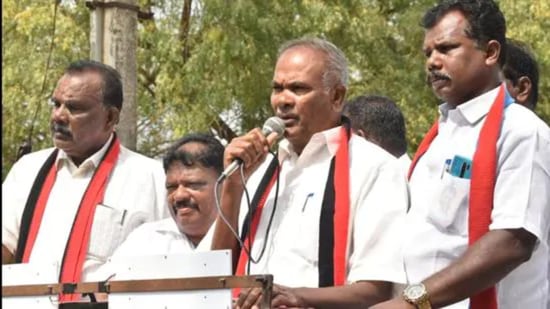
Appavu said that this was an important issue facing state legislation and also pitched for fixing a timeframe within which the Governors need to send bills to the President for consideration.
“When a bill is passed by a majority and sent for the assent of the Governors, the latter, sometimes, sit over the bill without giving his assent or returning the bill for an indefinite period, even though the Constitution requires it to be done “as soon as possible”,” Appavu said.
He added that “another problem” which erodes the authority of legislatures is that where a bill is required to be reserved for the consideration of the President, the Governors “are taking months together” even though they are bound to do so immediately. Pointing out that though Governors are heads of the State Executive since they are appointed by the Union government they are overruling the will of the state’s people when they stall the assent to a bill. “We have to work together to set a binding time frame within which bills have to be assented to, returned or reserved for the consideration of the Hon’ble President of India by the Hon’ble Governors,” Appavu said.
He further said that another “Constitutional issue” is for the President to give reasons if he withholds the assent and returns the bill. This would help the House to enact another bill by correcting shortfalls that caused the bill to be rejected, he said. “How else will the House that enacted the bill know what is the real impediment in withholding the assent?” he questioned saying that the House reflects the will of the people so it amounts to the rejection of them too. “Therefore, are not the people entitled to know at least the reason why the bill was not assented to?”
The Speaker’s comments assume significance in the backdrop of a bill passed by the Tamil Nadu Assembly on September 13 seeking exemption for students from the state from the National Eligibility cum Entrance Test (NEET) required for undergraduate medical college admissions. The bill was passed by the ruling DMK with the support of all parties except the BJP and it happened during the time when the then Governor Banwarilal Purohit was transferred and before Governor RN Ravi took charge on September 18. The bill is pending with Ravi and it is unclear if it has been sent to President Ram Nath Kovind. In 2017, the President rejected a similar bill seeking NEET exemption passed by the Assembly under the previous AIADMK regime.
In another sensitive issue in the state, the Tamil Nadu cabinet passed a unanimous resolution in 2018 in the assembly regarding the release of the seven prisoners convicted in the Rajiv Gandhi assassination case. The resolution was sent to then Governor Purohit but he did not take any action for more than two years. In January the Supreme Court, while hearing a plea, expressed that they were unhappy with the delay. In February, Purohit, without taking a call, passed the buck and said that the President was the competent authority to decide on the resolution. After forming the government in May, Tamil Nadu chief minister MK Stalin wrote a letter to President Kovind urging him to remit the life sentence of the seven convicts and to direct their immediate release.
The BJP in Tamil Nadu reacted saying that the Speaker should have had more awareness on the issue. “The Governor and the President operate as per the Constitution and nowhere is a time frame set,” said BJP’s spokesperson Narayanan Thirupathy. “Also the Supreme Court has so many times refused to instruct a time frame in several cases. I think the Speaker should have been aware of these aspects.”
Appavu recalled that President Kovind participated in the centenary celebrations of the Tamil Nadu assembly where he unveiled a portrait of DMK’s late patriarch M Karunanidhi. Quoting Karunanidhi, Appavu said that the Legislature is like a mirror to the executive branch. “The mirror reflects not only the beauty but also the flaws. Similarly, the Legislature should not only laud the good work of the Government but also criticize it when it falls short,” he said while seeing changes.
On the role of presiding officers, he said that they are the ultimate arbiters. “A very heavy responsibility is cast on the Presiding Officers to ensure that the independent and sovereign functions of the Legislature are guided in accordance with the Constitution so that the Judicial branch is not called upon to test the decisions of the Speakers,” he said.


