Prime Minister Narendra Modi on Tuesday consulted economists about navigating global uncertainty and maintaining India’s economic growth momentum, ahead of the NDA government’s second budget in its third term in office. Jobs, education and infrastructure were key discussion points at the meeting, held at Niti Aayog.
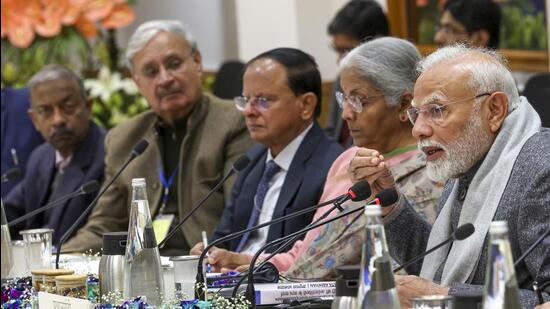
Economists shared suggestions on topics including employment generation, skill development, enhancing agricultural productivity, attracting investment and boosting exports, said an official statement.
The agenda of the meet was “Maintaining India’s Growth Momentum at a Time of Global Uncertainty” and invitees also included experts from rating agencies and academics.
Also read | Industry bodies ask finance ministry to ease TDS rates for Union Budget 2025
The PM began by outlining his government’s goal of Viksit Bharat (developed economy) by 2047, the 100th year of India’s Independence. Modi said both the government and the private sector needed to work in collaboration, keeping that “single goal in mind”, the person said.
The Prime Minister also said the country needs to foster a “fundamental change in mindset that is focused towards making India a developed nation by 2047”. He also sought policy guidance in three areas: sustainable growth, jobs and raising productivity in agriculture.
{{/usCountry}}The Prime Minister also said the country needs to foster a “fundamental change in mindset that is focused towards making India a developed nation by 2047”. He also sought policy guidance in three areas: sustainable growth, jobs and raising productivity in agriculture.
{{/usCountry}}The closed-door meet came ahead of finance minister Nirmala Sitharaman’s next budget for FY26, which will be her eighth, to be presented on February 1 next year. The budget is expected to spell out more measures to boost growth, which slowed to a seven-quarter low of 5.4% in the September (second) quarter of 2024-25, partly due to continuing tight monetary policy to curb inflation.
Also read | Nirmala Sitharaman holds pre-budget consultations with farm groups
Among top officials, the meet was attended by the finance minister, principal secretary to the PM, PK Mishra, Niti Aayog vice-chairman Suman Bery, Niti Aayog’s CEO BVR Subrahmanyam and chief economic advisor V Anantha Nageswaran.
“There was a very broad, in-depth discussion on all aspects of India’s economy,” said Chetan Ghate, the director of Institute of Economic Growth, Delhi University, and one of the participants. He declined to offer details because he was not authorised to speak.
Several economists pointed to a mismatch in skills and jobs, which had created a structural hurdle in employment generation despite availability of jobs, according to a second person. They proposed an overhaul of educational systems to include training on emerging skill requirements for the job market, the person said.
Experts spoke on strategies to navigate challenges posed by global economic uncertainties in the wake of US president-elect Donald Trump’s plans to ramp up tariffs on all US imports. “There were detailed discussions on changing geopolitical and economic landscape, which also presents a lot of opportunities for India. To benefit, the country will have to tap into shifting supply value chains,” the first person said.
During the discussions, chief economic adviser Nageswaran emphasized the need to raise the currently muted levels of private investment, for which, he said, the government had unveiled a range of incentives.
“To boost local manufacturing, I understand the upcoming Budget is likely to rejig certain customs duty waivers on some intermediate goods,” the second person said. The finance ministry is reviewing nearly 30 products where conditional lower customs duty regime of 0-5% are set to end by September 2025 and consultations on whether to scrap them or rework them are on, he said.
HT understands that agricultural economist Ashok Gulati urged speedier reforms and repurposing of subsidies to raise farm productivity, including opening up the sector to greater competition. Gulati didn’t respond to a request for a comment.
The Niti Aayog’s leadership said that all suggestions would be consolidated for further scrutiny by the government.
Those who presented proposals on trade, financial reforms, exports and employment included Janmejaya Sinha, director, Boston Consulting Group, Dharmakirti Joshi, chief economist, Crisil Ltd, Soumya Kanti Ghosh, chief group economist of State Bank of India, Sudipto Mundle of the Centre for Development Studies, Prof Amita Batra of JNU, Prof Bharat Ramaswami of Ashoka University and Rajni Sinha, chief economist CareEdge Group, among others.