
 E-Paper



The efforts of Chipko workers helped bring a change in attitude
In the last 125 years, this friendly relationship has been replaced by commercial exploitation of the forest wealth and forest resources

 Prefer HTon Google


From time immemorial, forests and the human settlements in and around them have existed in a symbiotic relationship. Forests have been a source of edible fruits and roots, water, grass and fodder for livestock and fertile soil for agriculture. Commenting on this, HG Walton wrote in the Almora Gazetteer 100 years ago, “The hill man is indeed specially blessed by the presence in almost every jungle of fruits, vegetables or roots to help him over a period of moderate scarcity.”
In the last 125 years, however, this friendly relationship has been replaced by commercial exploitation of the forest wealth and forest resources, resulting in incalculable harm. Thus, broad-leafed trees, such as the Himalayan oak, have largely been replaced by conifers, leading to a drying up of springs and erosion of soil.
Himalayan forests are green gold for state governments which earn considerable revenue from the sales of forests. Meanwhile, the bringing of more and more forest areas under the plough, the shrinking of pastures, and the cutting of the mountainsides for road-building have made soil erosion and landslides a phenomenon of geological proportions. On August 15, when the country was celebrating Independence Day, the Khela and Tawaghat area on the Indo-Nepalese border was the scene of a calamity. In a landslide, 44 people were crushed to death. This was by no means an isolated occurrence.
The Himalayas, at one time a source of prosperity, are now turning into a source of destruction. Soil erosion causes the displacement of about 600,000 tonnes of fertile land every year, soil which takes nature between 500 and 1,000 years to build. The loss in terms of nitrogen, potash and phosphates must be of the order of ₹70,000 crore. Soil erosion has also shortened the life and capacity of reservoirs and irrigation channels. The rate of siltation of the reservoirs constructed during the third and fourth five-year plans was 213% higher than the estimates. The Ramganga Project in Kalagarh, Uttar Pradesh, commissioned in 1976, has a reservoir life of 185 years. But on account of the higher silt load, the actual rate of siltation is now several times greater, thus reducing the useful life of the dam to a mere 48 years. About 20% of the Kosi canals are silted.
These problems of national importance have been frequently discussed in the state assemblies, in Parliament and at seminars, but no concrete steps have been taken to solve them. The Chipko movement has now drawn people’s attention to them in a most forceful manner.
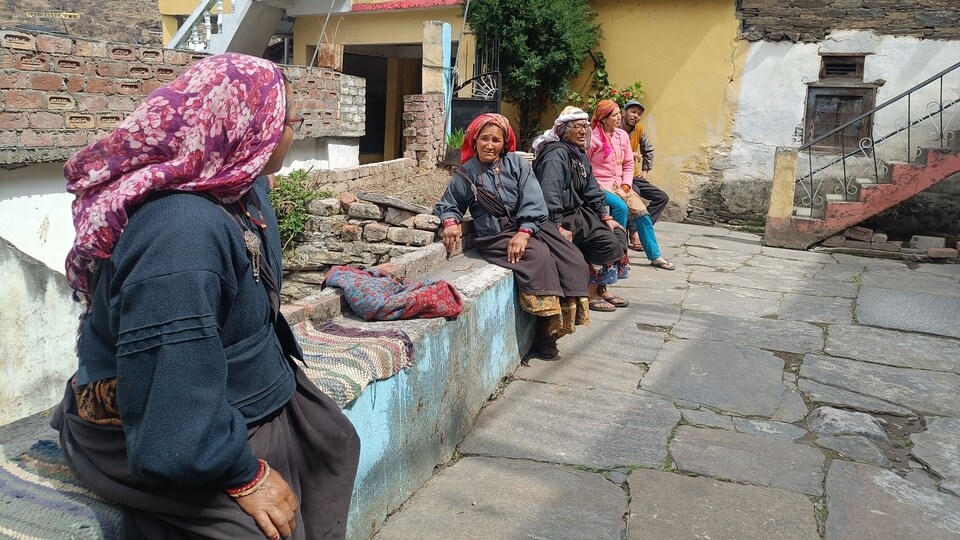
Women have always been in the forefront of this movement at all places – Mandal, Kedarnath Valley, Raini and Bhyundar (Chamoli), Pata-Sangrali (Uttarkashi), Chancharidhar (Almora) and Henwalghati (Tehri-Garhwal). The reason is obvious. With the disappearance of fertile topsoil of the hills, menfolk have left for the plains in search of employment. The whole burden of maintaining their families has fallen on the shoulders of women. Even if they purchase food grains and other necessities with their husbands’ income, they have to collect fuel to cook food, water to drink and fodder for the cattle. They have to trudge, quite often 30 kilometres and more, to collect fuel and draw water.
Each day, these necessities of life are becoming more and more distant for more and more people in the Himalayas. The UP government this year finalised a ₹125 crore scheme to supply drinking water to 1,250 villages in Uttarakhand. Some 12 years ago, a similar scheme was devised to bring water to Pauri from a source 60km away. The source at the time yielded water at the rate of 360 litres per minute. Today it yields only 108 litres per minute. The hill women, after hard labour, have to keep awake till late at night to wait for their turn to fill a pitcher of drinking water.
These are hard-pressed hill women – who came out of their homes in Raini (Chamoli) in March 1974 to stop the contractors from cutting the trees. They told them. “This forest is our maternal home. We won’t let you cut the trees.” This sentiment was echoed in Advani (Henwal valley, Tehrt. Garhwal), where women put sacred threads around the trees marked and sold for felling by the forest department. Whenever the contractors’ axemen came to cut the trees, they had to face strong opposition. And, when on February 1, last forest officers arrived with 50 armed policemen to help a contractor, they clung to the trees and told the axemen: “Cut us, not the trees.” The armed men had to turn back.
The chief outcome of the Chipko movement has been the rousing of tree consciousness among the masses. Even its worst critics admit that the efforts of the Chipko workers, on the social plane, have resulted in a change of attitude for the better among the local people. Before this, whenever there were agitations over forest issues by the forest dwellers, the agitators were the destroyers and the government the saviour of forests. Now the situation has been reversed.
The Chipko movement will live even after the present exploitative forest policy is changed. We cut more and more forests to meet our never-ending requirement of raw materials. The resources of natural wealth are diminishing. The forest area is decreasing with the extension of roads, cities and agricultural land. Wildlife is fast disappearing. The skinning of the earth by destroying its vegetative cover will bring about untold misery. The Chipko movement demands the plantation of fruit-bearing and fodder-bearing trees. If this is done, the Himalayas will once more become a source of prosperity, and the main product of the country’s forests will no longer be timber and resin, but oxygen, water and soil.
On XXXXXXX, HT carried this article by Sunderlal Bahuguna, an environmentalist and a Chipko movement leader.


