What is it like to experience the metaverse?
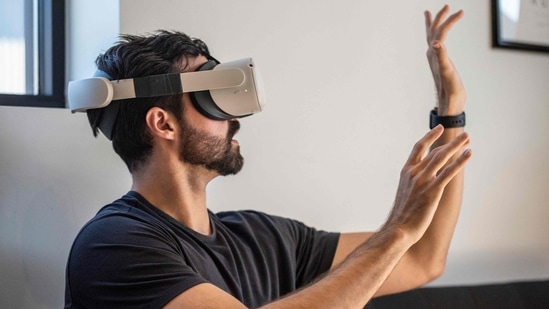
That was the question this writer set out to answer. In the months since Mark Zuckerberg’s Facebook Connect keynote – he announced that Facebook is now Meta Platforms and that the company is pivoting to the metaverse – there’s been significant coverage and hype about the term.
The metaverse will someday incorporate virtual reality (VR), augmented reality (AR), and blockchain to create immersive experiences that integrate seamlessly with everyday life. That’s the vision. Right now though, companies are rolling out versions of what is, in all honesty, a vague definition.
What Meta, Microsoft, Apple, and the like are creating (virtual avatars, meetings, entertainment, socialising, etc.) are the building blocks for the metaverse, not the metaverse itself. And almost all these building blocks ape gaming industry innovations: think Second Life, Final Fantasy, Pokémon GO, Dead or Alive Xtreme 3, and in-game concerts pioneered by Fortnite, Roblox, and Minecraft.
{{/usCountry}}What Meta, Microsoft, Apple, and the like are creating (virtual avatars, meetings, entertainment, socialising, etc.) are the building blocks for the metaverse, not the metaverse itself. And almost all these building blocks ape gaming industry innovations: think Second Life, Final Fantasy, Pokémon GO, Dead or Alive Xtreme 3, and in-game concerts pioneered by Fortnite, Roblox, and Minecraft.
{{/usCountry}}The nascency of the metaverse notwithstanding, traditional businesses are engaged in a mad rush. McDonald’s has filed patents to sell “virtual” food and beverages in the metaverse. Adidas, blockchain company Tokens.com, and rapper-entrepreneur Snoop Dogg own land in virtual worlds such as Decentraland, Sandbox, and Cryptovoxels.
Not to be left behind, Vashu Bhagnani – who produced a spate of Govinda and Salman Khan films in the ‘90s and aughts – recently bought real estate worth ₹4.22 lakhs on Cryptovoxels. Indian startups LOKA, Interality, and Yug Metaverse have also jumped on the metaverse bandwagon.
What the commentaries have so far missed out on is a hands-on tour of building blocks of the metaverse. And that is exactly where this story takes you – inside Meta Platforms’ virtual world that is at once fascinating, disorienting…
…and traumatising.
Event Horizon
Nothing could prepare me for Horizon Venues.
Meta positions Venues as “the future of entertainment”. This is a platform for events ranging from live sports to concerts. When I entered Venues, I was welcomed by placards announcing a Pete Davidson stand-up show, Snoop Dogg’s DJ set, and a Foo Fighters gig. I slid, then teleported (that’s how you move in the virtual world) to a venue named ‘Always On: Aerial Adventures’. And that’s when I heard it:
“How about you lift up that shirt?”
He laughed as he zoomed within inches of me. His avatar was brown-haired and goateed, and before I could register what had happened, he’d teleported out of Aerial Adventures.
My avatar was a likeness of me, but it was also cartoonish. Or so I’d thought.
Eight years ago, Meta acquired Oculus, the VR company whose gear hacks your visual cortex to give you the feeling of existing in a virtual world. This pioneering technology powers the Oculus Quest 2 headset and controllers. The latter has haptic feedback so sensitive, it kicked the Oculus Quest 2 to life when I simply moved the case in which it was placed.
Given the Quest 2’s sense of depth, scale, and realism it offers over other VR experiences, being harassed in Horizon Venues felt particularly disorienting. It builds on the stasis of freeze, fight, or flight we Indian women already live with on a daily basis.
I wanted to fight back in Venues. I couldn’t. After all, the VR harassment had felt more visceral; as University of Miami professor and Cyber Civil Rights Initiative president Mary Anne Franks noted in The Desert of the Unreal: Inequality in Virtual and Augmented Reality: “Harassment in VR is far more traumatic than in other digital worlds.”
There’s a ‘Safe Zone’ button on your virtual wrist that you can use to time yourself out of Horizon Worlds and Venues to report an offender. But I did not see his avatar when I used that option, and therefore could not report him.
Meta had also announced a four-foot ‘Personal Boundary’ earlier this month. If you approach an avatar’s protective bubble, your hands disappear, and your movement is halted to prevent unwanted interaction. The feature was implemented two months after a beta tester said she was groped on Horizon Worlds.
But as I experienced, the Personal Boundary does nothing to prevent verbal harassment. Meta Platforms, like other building blocks of the metaverse, has a Clubhouse problem. Unlike “physical” manifestations of the virtual – namely, text and avatars – ephemeral audio is impossible to regulate in real-time. The result is reactive moderation that cannot curb the swell of negative interactions as more users join a platform. As long as people’s mics are on, they can say anything with little or no consequence, despite Meta’s “trained safety specialists” keeping an eye on the virtual spaces.
And just three days ago, this happened:
This experience undid the glee I’d felt upon my first visit to the virtual world. I’d kickstarted my Oculus setup with the ‘Guardian’, a safety feature that requires you to establish a physical boundary. This kept me from bumping into walls and other obstacles while my avatar was navigating the unknown. I was welcomed by an outdoor ‘lobby’ with a screen straight ahead. The screen was where I’d created my avatar. It also launched me into the Oculus Store, which houses immersive apps spanning games, workspaces, entertainment (YouTube 360°, Netflix, VR movies) and Meta’s social VR spaces, Horizon Venues and Horizon Worlds. The latter now has 300,000 users.
It was electrifying to see the controllers morph into virtual manifestations of my hands, to have characters interact with me in an IMAX-like animated short, and to feel hypnic jerks while “flying” over a New York cityscape. A lion charging at me in National Geographic Explore sparked bladder-relieving terror, and immersive horror-induced phasmaphobia (fear of ghosts) where there was none. I’d even relished the mistake of “sitting” in the Yukon Striker – the world’s tallest dive roller coaster – after lunch. My heart had raced, and I felt the weightlessness of a 245-ft free fall in the pit of my stomach even as I sat cross-legged on my bed. It made me nauseous, but it was an experience bar none.
Horizon Venues was the full stop to it all.
Rinse, repeat
The Intersection contacted Meta Platforms and asked whether the metaverse team is working on audio regulation tools to limit verbal interactions between strangers. Antigone Davis, the Head of Global Safety at Meta, once said the platform is “investing in controls that allow users to manage and report problematic content and conduct, as well as safety tooling designed for immersive experiences.”
In response, a Meta spokesperson pointed to the Personal Boundary feature, which, as we’ve established, does nothing to prevent unwanted verbal interaction. They also noted that a user can ‘Mute’ to “stop audio from others if someone is being disruptive.”
This feature did not exist until a few days ago. But it is yet to be uniformly rolled out; when I revisited Horizon Venues on Thursday, the option was unavailable in the Menu on my virtual wrist.
Worse, there was a child in a space called ‘Always On: The Roots Jam Session’. Horizon Venues and Horizon Worlds are supposed to be accessible only to adults.
Meta Platforms — and other metaverse bandwagoners like it — learnt nothing from social media. “Social media started out as a “force for good” to help us connect with others, but its impacts and harms are now well-established. That should’ve been the map for the future, but the primary model for Big Tech remains the same,” says Apar Gupta, executive director of the Internet Freedom Foundation.
What is that model? Personal data-fuelled advertising. A report last month revealed that Meta has filed patents to harvest metaverse users’ pupil movements, facial expressions, and poses for hypertargeted content.
Old wine, new bottle. Now you know why businesses want a piece of the metaverse pie.
If user safety is an afterthought for Meta Platforms, what about the Indian companies creating virtual worlds? The metaverse is also slated to propel a 20x growth in data usage here, but this is also a country contending with online mobs and Clubhouse abuse. Given these factors, can multiple language interactions ever be regulated in virtual worlds created by and for Indians?
Utkarsh Shukla admits that it’s tricky. The creator of Yug Metaverse, which recently made news for hosting India’s first (and heavily sponsored) metaverse wedding, claims that his platform will soon allow users to mute the audio of strangers. He adds that voice records are stored only as long as sessions last. Shukla did not elaborate on how long audio records are stored if an unwanted interaction is reported.
***
The veneer of the metaverse — or rather, its building blocks — wears thin after a few days. There’s only so much you can do in Meta Platforms’ virtual worlds before minutes turn to hours and the Oculus Quest 2 weighs on your head, much like the problems ensconced within it. Your fatigued eyes become sandpaper, and your body begs for time to separate the wheat (real world) from the chaff (virtual world).
It’s all fun and games until you realise that both worlds are identical in their treatment of women.
(Roshni P Nair is a Staff Writer at The Signal, www.thesignal.co)