On Monday, the monsoon session of Parliament was adjourned ahead of schedule. This follows a disconcerting trend of truncated sessions during the current 17th Lok Sabha: of the nine sessions held since the beginning of its term in 2019, only two have completed the outlined schedule. The rest have ended earlier than planned.
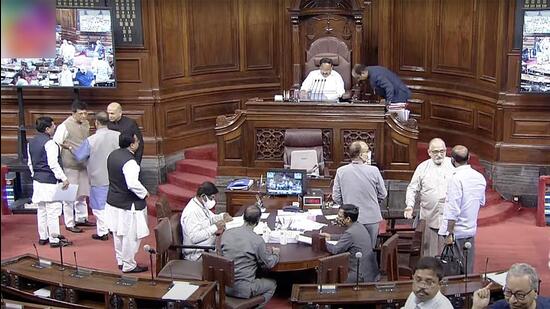
It’s not just the 17th Lok Sabha. In general, Indian Parliament has been progressively working fewer days, even when not facing disruptions. This session, the Lok Sabha
On Monday, the monsoon session of Parliament was adjourned ahead of schedule. This follows a disconcerting trend of truncated sessions during the current 17th Lok Sabha: of the nine sessions held since the beginning of its term in 2019, only two have completed the outlined schedule. The rest have ended earlier than planned.
It’s not just the 17th Lok Sabha. In general, Indian Parliament has been progressively working fewer days, even when not facing disruptions. This session, the Lok Sabha utilised only 47% of its scheduled time and the Rajya Sabha 42%. A Parliament functioning below its optimal capacity and not fulfilling its full remit has other trickle-down effects, notably a decline in debates and questions taken by government members of Parliament (MPs), and a greater use of mechanisms to make laws that bypass Parliament.
Fewer Sitting Days
Both Houses of Parliament were constituted in 1952 after independent India’s first general election. That year, the Lok Sabha sat for 103 days, while the Rajya Sabha sat for 60 days. Over the following two decades, the Lok Sabha averaged 120 days a year and the Rajya Sabha 97 days.
[Chart 1]
That pattern was broken by the Emergency declared by Indira Gandhi in 1975, and the sitting days of Parliament moved to a lower trajectory. The drastic decrease in sitting days became visible in the 2000s, with the Lok Sabha averaging 68 days a year and the Rajya Sabha 67, between 2000 and 2021. While India does not have a fixed parliamentary calendar, Parliament is conventionally expected to have three sessions in a year: budget session (sometime between January and March), monsoon session (July and August) and winter session (November and December). To be sure, the pandemic played its part in disrupting sessions in 2020 and 2021.
Fewer bills passed
Parliament is responsible for making laws for nearly one-seventh of the world’s population. Fewer bills have been passed by Parliament over the past two decades. The 16th Lok Sabha (2014-19) passed 205 bills. By comparison, the first Lok Sabha passed 333 bills—or, 38% more than the 16th Lok Sabha. The performance of the 16th Lok Sabha also pales in comparison to the BJP-led Atal Bihari Vajpayee government (1999 to 2004), which passed 302 bills. The two 14th and 15th Lok Sabhas passed 261 and 192 bills, respectively.
[Chart 2]
This session of Parliament saw a further dip in legislative activity. Of the 32 bills scheduled for passage, only five were passed by both Houses. Comparing all the Lok Sabhas that have had a full term, the maximum number of bills were passed during the 8th Lok Sabha (1984-89, 355 bills) and the least during 15th Lok Sabha (2009-14, 192 bills). Three years into its term, the tally for the current Lok Sabha stands at 151 bills passed by both Houses.
Lesser time for MPs to ask and answer questions
Besides passing laws, another vital element of Parliament’s functioning is ‘question hour’, where MPs can pose questions to the government. Typically, the first hour of every sitting in Lok Sabha and the second hour in Rajya Sabha is reserved for question hour. In the current Lok Sabha, productivity during question hour has progressively worsened . Less than 50% of the scheduled time was utilized in the latest session to answer questions. In Rajya Sabha, the question hour was not conducted on eight of the 16 days.
[Chart 3]
Adjournments during question hour usually occur due to protests by MPs. More time was lost in the Lok Sabha due to such interruptions in the latest monsoon session. It is vital to note that, as compared to other businesses of the House, time lost in question hour (on account of adjournments) cannot be made up during the rest of the sitting day.
Steady Step-Up in Ordinances
One mechanism available to Indian governments to expedite legislation is by promulgating ordinances. The Constitution of India provides for the government to make laws through ordinances when Parliament is not in session and when the situation requires urgent laws.
Since 1952, on average, 10 ordinances have been promulgated in a year. While their promulgation peaked during the 1975-1977 Emergency period and the 1993-1997 period, in the past decade, reliance on ordinances has been slightly but steadily rising from 2013. During this decadal period, the maximum number of ordinances were promulgated in 2019 (16).
[Chart 4]
Payoja Ahluwalia is a Hindustan Times-How India Lives data journalist fellow.
One Subscription.
Get 360° coverage—from daily headlines
to 100 year archives.
Archives
HT App & Website