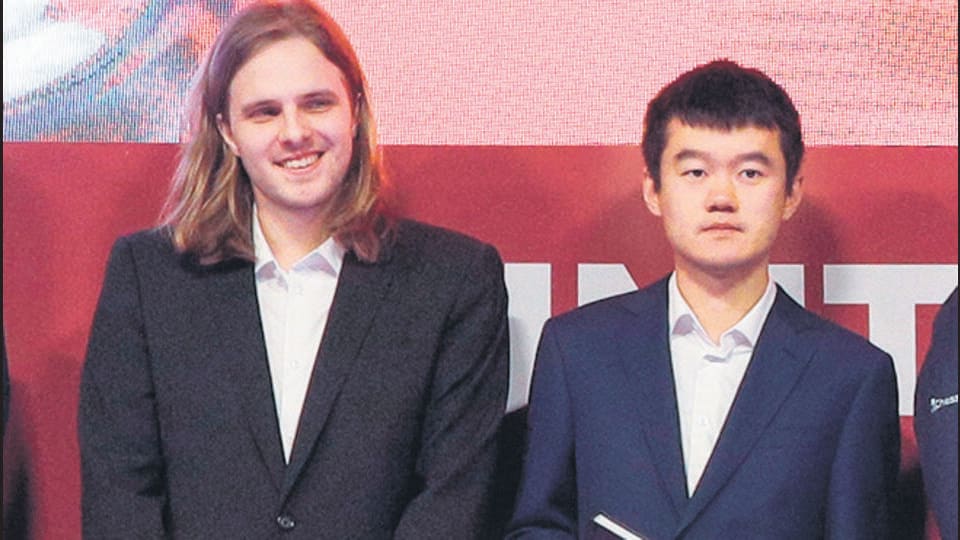
Ding Liren's team dynamics and the role of seconds in chess, highlighting their intense preparation and emotional support during World Championship matches.
On most game days, Ding Liren is accompanied by his second, Richard Rapport – dressed in striking shorts – up to the playing arena. The Hungarian Grandmaster, who was second to the reigning world champion during last year’s match as well, is usually flanked by another team member, Ni Hua. They watch Ding disappear behind the door before they head back up to their hotel rooms to perhaps catch up on some sleep or work on the next day’s game. Gukesh is usually seen ahead of the games with his father Rajini Kanth and trainer Grzegorz Gajewski. His extended team is operating in the shadows
On most game days, Ding Liren is accompanied by his second, Richard Rapport . (Shutterstock)
In chess, a second or trainer is usually a professional player who assists another usually higher-rated player with preparation for tournaments. For matches like the World Championship, teams are put together months in advance. A player picks seconds based on their opening repertoire, style of play, domain of expertise and they are expected to combine computer assistance with human know-how to produce strategies as well as play training games with the player if needed. The team trawls through engine evaluations, looks for deviations, novelties, lesser-known continuations and surprises and compiles the necessary information for the player into bite-sized formats and revise before games.
In high-stakes matches like this one, players often want to keep the identity of their team under wraps, so as to not give away any information. Much like Gukesh has chosen to do so for this match.
During Viswanathan Anand’s world title defence, his core team of seconds remained unchanged – Peter Heine Nielsen, Surya Ganguly, Radoslaw Wojtaszek and Rustam Kasimdzhanov. Wojtaszek, a young, relatively unknown Polish player, was surprised when Anand first asked him to join his team. Anand had played Wojtaszek in a Bundesliga match in 2007 and was impressed by his inventive opening ideas.
“I wondered if I was imagining all of it and agreed almost instantly,” Ganguly said in an earlier interview, recalling the time his idol Anand asked him if he was interested in assisting him for his 2007 World Championship match against Kramnik. “I didn’t care about the time, money, logistics, nothing. Nothing mattered. I was going to work for Anand, what more could I ask for?”
During his 2010 match against Veselin Topalov, Anand received an offer for help from former world champion Vladimir Kramnik. Anand was using Kramnik’s Catalan opening (which he had used in his 2006 win over Topalov) and the Slav Defence.
“I was very amused that you’re playing like me, but you’re doing so badly that I thought I should help,” Kramnik told Anand in his typically wry style, and chose to be a remote member of the Indian’s team.
Peter Heine Nielsen worked for both Anand and Magnus Carlsen through their World Championship run as a second. He sat out the 2013 match between both players since just ahead of it he had started working for Carlsen. He continues to be Carlsen’s trainer, though the world No 1 is no longer playing these matches.
“I worked with the best players in the world. They were expected to win. So, of course if you mainly feel that you’re supposed to win, you become afraid to lose.” Nielsen told HT.
Being a second can be a bit of a curious life. These players chose to set aside their own careers and pour months into analysing, evaluating and preparing – and any success that comes from it, essentially belongs to someone else – the player they work for. World Championship work can be especially intense with unforgiving schedules.
“ All I could think of was Anand winning the world title and how every idea or plan we came up with could either take him closer or farther away from it. Sometimes even after working 27 hours straight I felt I couldn’t afford to sleep not knowing if we had a foolproof plan in place to offer Anand when we walked into the workroom for a briefing next morning,” Ganguly recalled.
In an interview to HT earlier this year, Rapport described his experience as second for Ding in last year’s match as “weirdly draining, demanding, and stressful”. But when it was over, I was kind of missing it. So, for me it’s a very strange emotion when I think about the match.” He’s now back right into it, and Ding has spoken of how, outside chess, Rapport offers him emotional support through the match.
“I set aside my career to work for Vishy,” Nielsen said, “I don’t regret it one bit. They were some of the most enjoyable years of my life. We had one common goal – of him winning the World Championship. Working with Magnus has been a lot of fun too. He takes things less seriously, likes to try out things, chess960 for example. In a way it’s nice how it all worked, in the really ambitious phase of my life I worked with Vishy and then as I worked with Magnus, my family grew in size, his ambition for the world title dropped…somewhere our ambitions had a common meeting point.”
In 2021, Carlsen chose not to reveal his extended team – outside Nielsen – until the end of his match against Russia’s Ian Nepomniachtchi. When the names were finally revealed, there was furore over one of them – Russian GM Daniil Dubov. Russian players came down heavily on Dubov for choosing to work against a fellow Russian. Dubov’s response then was that he had joined Carlsen’s team ahead of the Candidates and at that time it was not clear who Carlsen’s opponent was going to be. Seconds usually have contracts and are remunerated for their time.
For Nielsen, after years of preparing for the World Championship on a loop between mid-2000s -2021, he’s finally broken free.
“It’s a weird life change for me. Preparing for the World Championships has been such a huge part of nearly the last two decades of my life. It’s my whole life’s work you could say,” said Nielsen. “I wouldn’t say I miss it…I guess I have more time for golf now.”

 E-Paper