The Supreme Court has rejected a set of review petitions challenging its August 1 decision that allowed subclassifications within Scheduled Castes (SCs) and Scheduled Tribes (STs) for preferential reservations.
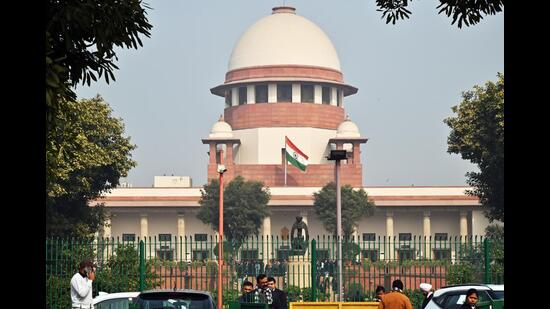
The review petitions, considered in chambers by a seven-judge bench led by Chief Justice of India (CJI) Dhananjaya Y Chandrachud, were dismissed as the bench found “no error apparent on the face of the record”.
“Having perused the review petitions, there is no error apparent on the face of the record. No case for review has been established. The review petitions are, therefore, dismissed,” stated the court order.
In a brief order, the bench, which included justices Bhushan R Gavai, Vikram Nath, Bela M Trivedi, Pankaj Mithal, Manoj Misra and Satish Chandra Sharma, concluded that none of the petitions provided sufficient grounds for reconsideration.
While the batch of review petitions were considered on September 24, the court order was released on Friday.
The review petitioners included several persons and organisations, including All Peoples Party leader Thumati Ravi, lawyer Jaishri Patil, Samvidhan Bachao Trust, Dr BR Ambedkar Global Mission, All India SC/ST Railways Employee Association, and the National Federation of Dalit and Adivasi Organisation.
On August 1, a Constitution bench of the Supreme Court delivered a 6-1 majority ruling, empowering state governments to create subclassifications within SCs and STs for preferential reservations, provided these decisions are based on empirical evidence and rational criteria. The majority ruling overturned the ruling in the 2004 EV Chinnaiah case, which had held that subclassification within SC/STs was impermissible, treating these groups as homogeneous classes. Justice Trivedi was the sole dissenter on the bench.
{{/usCountry}}On August 1, a Constitution bench of the Supreme Court delivered a 6-1 majority ruling, empowering state governments to create subclassifications within SCs and STs for preferential reservations, provided these decisions are based on empirical evidence and rational criteria. The majority ruling overturned the ruling in the 2004 EV Chinnaiah case, which had held that subclassification within SC/STs was impermissible, treating these groups as homogeneous classes. Justice Trivedi was the sole dissenter on the bench.
{{/usCountry}}By allowing subclassification, the top court apparently opened the door for states to identify and provide targeted benefits to the most disadvantaged subgroups within the broader SC/ST categories, provided they base their decisions on empirical evidence and rational criteria.
In a significant departure, the majority also supported the idea of excluding the “creamy layer” from SC/ST reservations, a concept previously applied only to OBCs. Authoring a separate judgment, justice BR Gavai, supported by Chief Justice of India Dhananjaya Y Chandrachud and others, emphasised: “The State must evolve a policy for identifying the creamy layer even within SCs and STs to achieve true equality as enshrined under the Constitution.”
The majority ruling acknowledged the social and economic diversity within SC/ST communities and allowed states to provide targeted benefits to the most disadvantaged subgroups, thereby promoting a more equitable distribution of affirmative action.
Marking a significant shift in the landscape of reservation policies in India, the court held that the SC/ST communities are “not homogenous” but are a “socially heterogenous class” and that there are varying degrees of backwardness within these groups that ought to be addressed by the State for the fulfilment of the constitutional goal of social equality.
The ruling held that subclassification within SCs does not violate Article 341(presidential order identifying SC) of the Constitution, provided that it does not lead to the exclusion of any caste from the list of SC. However, any preference or exclusive benefit to certain castes within such reserved categories must be justified by data and empirical evidence, it declared. To be sure, the judgment interpreted only Article 341 because that was the bone of contention in the case before it, but the principles enunciated in the verdict applies to both SCs and STs.
Holding that states can create subclassifications within SC/STs if there is a rational basis for doing so, such as inadequate representation of certain castes in public services, the majority verdict stated that the states must collect data on this inadequacy and demonstrate that it is linked to the caste’s backwardness. The judgment also stated that “the State must establish that the inadequacy of representation of a caste/group is because of its backwardness”.
Simultaneously, the court made it clear that states would not be allowed to set aside all of the seats designated for SC/STs in favour of a single subclass, disregarding all other castes on the list and that the subclassification would also be amenable to judicial review.
At the heart of the matter before the seven-judge bench was whether subclassification within the SC/ST categories is constitutionally permissible. This debate stemmed from the long-standing issue of whether all subgroups within SCs and STs, which are constitutionally recognised as homogenous classes, should be treated equally or if a more granular approach should be allowed to ensure that the most disadvantaged within these groups receive adequate benefits.