
 E-Paper



Trees Don’t Just Fall. They Are Failed by Cities.
The high court has described a tree as “a living being” and emphasised that solitary mature trees deserve the highest degree of protection

 Prefer HTon Google


Two mature trees crashed to the ground in Delhi’s East of Kailash this week; one outside the National Heart Institute and another near the ISKCON temple. Fortunately, no lives were lost unlike the last year that took the life of a biker. The roads were cleared, traffic resumed and the city moved on.
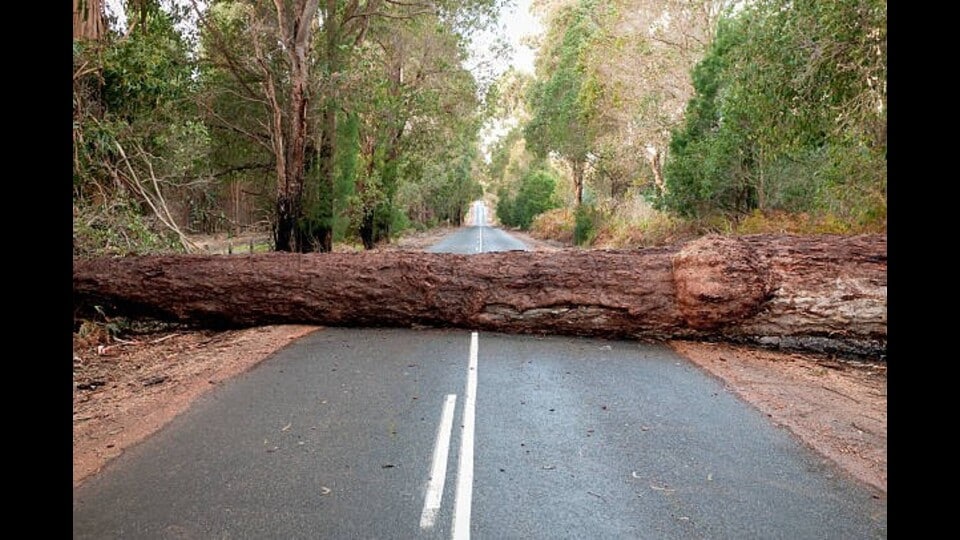
But perhaps we are asking the wrong question. Instead of asking, “Why did the rain bring down these trees?” we should be asking, “What did we do to these trees long before the rain arrived?”
Across the country, urban trees are increasingly being portrayed as hazards during the monsoon. They are blamed for crushing cars, blocking roads and, tragically, taking lives. Yet healthy, structurally sound trees do not simply collapse because it rains. Rain and wind are often only the final trigger. The real damage has usually been inflicted over years— through concretisation around trunks, repeated excavation, careless utility works, indiscriminate pruning, soil compaction and neglect of their root systems.
Mumbai offers a sobering warning. In just the first week of July, more than 1,100 trees collapsed, already exceeding the total number recorded during the entire 2025 monsoon. Three people lost their lives, including a schoolchild, while hundreds of vehicles were damaged. Many questions have been raised whether extreme weather alone can explain the crisis, pointing instead to widespread road concretisation, damaged root systems and poor arboricultural management.
Delhi should not dismiss this as Mumbai’s problem. It is India’s problem.
Our cities have become remarkably efficient at constructing roads, flyovers, drains, footpaths, metro corridors, pipelines and underground utilities. Every civil project comes with engineering drawings, timelines, contractors and inspection reports. Yet one critical question is rarely asked; how will the existing trees survive the project?
There is seldom a publicly available Tree Protection Plan. Excavation often occurs within root zones with little regard for structural roots. Trenches are dug, pavements are extended right up to trunks, heavy machinery compacts the soil and mature trees are left standing on islands of concrete. Months or years later, a storm arrives and the weakened tree falls. The rain is blamed, while the years of damage remain invisible.
This is not merely an environmental issue. It is an issue of public safety, urban planning and governance.
Every bridge collapse is investigated. Every aircraft accident is analysed. Every building failure leads to structural inquiries and accountability. Why should a mature tree collapse be treated any differently?
Every fallen tree should trigger a scientific post incident investigation. Authorities should document the species, age, health, root condition, pruning history, soil condition, evidence of fungal decay, extent of concretisation and any civil or utility works undertaken within its root zone during the preceding years. The executing agencies should disclose what measures were adopted to protect the tree before, during and after those works. Without such investigations, we will continue to mistake preventable failures for unavoidable natural disasters.
Ironically, while cities struggle to protect the trees they already have, they continue celebrating plantation drives. Every monsoon brings photographs of dignitaries planting saplings. Targets are announced, records are claimed and green credentials are advertised. Yet saplings cannot replace mature trees.
A 50-year-old tree is not simply fifty one-year-old saplings. It represents decades of accumulated ecological capital; shade, cooling, carbon storage, biodiversity habitat, stormwater regulation and, importantly, pollution removal. Scientific studies have consistently shown that mature urban trees capture particulate matter, reduce ambient temperatures, moderate urban heat islands and improve public health. Their ecological services increase with size and canopy area.
When such a tree is lost, the replacement value cannot be measured merely by planting another sapling elsewhere.
This contradiction defines India’s urban forestry today. We invest enormous effort in creating new green cover while allowing existing green infrastructure to deteriorate. We celebrate planting but neglect preservation. We count saplings but rarely count surviving mature trees.
The consequences are becoming increasingly visible.
Delhi’s own courts have repeatedly recognised that trees are not ordinary municipal assets. The high court has described a tree as “a living being” and emphasised that solitary mature trees deserve the highest degree of protection. The Supreme Court has repeatedly underlined that indiscriminate destruction of trees has profound consequences for public health and future generations.
Yet our institutional response remains fragmented. Citizens who report uprooted trees to restore are often shuttled between departments. The Delhi high court directed civic agencies to establish Tree Ambulances and Tree Surgery Units so that damaged trees could receive timely professional attention instead of being lost unnecessarily. But when citizens recently attempted to report uprooted trees for possible restoration, they found no accessible emergency mechanism capable of assessing whether these living assets could still be saved.
Climate change is undoubtedly bringing more intense rainfall and stronger winds. But climate change should not become an excuse for governance failures. In fact, it makes scientific tree management more important than ever. Stronger storms demand healthier root systems, larger uncompacted soil volumes, qualified arborists, periodic risk assessments and strict protection during infrastructure works.
The answer is not to remove more trees before every monsoon. Nor is it to prune them indiscriminately in the name of safety. Excessive and mindless pruning often weakens trees, reduces canopy, increases disease susceptibility and creates exactly the structural problems it claims to prevent.
Instead, India needs to treat its urban trees as critical infrastructure. Every infrastructure project should include mandatory Tree Protection Plans. Root zones should be mapped before excavation begins. Independent arborists—not contractors— should certify protection measures.
Every tree failure should be investigated. Cities should maintain publicly accessible inventories recording the health, maintenance history and structural condition of mature trees. And preservation—not plantation alone—should become the primary performance indicator of urban forestry.
Because the real tragedy is not that trees are falling.
The real tragedy is that we have normalised their decline.
The East of Kailash trees did not fail overnight. Nor did Mumbai’s 1,100 trees. They were weakened over years by countless small decisions that ignored the living systems beneath our feet.
Until our cities begin protecting trees with the same seriousness that they protect roads, bridges and buildings, every monsoon will bring more fallen trees, more damaged vehicles, more blocked roads and, inevitably, more preventable loss of life.
Trees don’t just fall.
They are failed by the cities that depend on them.
Bhavreen Kandhari is an advocate for environmental rights. The views expressed are personal.


