E-Paper



Two more bodies of Maoists recovered in Chhattisgarh: Police
Chhattisgarh police recovered two more Maoist bodies, raising the total to 16 after a gunfight. Notable leader Chalapathi was among those killed.


GARIABAND/BHUBANESWAR:At least two more bodies of suspected Maoists were recovered in Chhattisgarh’s Gariaband district following an encounter between security forces and Maoists, police said on Wednesday.
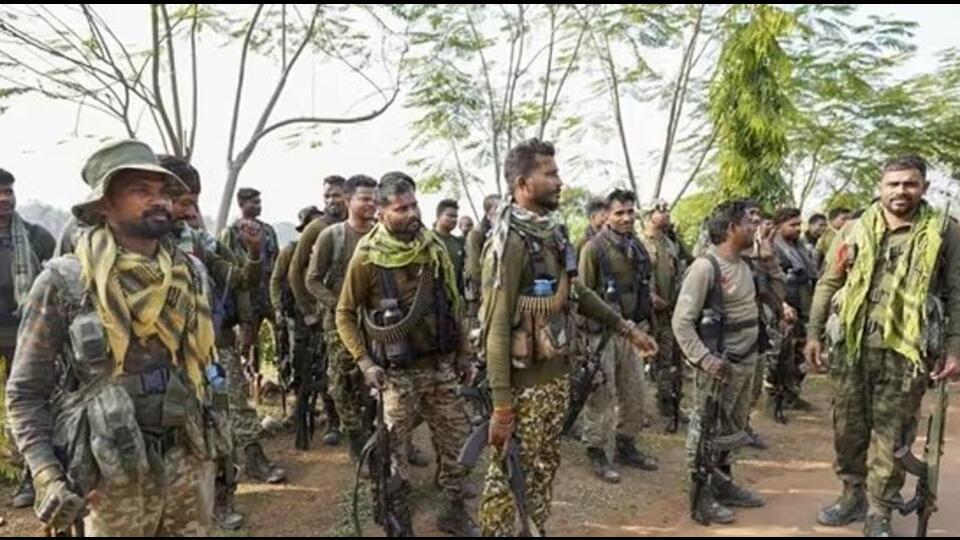
With this, the number of Maoists killed during the operation has risen to 16, according to a police officer.
“The bodies of two more Maoists and an AK-47 rifle were recovered on Wednesday during a search of the encounter site. The search operation will continue for the next couple of days,” said Amresh Mishra, inspector general of police, Raipur Range.
The gunfight broke out on Monday evening after a joint team of Chhattisgarh police’s district reserve guard (DRG), CRPF’s commando battalion for resolute action (CoBRA) commandos, and the special operations group (SOG) of Odisha Police launched a search operation in the Kularighat reserve forest, about 5 km from Odisha’s Nuapada district.
Mishra said the operation was launched on Sunday evening. “On Monday, two women Maoists were killed, and two jawans from CoBRA and SOG were injured. The police force cordoned off the area and camped inside the jungle on Monday night. On Tuesday, 14 bodies were recovered,” he said.
On Tuesday, the police confirmed that Central Committee member Jayram Pratap Reddy, alias Chalapathi, who had a bounty of ₹1 crore on his head, was also killed along the Chhattisgarh-Odisha border.
“The death of Chalapathi will be a major setback for the 40-50 Maoists active in Odisha,” said a senior officer from Odisha.
Chalapathi, who was alleged to be instrumental in the killings of Telugu Desam Party lawmaker Kidari Someswar Rao in 2008, former lawmaker Sivari Soma, and the abduction of Odisha cadre IAS officer Vineel Krishna in 2011, had headed the Odisha state committee of Maoists for several years.
“His death is a big success for security forces. However, he did not have much of a role in Odisha despite being in-charge of Odisha state committee. He along with his wife Aruna alias Chaitanya Venkat Ravi were holed up in south Bastar and used to visit the Swabhiman Anchal in Malkangiri district of Odisha through Gariabandh district on Odisha-Chhatisgarh border,” said a senior police officer.
Chalapathi had previously overseen military affairs on the Odisha-Andhra Pradesh border and played a key role in transforming the Narayanpatna block of Koraput district in Odisha into a Maoist stronghold in 2009, similar to Lalgarh in Bengal.
“Through the overground organisation Chasi Mulia Adivasi Sangh, a tribal front with over 30,000 members, he nearly overtook the police station until security forces managed to push back. Narayanpatna, surrounded by tall mountains and bordering Parvatipuram Manyam district in Andhra Pradesh, was a strategic location for Maoists in the mid-2000s, as it provided easy access to the hamlets of Visakhapatnam through Parvatipuram. The block also connected the remote areas of Malkangiri district, completing the Andhra-Odisha-Chhattisgarh axis,” the officer said.
However, Chalapathi’s influence in Odisha had waned in the past five years as the state made inroads into the Swabhiman Anchal area of Malkangiri. “In Odisha, the only Maoist leader with any influence is Nikhil alias Niranjan Rout, who operates in the Kalahandi and Kandhamal areas. Another leader, Modem Balakrishna, also a Central Committee member, who was active on the Odisha-Andhra border, no longer has any influence in the state. The 40-50 Maoists operating in Odisha are a scattered group with little support for Maoist ideologies, resulting in negligible recruitment,” said another senior police officer.
Odisha Police said that three SOG teams, with operational names SOG 21, 40, and 44, were already stationed in Nuapada district, conducting area domination exercises when intelligence reports indicated Maoist movement. On Sunday, the SOG teams, accompanied by two teams from Chhattisgarh Police’s E-30 Force and five teams from the CRPF, began area domination, leading to a fierce gun battle with Maoists later that night.
Odisha Police also conducted an aerial survey using an advanced drone, which detected rebel movement on Monday night. Security forces then launched controlled firing and recovered the body of Jayram alias Chalapathi. The CRPF also deployed its own drone.
The total number of Maoists killed in Chhattisgarh this year is 42, said the officer.
-kW0H-U20214218012MgB-250x250%40HT-Web.jpg)