Two Indian peacekeeping troops were killed on Tuesday in the Democratic Republic of Congo, which has witnessed protests over the past two days against the United Nations peacekeeping mission’s apparent failure to stem violence.
External affairs minister S Jaishankar tweeted on Tuesday night that the dead peacekeepers were Border Security Force (BSF) personnel serving with the UN Organisation Stabilization Mission in the Democratic Republic of Congo or MONUSCO. He called for perpetrators of the attacks on Indian troops to be brought to justice.
“Deeply grieved at the loss of lives of two valiant Indian peacekeepers of the BSF in the Democratic Republic of Congo. They were part of the MONUSCO. The perpetrators of these outrageous attacks must be held accountable and brought to justice,” he tweeted.
Jaishankar also conveyed his deepest condolences to the bereaved families.
Officials said the two BSF personnel succumbed to injuries sustained when more than 500 protestors attacked a camp at Butembo, where the Indian peacekeepers are stationed alongside troops from Morocco. One Moroccan personnel also died in the attacks.
Congolese police and army troops were unable to control the protestors, who initially pelted stones at the peacekeepers. The Moroccan troops fired in the air while BSF personnel used teargas to disperse the protestors, who breached the perimeter wall at three places.
{{/usCountry}}Congolese police and army troops were unable to control the protestors, who initially pelted stones at the peacekeepers. The Moroccan troops fired in the air while BSF personnel used teargas to disperse the protestors, who breached the perimeter wall at three places.
{{/usCountry}}Though the protestors were repelled, they gathered again for a second attack that was fiercer, the officials said. There were also reports that armed rebels infiltrated the protestors and used small arms during the second attack. In response, the Moroccan and Indian troops fired in self-defence, the officials said.
Two BSF platoons have been deployed at the camp in Butembo since June 2. Additional UN peacekeeping troops have been sent to the area to control the situation.
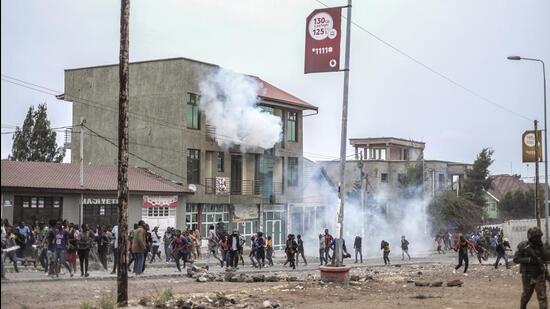
The violence in Butembo came a day after protests in the nearby city of Goma on Monday. Groups affiliated to the ruling party in Congo had called for protests against MONUSCO across the country since the beginning of the week.
A local government spokesman said at least five people were killed and about 50 others injured in protests against MONUSCO in Goma in eastern Congo on Monday. Hundreds of protestors blocked roads in the city and shouted slogans against the UN before storming the local headquarters of MONUSCO and a logistics base.
The protesters looted offices at the headquarters and demanded the peacekeepers leave the area for failing to protect civilians.
MONUSCO has faced criticism for its apparent inability to stop fighting in eastern Congo, which has been plagued by militia violence. More than 120 armed militias are active in the region, where fighting has displaced millions of people, according to local media reports.
The protest in Goma came after the president of Congo’s senate, Modeste Bahati, told supporters in the city on July 15 that MONUSCO should “pack its bags”, the media reports said.
India is one of the largest contributors of troops to UN peacekeeping missions around the world. Since it participated in the UN Multinational Force in Korea in 1950, India has sent troops for 51 out of 71 peacekeeping missions established by the UN. It has contributed more than 264,000 personnel for these missions over the decades.
The Indian Army currently has a presence in eight out of 14 UN missions worldwide. More than 6,700 personnel from the Indian Army and paramilitary forces are currently deployed with these missions.
More than 160 Indian peacekeepers have lost their lives around the world, the highest number for any troop contributing country. Indian peacekeepers have served in Congo since 1960 and the country has also suffered the highest number of fatalities – 39 – in the African nation.