As the chief ministerial candidates in the fray are all tried and tested, this time around, poll issues may play a dominant role in the 2022 Uttar Pradesh (UP) assembly elections.
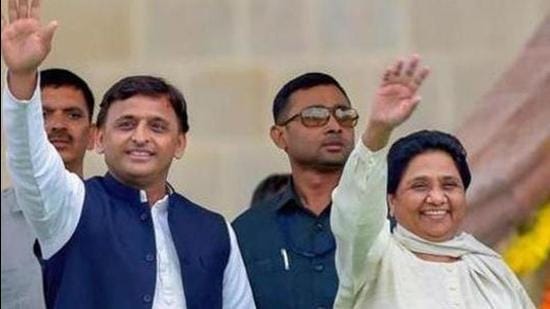
In UP, the last three assembly elections were eclipsed by personalities. People witnessed the rule of Bahujan Samaj Party (BSP)’s Mayawati, Samajwadi Party (SP)’s Akhilesh Yadav, and the Bharatiya Janata Party (BJP)’s Yogi Adityanath. The report cards of these three tenures are now ready.
It was Mayawati’s social engineering
As the chief ministerial candidates in the fray are all tried and tested, this time around, poll issues may play a dominant role in the 2022 Uttar Pradesh (UP) assembly elections.
In UP, the last three assembly elections were eclipsed by personalities. People witnessed the rule of Bahujan Samaj Party (BSP)’s Mayawati, Samajwadi Party (SP)’s Akhilesh Yadav, and the Bharatiya Janata Party (BJP)’s Yogi Adityanath. The report cards of these three tenures are now ready.
It was Mayawati’s social engineering that paved the way for the BSP’s victory in 2007. However, the 2012 and 2017 assembly elections were primarily driven by personalities.
In 2012, Akhilesh Yadav, who rode the anti-incumbency wave against the Mayawati government, crisscrossed the state on his bicycle, mobilising the support of first-time voters, backward classes and Muslims. His father Mulayam Singh Yadav worked behind the scenes, micro-managing the election that eventually launched his son, whom he fondly called Tipu. Then, in 2017, voters were captured by the charisma of Prime Minister (PM) Narendra Modi. Adityanath then shifted base from the Gorakhnath mutt to the chief minister’s chair.
The three leaders are no longer fresh faces. People know their acts of omission and commission, and they have their respective domains as well. It is only Priyanka Gandhi Vadra who can be the only new claimant for the chief minister’s position. She comes without any baggage, except for the Congress’s dismal health, both nationally and within the state.
Also Read | The outcome of the Monsoon Session
Thus, it is likely that poll issues will overshadow personalities, despite caste combinations being an integral component of elections in UP. All political parties have already begun fixing the caste matrix.
For instance, while both the SP and the BSP are wooing the disgruntled Brahmins, the ruling BJP tried to give representation to backward castes in the central Cabinet during the recent expansion. They even inducted a Lodh leader as minister to fill in the vacuum that Kalyan Singh’s ailment caused.
As of now, the Opposition is banking on Covid-19 mismanagement, the farmers’ agitation, price rise and unemployment, besides the ritual of playing up anti-incumbency against the ruling dispensation.
Former SP minister Abhishek Mishra, who travelled across 56 districts, claims that the people of UP may be silent, but the desire for change is strong. The main issues plaguing villages are price rise and unemployment. He also said that Brahmins are upset with the current dispensation and have decided to vote against the BJP.
According to him, the SP needs an increase of 5% to 7% in their vote-share over their 2017 vote percentage on the 298 seats that they had fought in alliance with the Congress. Experts, however, believe that despite anti-incumbency, the BJP’s tally will not fall by more than 100 seats from 325 seats won (including those of allies) in the previous election. They feel that the BJP will still cross the majority mark. Both the SP and the BJP are claiming over 350 seats.
Political activist and analyst from west UP, professor Satish Prakash, however, feels that the poll agenda will be clearly determined closer to the election. This, he believes, will decide the outcome. “As of now, the voter is silent but anger against the present dispensation is palpable. The key issues are unemployment and farmers’ demands,” he said.
He also believes that the timing of the elections will define the agenda, adding, “Who will dare raise any other issue during a Covid wave?”
Also Read | Retrospective tax: A policy based on delusion gets buried
There is a consensus among experts who agree that the multi-cornered fight will gradually narrow down to a battle between the SP and the BJP. Thus, the anti-BJP votes may also not get divided. However, Prakash dismisses this as BJP propaganda to make the election communal.
While Muslims are putting pressure on Akhilesh Yadav to ally with like-minded parties, including the Congress, the former is leaning towards a tie-up with smaller caste-based parties, apart from the Rashtriya Lok Dal (RLD).
Former Rajya Sabha Member of Parliament (MP) Mohammad Adeeb, concerned about the split in the Muslim vote after the entry of All India Majlis-e-Ittehadul Muslimeen (AIMIM), feels that like-minded parties should unite on a single platform to defeat the “communal agenda” of the BJP. Without this, Muslims may even decide not to cast their votes in the election.
Congress general secretary Priyanka Gandhi Vadra has indicated the party’s readiness to ally with such parties. However, the coming together of major players is unlikely. After all, the party eyeing the chair will have to contest 300 seats from a pie of 403.
The BJP has already launched an intensive campaign to woo farmers and confront the Covid-19 charges against the government. PM Modi, defence minister Rajnath Singh, Union home minister Amit Shah, and BJP national president JP Nadda have all praised Adityanath for his management of Covid-19 and the development of the state during his term.
Nadda made it clear that while Modi — the face of the party — will continue to connect with people before launching big rallies, party leaders and lawmakers should market the initiatives of the BJP government at the Centre and the state.
Amit Puri, who was actively associated with late Atal Bihari Vajpayee’s election as a member of the state working committee, however, says the issues will be spelt out in the party manifesto and the political narrative be decided thereafter. But regional parties are unlikely to match the BJP’s leadership at the central or state level.
Also Read | Climate crisis: No one will be spared
The impact of cash transfers may also not be as large as parties believe that they are. The PM recently released ₹6,000 to farmers as a part of the PM-Kisan scheme. But SP leader Mishra states that farmers now understand the economics. Getting a meagre ₹6,000, while paying at least ₹50,000 or more for diesel, petrol, fertilisers and other essentials for cultivation, indicates that the price rise will be seen as a principal issue.
The question remains: Who will decide the poll agenda? None of the regional parties has the wherewithal to match the BJP’s machinery. When it comes to star campaigners, both the BSP and the SP are two-leader parties -- Mayawati and SC Mishra, and Akhilesh Yadav and his wife Dimple Yadav, now that Mulayam Singh is no longer in a position to campaign for the election. As for the Congress, its only star campaigners are the Gandhis -- Rahul and Priyanka Gandhi Vadra.
Once the BJP deploys its entire machinery, with Union ministers descending on the state, they will attempt to set the poll agenda while the Opposition counters the BJP’s Hindutva and nationalist agenda, which has captured the psyche of a major chunk of voters.
Opposition leaders, however, remain confident of the fall of the BJP in the upcoming elections. And a major part of this confidence comes from the BJP’s defeat in the West Bengal assembly election, where it won only 77 of the 294 assembly seats. The context however is different and the incumbent is walking into the election with State power and a formidable election machine. How it navigates issues is to be seen.
One Subscription.
Get 360° coverage—from daily headlines
to 100 year archives.
Archives
HT App & Website