A bunch of resignations in poll-bound Uttar Pradesh, including that of minister in the state government, Swami Prasad Maurya, 68, who joined the Samajwadi Party citing “neglect of Dalits and OBCs” has set alarm bells ringing in the Bharatiya Janata Party (BJP) ahead of assembly elections scheduled between February 10 and March 7 in seven phases.
Fifty-eight constituencies in 11 districts of the state will go to the polls on February 10.
The resignation of Maurya, a prominent OBC (other backward classes) face which was followed by news of the resignation of at least three more BJP legislators, Roshan Lal Verma, Brijesh Prajapati and Bhagwati Sagar, came on a day when the party’s senior leadership, including UP chief minister Yogi Adityanath, began deliberations over the choice of candidates in the national capital.
In his resignation letter addressed to CM Adityanath, which he later posted on social media, Maurya said he “worked with dedication despite following a divergent ideology” but was resigning “because of the grave oppression of Dalits, OBCs, farmers, unemployed and small businessmen“.
A five-term MLA, Maurya was a senior leader of the Bahujan Samaj Party till 2016, and served as a minister in Mayawati’s government. He is considered to be influential among OBCs and may help broad-base the SP’s appeal.
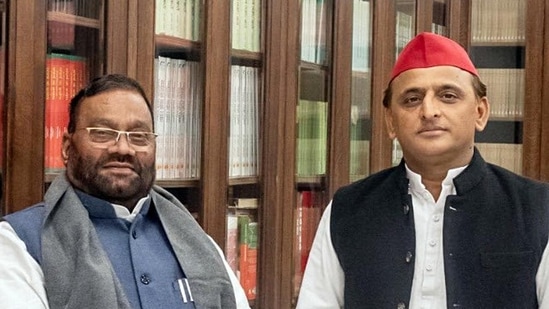
In a post on Twitter, Samajwadi Party chief Akhilesh Yadav welcomed the minister to his party: “Known for his fight for social justice and equality, Swami Prasad Maurya is welcome with greetings and honour, along with his workers and supporters. There will be a revolution on the social justice front. There will be a change in 2022.”
{{/usCountry}}In a post on Twitter, Samajwadi Party chief Akhilesh Yadav welcomed the minister to his party: “Known for his fight for social justice and equality, Swami Prasad Maurya is welcome with greetings and honour, along with his workers and supporters. There will be a revolution on the social justice front. There will be a change in 2022.”
{{/usCountry}}Reacting to Maurya’s resignation, senior BJP leader and deputy chief minister Keshav Prasad Maurya said: “I do not know the reasons why respected Swami Prasad Mauryaji has resigned. I appeal that he should sit to talk. Any decision taken in haste could prove wrong.”
The UP Raj Bhawan has confirmed the receipt of the resignation letter from Maurya. Chief minister Adityanath has not responded to Maurya’s resignation.
An OBC issue?
Other OBC leaders in the past have publicly aired differences with the UP CM. In 2019, OP Rajbhar, the general secretary of Suheldev Bharatiya Samaj, a BJP ally, joined forces with the SP.
Like Maurya, Rajbhar expressed disappointment that people from the backward classes were being ignored and discriminated against by the BJP government.
The defection of both Rajbhar and Maurya and the buzz about growing discomfiture between the BJP and its other ally, the Apna Dal, which commands support of the Kurmis (also OBCs), indicates that the ruling party, which has gained electorally with support from the OBCs in the 2014 Lok Sabha polls and the 2019 state polls, will have to focus on its outreach to the community, analysts said.
OBCs make up for about 42-45% of the electorate of which 9% are Yadavs, the traditional base of the SP. The BJP has been wooing the remaining 32-35% of the non-Yadav OBC votes, which includes Kurmis (5%), Lodhs (4%), and Nishads (4%).
While a few senior BJP leaders in Delhi asserted that the resignations will have no impact on its electoral fortunes and that its rainbow coalition of OBCs and Scheduled Castes remained intact, a few state-level leaders admitted that the party will have to work harder to retain support of the wider assortment of non-Yadav OBCs. “There is a problem with the larger OBC coalition; there is a struggle for more political empowerment among all castes irrespective of their numerical strength,” a state BJP leader said on condition of anonymity.
Basically, everyone wants a piece of the action, and the party does not seem to have been able to satisfy everyone. That was evident in Maurya’s comments.
“Ab pata chalega Swami Prasad Maurya kaun hai. Main jahan rahunga, wahan sarkar banegi. (Now it will be known to them who Swami Prasad Maurya is. The party, where I remain, will form the government),” said Maurya, speaking to mediapersons soon after his resignation.
The state leader explained that with Maurya’s exit, the party expects a dent in its performance in Rae Bareli, Khushinagar and Badaun. “These exits will not lead to massive vote transfer but will certainly bring down the margins. Rajbhar’s party has 4% vote share in the state with a strong base in Purvanchal. In places such as Ghazipur, Ballia, Ambedkarnagar, he will impact the BJP’s vote share.”
More disgruntlement
While it may not apply to Maurya, the BJP’s record of dropping legislators in a bid to counter anti-incumbency -- this has been seen across states -- is also causing some disquiet in the party.
Thus, while Maurya’s exit was followed soon by that of three other BJP MLAs -- Bhagwati Sagar from Bilhaur (Kanpur), Brajesh Prajapati from Tindwari (Banda), and Roshan Lal Verma of Tilhar (Shahjahanpur) -- there is speculation that their action may have been triggered by fears that the party could drop around 100 sitting legislators.
The three MLAs who quit the BJP on Tuesday are all considered loyalists of Maurya and told reporters that they will follow the former minister wherever he went.
“This must be a fallout of pressure tactics instead of ideological commitments. Maurya may have wanted the BJP to distribute tickets his way while the BJP may be having its own considerations. Leaders may not be satisfied over the distribution of tickets and may leave their respective parties before polls,” said professor SK Dwivedi, former head of department, political science, Lucknow University.
“Defections happen all the time. In recent times we have seen senior leaders from all parties join the BJP. It is only natural that some of the BJP members for various reasons will choose to join some others, it does not mean the BJP is not doing well,” said a BJP functionary in Delhi.
The functionary added that since the BJP is likely to “drop between 35-40%” of the sitting legislators to buck anti incumbency, more defections “can be expected”.
“In (SP) Maurya’s case for instance, he was upset because he was pushing for a ticket for his son. He was a minister himself; his daughter Sanghmitra is a Lok Sabha MP and now he wanted more. So defections based on such personal reasons cannot be seen as a caste group being unhappy with the party.”
Still, with three other BJP lawmakers quitting and at least a dozen others said to be considering resigning, the BJP’s central leadership has directed the party’s state chief Swatantra Dev and state general secretary (organisation) Sunil Bansal to talk to all disgruntled leaders.
The BJP’s counterstrategy involves getting some important leaders from the main opposition SP to join it. On Tuesday, the names of some Brahmin leaders of the SP were doing the rounds, with speculation that they could join the BJP on Makar Sankranti (January 14) regarded by Hindus as an auspicious day.
While some UP ministers and BJP leaders began targeting Maurya, others admitted that the labour minister’s exit was a “big loss” before the state goes to the polls from February 10.
Apart from his influence with voters, Maurya also enjoys the loyalty of some legislators.
Verma, who resigned, is one. He said he would go wherever Maurya does.
“We felt humiliated. I complained against a minister and officials but none heard me,” Verma said accusing some senior ministers in the UP government of not providing them respect.
Meanwhile, Swami Prasad Maurya’s supporters distributed sweets and said that the OBC grassroots leader would now strengthen the SP. State BJP leader Dharam Singh Saini (also from the OBC community), who is close to Maurya, denied reports that he could be leaving the party. “It is true that Mauryaji is like my elder brother but I am not quitting the BJP,” he said.
Maurya, who said he didn’t get respect in the BJP and that he won’t reconsider his decision even if he was allowed to pick up a dozen candidates of his choice, similarly quit the BSP in 2016 after failing to convince his then party chief Mayawati to field his son Utkrisht Maurya and daughter Sanghmitra.
Maurya’s daughter Sanghmitra Maurya is a BJP MP from Badaun from where she defeated Samajwadi Party heavyweight Dharmendra Yadav. In November, Sanghmitra Maurya was seen with SP patron Mulayam Singh Yadav, although no one gave the incident much attention then.
She continues to remain with the BJP.