In its Gandhinagar facility, Gujarat Biotechnology and Research Centre (GBRC) is testing on guinea pigs and mice a vaccine that holds the promise of preventing a repeat of 2018 and 2020, when a large number of lions died at the Gir National Park.
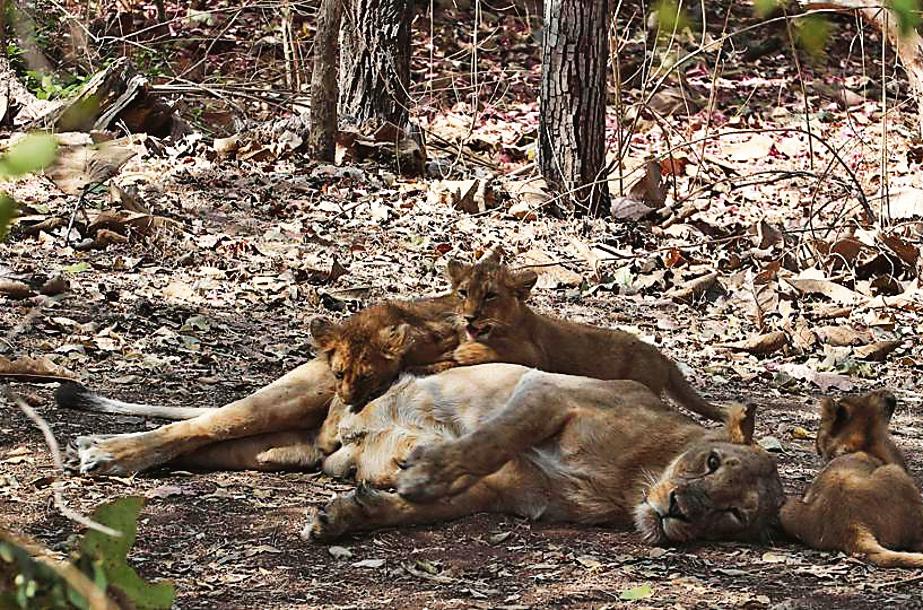
The culprit (at least in 2018; there’s been no reason given for the 2020 deaths): Canine Distemper Virus (CDV).
GBRC is hoping to roll out the vaccine for lions later this year (after a trial on the big cats themselves); its plans include trials on leopards and tigers subsequently, two officials familiar with the development said.
GBRC has joined hands with Hester Biosciences, an Ahmedabad-based Indian animal healthcare company, for commercial roll-out of the CDV vaccine that is presently undergoing animal trials.
CDV is a disease that results in encephalitis and pneumonia and it was found in dogs earlier. Over the years, it has spread to the wild cats, killing a number of leopards too in Gujarat, according to a GBRC official. CDV is believed to be responsible for wiping out nearly one-third of the 3,000 lions in Serengeti National Park, Tanzania, in early 1994.
The virus also killed 30 lions in a span of two months in 2018 at Gir National Park in Gujarat , the last abode for the endangered species in India. In first half of 2020, there was another CDV outbreak at Gir. An environment ministry committee found 85 lions had died in the six-month period under review and did not mention the cause of death as CDV although it recommended expediting the development of the vaccine.
{{/usCountry}}The virus also killed 30 lions in a span of two months in 2018 at Gir National Park in Gujarat , the last abode for the endangered species in India. In first half of 2020, there was another CDV outbreak at Gir. An environment ministry committee found 85 lions had died in the six-month period under review and did not mention the cause of death as CDV although it recommended expediting the development of the vaccine.
{{/usCountry}}The recorded population of lions in Gujarat as per the 2019 census is 674, a 29% rise from 523 in 2015.
“GBRC has already achieved a breakthrough in its research and is presently conducting the trials on small animals like guinea pigs and mice for the CDV vaccine. The efficacy of the vaccine is found to very high at more than 80% as per initial results,” said a state government official aware of the matter who asked not to be named.
The novel vaccine project is backed by the state government which has approved ₹50 lakh for it. GBRC was established under Gujarat government’s department of science & technology to undertake biotechnology research in the state.
A senior GBRC official said it has sought the Ministry of Forest, Environment and Climate Change (MOEF&CC)’s permission to begin trials on zoo lions and also approached Drugs Controller General of India (DCGI) for a commercial launch. The trial is likely to be carried out on five to six lions, the official added.
The commercial production of the vaccine will start, after it gets all necessary approvals, at Hester’s plant at Kadi near Ahmedabad.
“This is for the first time in India that any state government or its department is working on a vaccine for wildlife. Earlier such initiatives have been taken for poultry, cattle, sheep and other domestic animals. We have collaborated with GBRC for the commercial roll out of the vaccine,” said Rajiv Gandhi, CEO & MD of Hester Biosciences.
In 2018, after the first outbreak of CDV in Gir lions, GBRC offered diagnostic services. “During genome sequencing, we found that the virus strain was different by about 6.6 % than the reference genome of CDV. It is a very significant variation. Hence, we decided to develop an indigenous vaccine for Asiatic lions. This will be the first CDV vaccine in the world for Felidae family. We aim to roll out the vaccine this calendar year,” said a third official at GBRC who is involved in the project.
In 2018, the state forest department imported a ferret distemper vaccine from the US after the Indian Council for Medical Research recommended that “existing CDV Vaccine which should work as protective intervention”.
Thirty-three lions from Gir were captured and quarantined by the forest department for vaccination. Four years later, their re-introduction to their natural habitat remains uncertain.
However, there are challenges in vaccinating Gir’s lions with a two-dose vaccine. The animals will have to be captured for vaccination, said a Gujarat government official, asking not to be named. “Catching such a large number of big animals is not easy,” he said. After the first dose of vaccine, the second dose is to be administered in twenty-one days. Then, booster doses can be given every year if required, he said.
Y V Jhala, Dean of Wildlife Institute of India and an expert on lions said the CDV is very active and can prove fatal for lions. He added that while it is good that the government is doing research on a CDV vaccine for lions, it should also consider an alternative home for lions outside Gir.
“Gujarat should spread its risks so that the population is not wiped out in case of an epidemic. There are many places in Gujarat, far away from Gir that can serve as an alternative home for lions.”
Proper testing and minimal human intervention should be the norm for all wildlife, especially in Protected Areas, he added.