Observing that it is “very, very unhappy”, the Supreme Court on Wednesday said that in a democratic country governed by the rule of law, the government cannot assert its authority to reject the names recommended by selection committees, headed by the judges of the top court, for appointments to various tribunals.
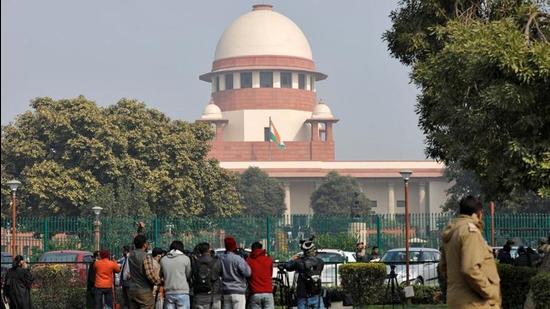
“If the government has the last laugh, what is the sanctity of the selections made by us after conducting interviews?... We are very, very unhappy the way in which things are going on and how the government has been acting,” a bench, headed by Chief Justice of India NV Ramana, told attorney general KK Venugopal.
“You cannot deny access to justice. How can people be left in the lurch? This is the problem everywhere. We are waiting very patiently. You have to make appointments to the tribunals...tell your government,” the bench, which also comprised justices Dhananjaya Y Chandrachud and L Nageswara Rao, told the AG.
It gave the government two weeks to make appointments to the tribunals and file a comprehensive affidavit in this regard. “Please, file your affidavit with vacancy and appointment positions. And give reasons wherever appointments cannot be made,” directed the court.
The bench further pointed out that some recent appointments to tribunals depict “cherry picking” and “lack of service jurisprudence” where the government decided to exclude the names from the main selection lists and chose members from the wait lists, which were prepared for future appointments.
{{/usCountry}}The bench further pointed out that some recent appointments to tribunals depict “cherry picking” and “lack of service jurisprudence” where the government decided to exclude the names from the main selection lists and chose members from the wait lists, which were prepared for future appointments.
{{/usCountry}}Hours before this hearing on a clutch of petitions that have highlighted massive vacancies across all 15 tribunals in the country, the Centre filed an affidavit stating that it has appointed 84 members to various tribunals since 2020 and there are no recommendations pending with it anymore. Of them, 39 members were appointed in the current month after the court on September 6 lashed out at the government for sitting over recommendations made by the search cum selection committees (SCSCs) more than a year ago. There are around 200 posts lying vacant across 15 tribunals.
Commenting upon the recent appointments, the bench said: “The selection committee selected 11 judicial members and 10 technical members for the national company law tribunal (NCLT). But the members were cherry-picked. There were four names selected from the main list and six were selected from the wait list. What type of selection is this? What kind of appointment is this? What kind of service jurisprudence is this? The same thing happened with the ITAT (income tax appellate tribunal).”
The AG, representing the Centre, replied that the government has the discretion under the 2021 Tribunal Reforms Act to select names from the list of names forwarded by the SCSCs and not all names have to be cleared. “Just like the government has the power not to accept any name recommended...” added Venugopal.
“We think we are a democratic country governed by the rule of law. You cannot say the government will not accept anything. We don’t know how you can continue like this even after more than a year,” retorted the bench.
The CJI told the A-G: “We interviewed 534 candidates for the post of judicial members and 400-odd candidates for technical members for NCLT. Your two secretaries were also with us. We travelled across the country during Covid on the request of your government. We wasted our time conducting interviews, meeting people. And then you delayed these appointments for almost two years. They were 62 when we selected them. They are now 64. If they have to retire at 65, why will a judge take up an assignment for one year? It is very unfortunate and the government has to realise this.”
As justices Chandrachud and Rao mentioned the recommendations made by the committees headed by them for appointments in the national consumer commission and appellate tribunal for telecom disputes, the AG said that two members picked up by the selection committee for TDSAT were appointed elsewhere while the government was considering their appointments.
“This is the problem. If there is a delay of more than a year, the very utility of these selections will go...they become useless,” said the bench, adding there have been judgments by the apex court favouring constitution of a national tribunals commission as an umbrella body to supervise working of tribunals and appointing members.
“The government will have to make a separate body, then only something will happen. In several judgments, starting with the L Chandrakumar case in 1997, we talked about the national tribunals commission. We have given you the solution too. It is for you to now do something... Please make arrangements and make appointments without inviting us to pass orders, which we can also do very happily,” the bench told Venugopal.
Justice Rao went on to point out an appeal by the Securities and Exchange Board of India (Sebi) against the SAT order in the PNB Housing Finance case that relates to the housing finance company’s ₹4,000 crore equity capital raise plan. The judge said that two members in SAT gave split verdict and the case cannot go to a third technical member since there is none.
“It is very difficult for tribunals to function... Whatever problems we have, appointment of members is the real solution,” the court added.
On his part, Venugopal asked for some time to get instructions on all the aspects of the matter, including the challenge to the 2021 law, which the bench had on September 6 pointed out, brought back the exact same provisions that were struck down by the top court in July.
Senior advocate Arvind Datar complained about the manner in which appointment letters were being issued to the tribunal members. He said that these letters included an additional clause - ‘until further orders’- for continuance of a member, which he said, was not under the law that mentioned that a member shall continue for a certain tenure till he attains a particular age.
“Let some appointments come first...we will then examine this,” the bench told Datar.
Advocate Siddharth R Gupta, representing the state bar council of Madhya Pradesh, rued that litigants in Jabalpur were compelled to travel to Lucknow since the charge of debt recovery tribunal at Jabalpur has been given to the Lucknow tribunal because there is no member at Jabalpur. “And DRT at Lucknow says it will take up only those cases where files have been received by it physically. Only urgent matters are being taken up.
No cases of borrowers are being heard,” Gupta said.
Justice Chandrachud concurred with Gupta. “A litigant from Jabalpur will have to travel to Lucknow, How will this work? In March, Kerala high court struck down such transfers of jurisdiction but you are still doing it. The high courts are not willing to entertain such petitions directly. There is no recourse to a debtor today. They will take your house, your factory and other assets and there is no remedy at all,” said the judge.
Thirty-nine names were cleared by the government for different tribunals in September. Of these, 18 members were appointed to the national company law tribunal (NCLT); 1 member to telecom disputes and settlement appellate tribunal (TDSAT); 13 members to income tax appellate tribunal (ITAT); 1 member to appellate tribunal for electricity and 6 members to armed forces tribunal (AFT).
The court was hearing a clutch of separate petitions on vacancies across the tribunals and a challenge to the Tribunal Reforms Bill, which was passed by both the houses in the Monsoon session of the parliament. Petitioners before it included State Bar Council of Madhya Pradesh, advocates Amit Sahni and Amarjit Singh Bedi, Congress MP Jairam Ramesh and Delhi Bar Association.